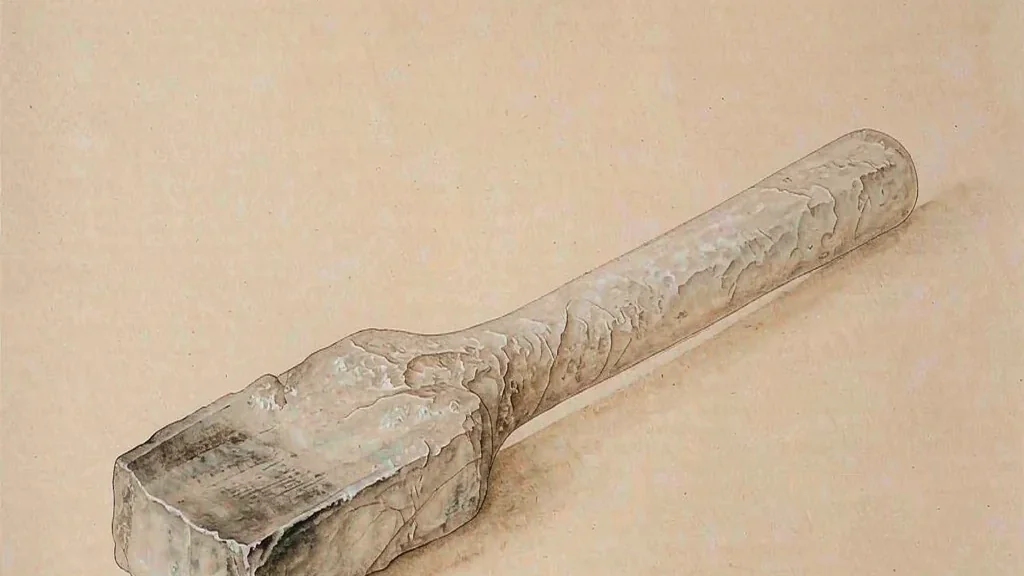
The stonecarver's chisel (石凿, shízáo) is the most ancient of Chinese sculptural tools, and its marks have shaped the Chinese landscape for more than two thousand years. From the colossal Buddhas of the cave temples to the smallest jade pendants, stone carving in China encompasses the full range of human scale and ambition. It is an art of patience and permanence — removing material that can never be replaced.
Materials of Chinese Stone Carving
Chinese stone carvers worked in many materials: sandstone, limestone, marble, granite, and the semi-precious stones used for jade carving. Each stone required different tools and techniques. The finest-grained stones like marble allowed for the most detailed work.
Tools and Techniques
The basic tools of the stone carver have changed little since antiquity: the point chisel for roughing out, the tooth chisel for texturing, the flat chisel for smoothing, and the drill for creating deep holes.
The carver begins with a heavy point chisel to remove large masses, then progresses to finer tools for detail. The final surface may be polished with abrasives.
The Stone Carver's Tradition
Stone carving was a hereditary craft in China, with families passing techniques from father to son. The most famous stone-carving centers were in Hebei (marble), Zhejiang (bluestone), and Fujian (granite).
Relief and In-the-Round
Stone carvers distinguish between relief carving, where figures project from a background, and in-the-round carving, where figures are fully three-dimensional. Relief was used for architectural decoration and stele inscriptions; in-the-round for statues and garden ornaments.
The Quyang Stone Carving Tradition
Quyang County in Hebei Province has been the most famous center of Chinese stone carving for over 2,000 years. The white marble quarries of Quyang produced the stone for the imperial palaces, temples, and tombs of many dynasties. Quyang carvers created the stone lions for the Forbidden City, the marble balustrades of the Ming Tombs, and countless Buddhist statues.
The Quyang tradition is maintained today by hundreds of carvers who continue to use traditional techniques passed down through families. The Quyang Stone Carving School, established in the 20th century, trains new generations in the art. Modern Quyang carvers produce works for clients worldwide, from Buddhist statues for temples in Japan to architectural ornament for buildings in Europe and America.
The Fujian School: Shoushan Stone Carving
Fujian Province developed a distinctive stone carving tradition based on Shoushan stone (寿山石, Shòushān shí), a remarkably soft, waxy stone that comes in many colors — white, yellow, red, green, and black. Shoushan stone was used primarily for carved seals (印章, yìnzhāng), but also for figurines, brush rests, and decorative ornaments.
Shoushan stone carving reached its peak during the Ming and Qing dynasties. The best carvers could use the natural color variations of the stone in their designs — carving a red section into a flower, a black section into a character's hair. The most famous type of Shoushan stone is 'tian huang' (田黄, 'field yellow'), a golden-yellow stone that is more valuable by weight than gold.
The Tools of the Stone Carver
The Chinese stone carver's toolkit includes the point chisel for roughing out, the tooth chisel (which leaves parallel grooves) for texturing, the flat chisel for smoothing, and the bullnose chisel for curved surfaces. For fine detail, small carving knives and rifflers (curved files) are used. The electric hammer and pneumatic chisel have been adopted in modern times, but traditional hand carving is still practiced.
The carver works by removing material from the outside in — the largest masses are removed first, then the intermediate forms, then the fine details. The process is irreversible: a piece of stone removed cannot be put back. This demands careful planning and a clear mental image of the final form before the first blow is struck.
Stone Carving in the Cave Temples
The ambition of Chinese stone carving is most visible in the great Buddhist cave temples cut into cliffs across northern China. At Yungang, Longmen, and Maijishan, generations of carvers transformed living rock into tens of thousands of Buddhas, bodhisattvas, and celestial guardians, working from scaffolding against the cliff face. These projects, begun as early as the fifth century, required not only skill but enormous organized labor, as teams roughed out huge figures with points and hammers before finer chisels added drapery and expression. The cave temples show stone carving at its most public and devotional, intended to inspire awe in pilgrims rather than decorate a single patron's garden. They also preserve a continuous record of changing style, from the robust foreign-influenced forms of the north to the graceful sinicized figures of later centuries.
❓ Frequently Asked Questions
📝 Chinese Vocabulary
石凿 — : stone chisel.
石刻 — : stone carving.
浮雕 — : relief carving.
圆雕 — : in-the-round carving.
石凿 — : stone chisel; the primary tool of stone carving
石刻 — : stone carving
寿山石 — : Shoushan stone; Fujian carving stone
青田石 — : A fine pale limestone quarried in Qingtian, Zhejiang, long favored for detailed relief carving and for the small seal stones used in Chinese letterpress art.
🎉 Fun Facts
- The Quyang stone-carving tradition in Hebei has been active for over 2,000 years.
- Some Chinese stone carvers can carve a chain with movable links from a single block of marble.
- The dust from stone carving has caused lung disease in carvers for millennia.
- The Quyang stone carving tradition is so old that local legend traces it to the Han dynasty, over 2,000 years ago.
- Tian huang (field yellow) Shoushan stone is so valuable that a single seal stone the size of a finger can be worth hundreds of thousands of dollars.
- The great cave-temple complexes such as Yungang and Longmen preserve tens of thousands of stone-carved Buddhas, showing that Chinese stone carving reached monumental scale centuries before the great cathedrals of Europe.