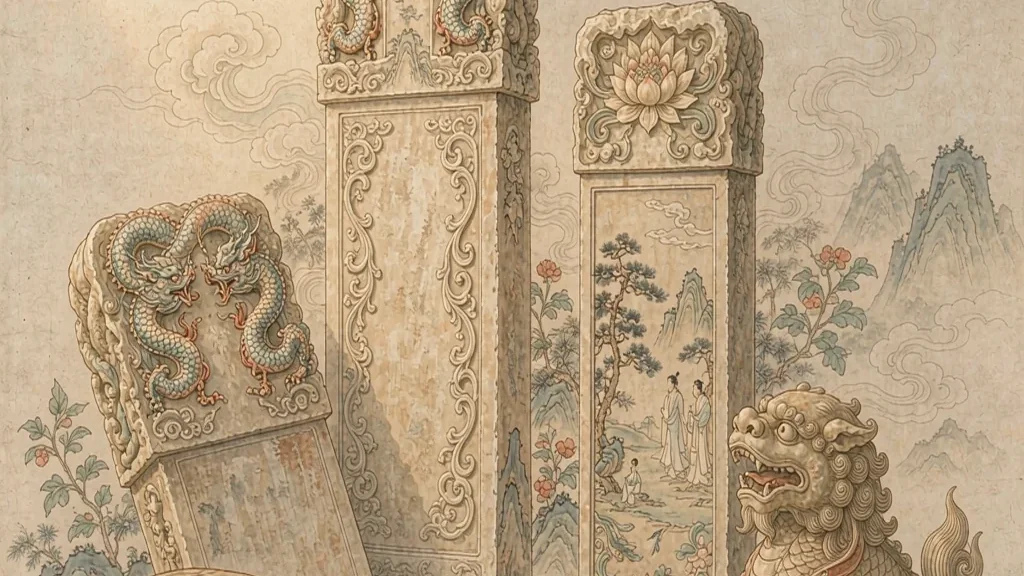
In China, stone steles (石碑, shíbēi) are the most permanent form of writing — texts carved into stone to endure for millennia. Chinese stele carving combines calligraphy, sculpture, and historical documentation in a single art form. Steles have recorded everything from imperial edicts and Buddhist sutras to poems, maps, and medical prescriptions. The stonecarver's chisel has preserved Chinese civilization's written record when paper would have crumbled to dust.
The Origins of Chinese Steles
The earliest Chinese steles date to the Qin dynasty (221-206 BCE), when the First Emperor erected stone tablets on sacred mountains to record his accomplishments. The Han dynasty saw the explosion of stele carving, with steles recording the names and virtues of officials, scholars, and filial sons.
The Stele Forest of Xi'an
The most important collection of Chinese steles is the Stele Forest (碑林, Bēilín) in Xi'an, established in the 11th century. It contains over 3,000 steles spanning 2,000 years. The most famous is the Nestorian Stele of 781 CE, which records the arrival of Christianity in China.
Calligraphy in Stone
Stele carving is inextricably linked to calligraphy. The finest calligraphers had their works carved into steles for preservation. The Stele Forest preserves original works of Wang Xizhi, Yan Zhenqing, and other masters.
Buddhist Stele Carving
The greatest Buddhist stele carving project was the 'Clouds of Dharma' (云法) project at Mount Taishan, where the entire Buddhist canon was carved into the mountain surface.
The Stele Forest of Xi'an in Detail
The Stele Forest (碑林, Bēilín) in Xi'an was established in 1087 during the Northern Song dynasty to preserve ancient stone inscriptions. It contains over 3,000 steles arranged in a series of halls and courtyards. The collection spans from the Han dynasty to the Qing, representing the complete history of Chinese calligraphy in stone.
The most famous work in the Stele Forest is the 'Model Letters of Wang Xizhi' (王羲之书圣碑), a stele that reproduces the calligraphy of the great Jin dynasty master. Other treasures include the 'Yan Family Stele' by Yan Zhenqing, considered the finest example of Tang regular script, and the 'Cao Quan Stele' (曹全碑), a Han dynasty stele discovered in the Ming dynasty.
The Process of Stele Carving
The carving of a stele began with the preparation of the stone — typically limestone or marble — which was cut to size and polished smooth. The calligrapher's text was written on paper, and the paper was pasted face-down onto the stone. The carver traced the characters through the paper, making a light incision. Then the paper was removed and the characters were deepened with chisels.
The carving required extraordinary precision — a mistake could not be corrected. The best carvers could reproduce the subtlest variations of the calligrapher's brushwork, including the changes in line thickness, the 'flying white' effect where the brush leaves gaps in the ink, and the emotional character of the handwriting. A good carving was one that preserved the calligrapher's spirit, not just the shapes of the characters.
The Buddhist Canon in Stone
The most ambitious stele carving project in Chinese history was the engraving of the Buddhist canon at Fangshan (房山石经, Fángshān shíjīng), near Beijing. From the 7th to the 17th century, over 14,000 stone slabs were carved with Buddhist sutras, stored in a cave to protect the scriptures from the predicted destruction of the Buddhist teachings.
The Fangshan stone sutras were carved as an act of religious devotion, to preserve the Buddhist scriptures through the 'age of the declining dharma' that was believed to follow the Buddha's passing. The project was supported by generations of monks, emperors, and lay believers. The sutras were rediscovered in the 20th century and recognized as one of the most important Buddhist archaeological discoveries in China.
The Turtle-Bearing Tradition
Many Chinese steles do not rest directly on the ground but ride on the back of a monumental stone tortoise, a mythical beast charged with bearing the weight of memory. This pedestal form appeared as early as the Han dynasty and became standard for important imperial and commemorative steles. The tortoise was chosen because it symbolized stability, longevity, and the power to carry heavy burdens without complaint, qualities fitting for a monument meant to outlast dynasties. Above the slab, a carved dragon or rounded cap often crowned the inscription, marking it as official. To read a great stele therefore meant approaching a small architecture of stone: a beast below, a text in the middle, and a heavenly ornament above, each part reinforcing the message that what was written here was meant to endure.
❓ Frequently Asked Questions
📝 Chinese Vocabulary
石碑 — : stone stele.
碑林 — : Stele Forest; Xi'an's collection.
拓片 — : rubbing; paper impression of a carved stele.
碑文 — : stele inscription.
石碑 — : stone stele; inscribed stone tablet
碑林 — : Stele Forest; Xi'an's collection of inscribed steles
拓片 — : rubbing; ink impression of a carved surface
拓片 — : A paper rubbing taken from a carved stone, preserving its inscription or image as a black-and-white impression that could be studied and reprinted.
🎉 Fun Facts
- The Nestorian Stele records the arrival of Christianity in China in 635 CE.
- Stele rubbings have been collected as calligraphy models for over a thousand years.
- The Nestorian Stele in the Stele Forest is the earliest known monument of Christianity in China, dating to 781 CE.
- The Fangshan stone sutras contain over 14,000 stone slabs, making them one of the largest stone-carving projects in the world.
- The Nestorian Stele in Xi'an's Forest of Steles records a Christian community in Tang China and is sometimes called the Sino-West monument for its bilingual Chinese and Syriac inscription.
- Some steles were deliberately buried or hidden during wars and later unearthed by chance, their surfaces preserved perfectly underground while comparable above-ground stones weathered away.