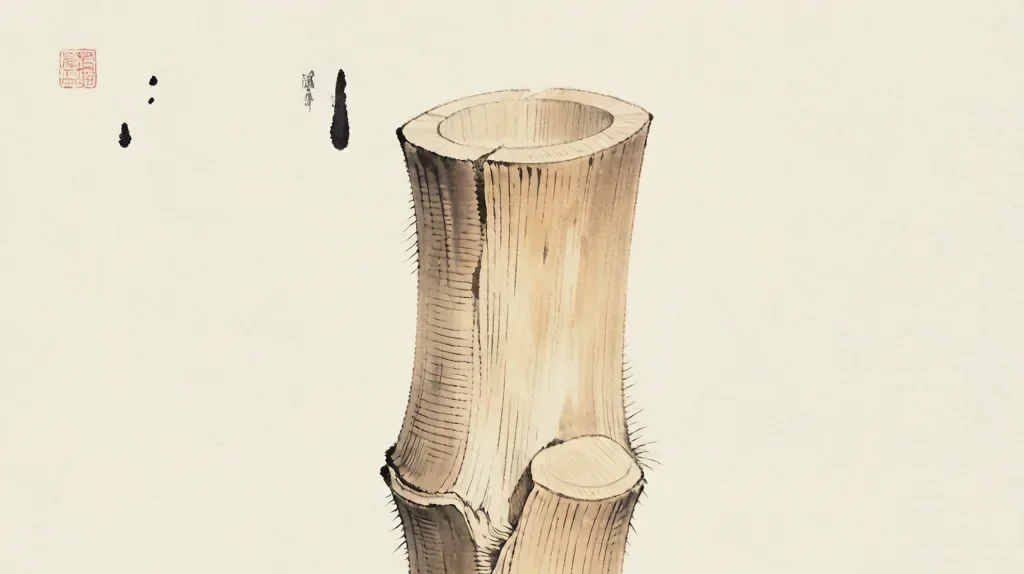
While the literati painted bamboo on silk and paper, another tradition carved bamboo into three-dimensional form — turning the hollow stems of this humble grass into brush pots, incense holders, and figurines of exquisite refinement. Bamboo carving (竹雕, zhúdiāo) emerged as a distinctive art form during the Ming dynasty and reached its peak in the Qing, producing works that combined the scholar's appreciation for bamboo with the craftsman's mastery of carving tools.
The Materials of Bamboo Carving
Bamboo carving uses the stems of certain bamboo species, particularly the large 'bamboo timber' varieties that grow in southern China. The carver works with the natural surface of the bamboo, using its skin, texture, and color as elements of the design. The most prized bamboo carvings use the 'skin' of the bamboo (the outer layer) as the foreground and the inner layers as the background, creating a natural two-tone effect.
Bamboo is a difficult material to carve. It is hard but fibrous, and the knife must follow the grain or the bamboo will splinter. The carver must understand the growth patterns, density, and moisture content of the bamboo to produce clean cuts.
The Jiading School of Bamboo Carving
The center of Chinese bamboo carving was Jiading (modern Shanghai), where a school of carvers developed in the Ming dynasty and continued into the Qing. The founder of the Jiading School was Zhu He (朱鹤, active 16th century), who adapted the techniques of seal carving to bamboo. His works were praised for their 'bold and vigorous' style, with deep cuts and strong three-dimensional forms.
Zhu He's son Zhu Yuan (朱元) and grandson Zhu Yatai (朱雅泰) continued the family tradition, and the Zhu family established the reputation of Jiading bamboo carving. By the Qing dynasty, Jiading was producing the finest bamboo carvings in China.
Types of Bamboo Carvings
Bamboo carvings served both practical and decorative purposes. The most common object was the brush pot (笔筒, bǐtǒng) — a container for calligraphy brushes — which was the standard vehicle for bamboo carving from the Ming through Qing. Other objects include incense holders, arm rests (for calligraphers), fan handles, and figurines.
Brush pots were typically carved from a section of bamboo stem, with a design in relief that wrapped around the cylinder. Popular subjects included scholars in landscape settings, birds and flowers, and calligraphic inscriptions. The relief carving could be shallow (shallow relief, 薄地阳文, báodì yángwén) or deep (deep relief, 高浮雕, gāo fúdiāo).
The Qing Dynasty Proliferation
The Qing dynasty (1644–1912) was the great age of bamboo carving, with carvers in Jiading, Fujian, and Hunan producing works of extraordinary variety. The Kangxi and Qianlong emperors collected bamboo carvings, and the imperial workshops included bamboo carvers alongside jade and ivory specialists.
The Qing carver Zhou Hao (周颢, 1685–1773) was the most famous bamboo carver of his era, celebrated for his brush pots with landscape scenes. His works combine the compositional principles of landscape painting with the three-dimensionality of sculpture.
The Aesthetic of Bamboo Carving
Bamboo carving was particularly valued by the literati class because it combined the scholar's love of bamboo with the craftsman's skill. A fine bamboo brush pot was a practical object that also served as a work of art — it was useful, beautiful, and morally uplifting, since bamboo itself symbolized the gentleman's virtues.
The aesthetic of bamboo carving values the natural properties of the material. The bamboo's grain, color, and texture should be enhanced by the carving, not concealed. A bamboo carving should show respect for the material, working with its qualities rather than against them.
Regional Styles of Bamboo Carving
Beyond Jiading, other centers of bamboo carving developed distinctive regional styles. In Fujian Province, carvers specialized in 'liu qing' (留青) technique, where the green outer skin of the bamboo was retained as the foreground and the underlying layer was cut away as background. The contrast between the green skin and the pale inner layer created a natural two-tone effect that Fujian carvers exploited with great artistry.
In Hunan Province, bamboo carvers developed a style characterized by deep relief and bold, vigorous carving. Hunan bamboo carvings often depicted landscapes and figures from Chinese mythology, carved with a freedom and energy that distinguished them from the more refined works of Jiading.
The Collectors of Bamboo Carvings
Bamboo carvings were collected by scholars and connoisseurs from the Ming dynasty onward. The most famous collector was the Qing dynasty scholar and official Weng Fanggang (翁方纲, 1733–1818), who owned hundreds of bamboo carvings and wrote extensively about the craft. His collection of bamboo brush pots was legendary, and his writings helped establish bamboo carving as a respected art form.
Today, bamboo carvings are collected by museums and private collectors worldwide. The Shanghai Museum, the Palace Museum, and the Metropolitan Museum of Art have significant collections. Fine bamboo carvings from the Ming and Qing dynasties can command prices in the hundreds of thousands of dollars at auction.
Bamboo Carving Techniques in Detail
The techniques of bamboo carving are many and varied. In shallow relief (薄地阳文, báodì yángwén), the background is cut away to a shallow depth, leaving the design raised. In deep relief (高浮雕, gāo fúdiāo), the carving is deeper, creating strong three-dimensional forms. In openwork (镂空, lòukōng), the background is cut completely through, creating a lace-like pattern.
The 'liu qing' (留青) technique, or 'leaving the green,' is unique to bamboo carving. The carver leaves the green outer skin of the bamboo in areas that form the image, while cutting away the skin in the background to reveal the pale inner layer. As the bamboo ages, the skin darkens to amber while the inner layer remains light, creating an increasingly beautiful contrast over time.
❓ Frequently Asked Questions
📝 Chinese Vocabulary
竹雕 — : bamboo carving
笔筒 — : brush pot; the most common bamboo carving
嘉定派 — : Jiading School; the center of Chinese bamboo carving
薄地阳文 — : shallow relief; a technique of bamboo carving
留青 — : leaving the green; carving that keeps the bamboo skin
留青 — : leaving the green; bamboo carving technique that retains the green skin
高浮雕 — : deep relief; three-dimensional bamboo carving
镂空 — : openwork; through-carving technique
🎉 Fun Facts
- Bamboo carving was sometimes called 'the literati craft' because it combined painting, calligraphy, and carving skills.
- A finely carved bamboo brush pot by a master carver could be worth as much as a painting by a famous artist.
- Some Qing bamboo carvers created works that were so detailed they had to be viewed with a magnifying glass.
- The oldest known signed and dated Chinese bamboo carving is a brush pot from 1512.
- Some bamboo carvers specialized in carving miniature landscapes on the surface of a single bamboo segment, complete with figures, buildings, and trees.
- Because bamboo is botanically a grass with a fibrous, splitting grain, carvers had to read the stalk's nodes and work with the grain, making deep clean relief a real test of control rather than just patience.