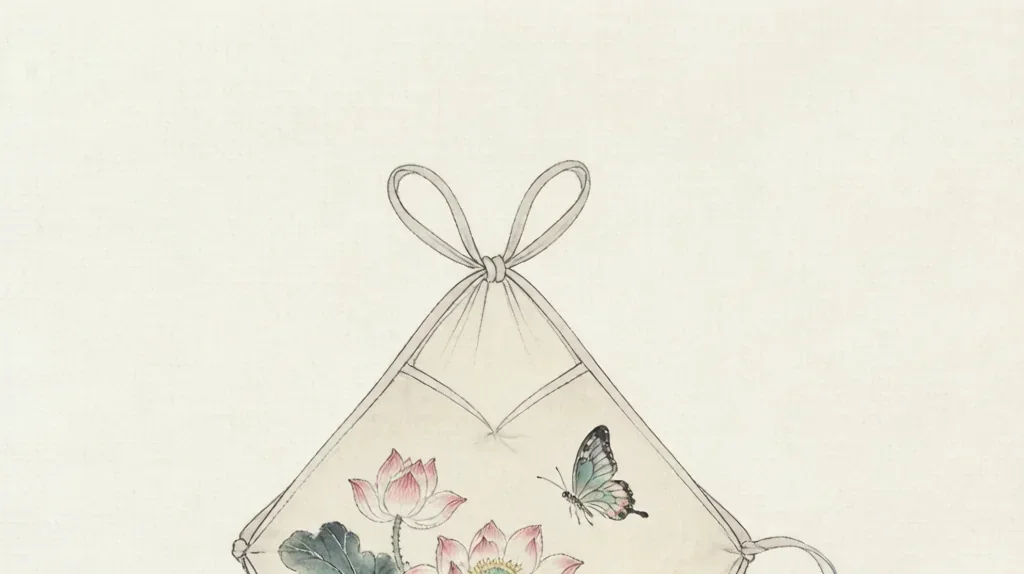
The dudou (肚兜), literally "belly wrap" or "belly cover," is a traditional Chinese undergarment with a history spanning more than 2,000 years. This simple diamond-shaped piece of cloth, tied around the neck and waist with silk cords, was the standard undergarment for Chinese women — and, in earlier periods, for men and children as well — from the Han dynasty (206 BCE–220 CE) through the early 20th century. Far more than a mere practical garment, the dudou was a canvas for elaborate embroidery, a vessel for medicinal herbs, a symbol of erotic allure, and an expression of familial love. Today, the dudou has transcended its origins as underwear to become a fashion element in its own right, appearing on international runways and in contemporary Chinese-inspired street style.
Origins and Historical Evolution
The earliest form of the dudou can be traced to the Han dynasty, where it was known as "xieyi" (亵衣, literally "intimate clothing") or "xinyi" (心衣, "heart clothing"). Archaeological evidence from Han tombs confirms the diamond-shaped design with neck and waist ties that would remain essentially unchanged for two millennia. During the Tang dynasty (618–907), a period of relative openness in women's fashion, the dudou was sometimes worn as outerwear, visible beneath the translucent silk robes depicted in Tang paintings and figurines. By the Ming (1368–1644) and Qing (1644–1912) dynasties, the dudou had become standard underwear for women of all social classes, from peasant to palace concubine. The garment's remarkable longevity — the same basic design persisted through multiple dynasties, political upheavals, and dramatic changes in outer fashion — testifies to its perfect functional design: simple to make, comfortable to wear, and effective at its primary purpose of keeping the torso warm, which traditional Chinese medicine considered essential for health.
The dudou's design evolved subtly across dynasties while maintaining its essential form. Han dynasty dudou were relatively plain, made from hemp or coarse silk, with simple ties. Tang dynasty dudou, reflecting the period's prosperity and cultural openness, were made from finer silks and sometimes featured gold thread. Song dynasty dudou were characterized by more restrained colors and patterns, reflecting the Neo-Confucian emphasis on modesty. Ming dynasty dudou reached new heights of sophistication, with the introduction of the "hundred birds" and "hundred children" embroidery motifs. Qing dynasty dudou were the most elaborately decorated, with the development of new embroidery techniques and the availability of imported dyestuffs that enabled brilliant new color combinations. Throughout these changes, the dudou remained remarkably consistent in its basic construction, a testimony to the wisdom of its original design.
Design, Embroidery, and Personal Expression
Though hidden from public view, the dudou was often the most beautifully decorated item in a woman's wardrobe. The diamond-shaped front panel provided an ideal surface for embroidery, and women poured their creativity and emotions into decorating these intimate garments. Common motifs included lotus flowers (symbolizing purity), mandarin ducks (marital fidelity), butterflies (love and transformation), and peonies (wealth and honor). Brides prepared elaborately embroidered dudou as part of their trousseau, often incorporating secret messages or personal symbols. Mothers embroidered dudou for their children with protective motifs — tigers to ward off evil spirits, the "five poisons" (五毒: scorpion, viper, centipede, toad, and spider) to immunize against harm, and auspicious characters like "longevity" (寿) and "good fortune" (福). The embroidery of a dudou was thus simultaneously an act of personal creativity, a declaration of love, and a ritual of protection — a private world of meaning worn against the skin.
The embroidery techniques employed on dudou represent some of the finest examples of Chinese needlework. The most common technique was Suzhou embroidery (苏绣), known for its fine, even stitches and subtle color gradations. Suzhou embroiderers used split stitches so fine that the thread could not be seen by the naked eye, creating a smooth, painted effect. For dudou intended as wedding trousseau, the satin stitch (齐针) was used to create solid areas of color, while the seed stitch (打籽绣) produced a raised, textured surface resembling pearls. Gold thread embroidery (盘金绣) was reserved for the most luxurious dudou, with the metal thread couched onto the fabric surface using tiny silk stitches. The most labor-intensive technique was hair embroidery (发绣), in which the embroiderer used human hair — often her own — instead of silk thread. Hair embroidery was believed to imbue the garment with the maker's spiritual essence and was typically used for dudou created for a husband or child. A single hair-embroidered dudou could require months of painstaking work, with the fine hair thread demanding exceptional eyesight and steady hands.
The Dudou in Erotic Literature and Art
As an intimate garment worn directly against the skin, the dudou acquired powerful erotic connotations in Chinese literature and art. In the Ming dynasty erotic novel "The Plum in the Golden Vase" (Jin Ping Mei), the dudou appears as a token of romantic intimacy, exchanged between lovers as a promise of fidelity. The act of unfastening a dudou's side ties became a literary metaphor for sexual consummation. During the late Ming and early Qing periods, the dudou featured prominently in "spring palace paintings" (chun gong tu), the Chinese tradition of erotic art, where it was depicted in various states of being put on, worn, or removed. These artistic representations reveal a nuanced understanding of the dudou's role in sexual psychology: the garment concealed even as it revealed, emphasizing the erotic potential of what remained hidden. The dudou's strategic placement of ties and openings made the act of undressing a deliberate, ceremonial process that heightened anticipation.
In the 20th and 21st centuries, the dudou's erotic symbolism has been reimagined in various media. Mainland Chinese films of the 1990s, such as Zhang Yimou's "Raise the Red Lantern" (1991) and Chen Kaige's "Farewell My Concubine" (1993), used the dudou as a visual shorthand for female sensuality and historical authenticity. International fashion photographers have frequently styled models in dudou-inspired garments to evoke a sense of exotic elegance and restrained eroticism. The dudou's journey from hidden undergarment to visible fashion statement reflects broader changes in Chinese attitudes toward the body, sexuality, and tradition. In contemporary China, the dudou is no longer a secret garment but a confident expression of cultural identity and personal style, worn openly as a crop top or beach cover-up — a transformation that would have been unthinkable just a generation ago.
Functions Beyond Underwear: Medicine and Protection
The dudou served purposes that extended well beyond basic underwear. In traditional Chinese medicine, the abdomen is considered the seat of qi and the location of the "dantian" (丹田), the body's primary energy center. Keeping the belly warm was believed essential for digestion, reproductive health, and overall vitality — especially for women, whose bodies were considered more vulnerable to cold. The dudou's design, covering the abdomen and lower chest while leaving the back and shoulders free, reflected this medical theory precisely. Some dudou incorporated pockets to hold warming herbs like mugwort (艾草) or aromatic medicines, creating a wearable therapeutic device. For infants and young children, the dudou was worn continuously, day and night, to protect the vulnerable belly from chills — a practice that persisted in rural China well into the 20th century. During the hot southern summers, laborers of both sexes sometimes wore nothing but a dudou and loose trousers.
The Dudou in Modern Fashion and Culture
With the Westernization of Chinese dress in the early 20th century, the dudou gradually disappeared from everyday use, replaced by Western-style bras and undershirts. But in the late 20th and early 21st centuries, it experienced a remarkable revival. Film costumes in epics like Zhang Yimou's "Curse of the Golden Flower" and "House of Flying Daggers" featured elaborate dudou-inspired designs that captivated global audiences. International fashion designers including Versace, Dior, and Guo Pei have incorporated dudou elements into haute couture collections. On Chinese social media, the dudou has become a popular summer fashion item, worn as a crop top with high-waisted skirts or jeans in the "new Chinese style" (新中式) trend. The garment's journey from hidden underwear to visible fashion statement reflects broader changes in Chinese attitudes toward the body, tradition, and modernity.
The contemporary dudou revival represents more than a fashion trend — it is part of a broader cultural reclamation of Chinese heritage. Young Chinese designers are reinterpreting the dudou for modern consumers, using traditional embroidery techniques but applying them to contemporary silhouettes. E-commerce platforms like Taobao and Tmall feature thousands of dudou designs, from faithful reproductions of Qing dynasty originals to avant-garde interpretations combining the dudou shape with leather, lace, and metallic fabrics. The garment has also found unexpected popularity among non-Chinese consumers, who appreciate its minimal design and versatility. On Western fashion platforms like Etsy and ASOS, "dudou" searches increased by over 300% between 2018 and 2023, driven by the growing interest in East Asian fashion aesthetics. The dudou's ability to span the spectrum from intimate underwear to outerwear, from traditional folk garment to cutting-edge fashion, testifies to its extraordinary versatility as a canvas for both cultural memory and creative innovation.