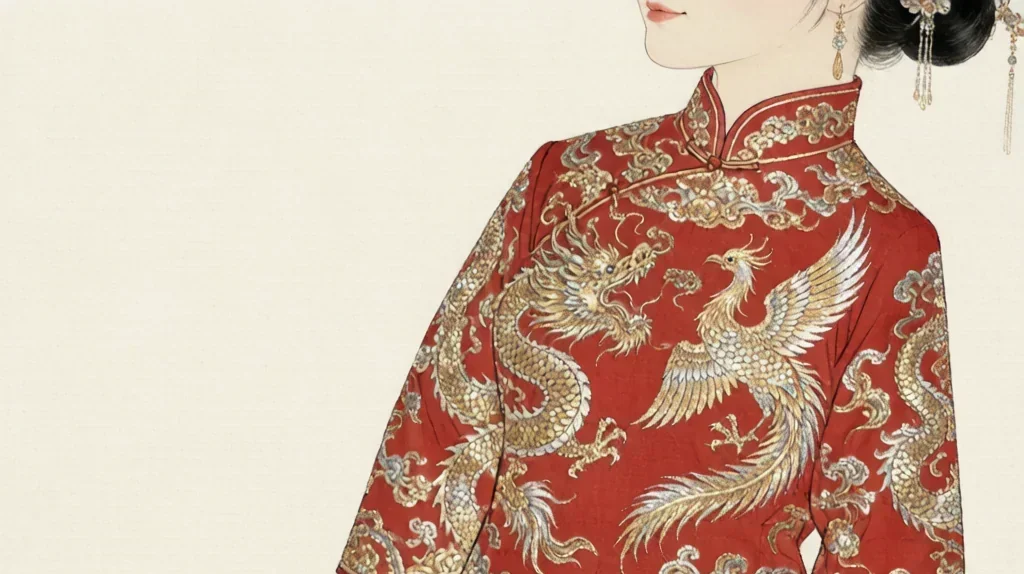
The longfenggua (龙凤褂), or "Dragon Phoenix Gown," is the most prestigious form of traditional Chinese wedding attire — a spectacular ensemble embroidered with dragons (龙) and phoenixes (凤) in gold and silver thread, symbolizing the perfect union of masculine and feminine energies. Originating in Guangdong province and refined by generations of master embroiderers, the longfenggua represents the apex of Chinese bridal craftsmanship. Unlike the more familiar red qipao or the ornate phoenix crown and cape (凤冠霞帔) of northern traditions, the longfenggua is distinguished by its dense, sculptural embroidery that covers the entire garment, creating a surface that shimmers like liquid metal.
A Thousand Years of Bridal Embroidery: The History of Longfenggua
The origins of the longfenggua can be traced back over a millennium to the Tang dynasty (618–907 CE), when high-ranking brides in the imperial court wore elaborate ceremonial robes embroidered with dragon and phoenix motifs reserved exclusively for the aristocracy. During the Song dynasty (960–1279), sumptuary laws strictly regulated who could wear dragon embroidery — only the empress and imperial concubines were permitted full dragon motifs, while lower-ranking noblewomen wore phoenix-only designs. It was not until the Ming dynasty (1368–1644) that the dragon-phoenix combination gradually spread beyond the imperial family to the general population, a democratization of bridal fashion that accelerated during the Qing dynasty (1644–1912). The garment as we recognize it today — a fitted jacket (褂) paired with a long skirt (裙) — crystallized in the late Qing period in the Guangdong region, where the maritime trade brought unprecedented wealth to merchant families who could afford the finest embroidery. The name "longfenggua" itself became standardized only in the early 20th century, when Shanghai's bridal ateliers began marketing the style to a national audience. Throughout this evolution, the essential symbolism remained constant: the dragon and phoenix, representing the complementary forces of yin and yang, blessing the marriage with harmony and prosperity.
The Chaozhou Embroidery Tradition: Gold Thread and Padded Stitches
The embroidery technique that defines the longfenggua is Chaozhou embroidery (潮绣), one of China's four major embroidery schools, centered in Chaozhou city in eastern Guangdong province. Chaozhou embroidery traces its roots to the Tang dynasty, when the region was a thriving hub on the Maritime Silk Road, and foreign traders brought gold and silver threads from Persia and Central Asia. By the Ming dynasty, Chaozhou embroiderers had developed their most distinctive innovation: "padded gold embroidery" (垫金绣), in which layers of paper, cotton, or silk batting are sewn beneath the gold thread to create a raised, three-dimensional effect. This technique requires extraordinary precision: the embroiderer must first sketch the design in ink on the silk base, then build up the padding layer by layer, and finally cover every millimeter with tightly spaced gold stitches. A master embroiderer can complete only a few square centimeters of padded gold work per day — which explains why a top-grade guahuang requires an entire year of labor.
The gold thread itself is a marvel of traditional craftsmanship. Known as "flat gold thread" (平金线), it is made by hammering pure gold into paper-thin foil, cutting the foil into hair-thin strips, and wrapping each strip around a silk thread core. The result is a thread that is both flexible enough to pass through fabric and lustrous enough to catch light from every angle. Different shades are achieved by using gold, silver, or rose-gold foil, and occasionally thread wrapped with peacock feather filaments for an iridescent sheen. Chaozhou embroidery also employs a distinctive "nail gold" (钉金) technique, in which the gold thread is secured to the fabric with tiny colored silk stitches that form decorative patterns — the stitches themselves become part of the visual design. The accumulated wisdom of this craft is passed down through oral tradition and hands-on apprenticeship; a full master requires at least fifteen years of dedicated practice. Today, fewer than one hundred master embroiderers in all of China can execute the highest grade of guahuang work, making each such garment not merely a dress but an irreplaceable work of art.
The Longfenggua in the Wedding Ceremony
In a traditional Cantonese wedding, the longfenggua is worn at the most emotionally charged moments of the daylong celebration. The bride typically dresses in her gown early in the morning at her family home, assisted by a "good luck woman" (好命婆) — a married woman with living parents, healthy children, and a harmonious marriage — who helps her into the garment while reciting auspicious blessings. The tea ceremony (敬茶) follows: the bride and groom, both in their finest traditional attire, kneel before the groom's parents and serve tea in a ritual that formalizes the bride's entry into the new family. The longfenggua's shimmering gold embroidery catches the light as the bride moves, creating a visual spectacle that photographs and videos capture with particular drama. After the tea ceremony, the bride changes into the kwan kwa (裙褂) — a slightly less elaborate version of the gown — for the wedding banquet, while the full longfenggua is preserved for the most formal photographs.
The accessories that accompany the longfenggua are equally rich in symbolism. The bride wears a set of gold jewelry called the "dragon-phoenix wedding jewelry set" (龙凤结婚金器): a pair of wide dragon-phoenix bangles (龙凤镯), a matching necklace with a dragon-phoenix pendant, and a pair of earrings featuring the double happiness character. These pieces are traditionally gifts from the groom's family to the bride, representing the transfer of family wealth and the groom's family's acceptance of the bride. In traditional practice, the bride's mother would also present her daughter with a gold hair ornament called the "hairpin of abundance" (如意簪), which the bride wears tucked into her bun. The total weight of gold jewelry a bride wears can reach several kilograms, and elaborate displays of gold remain a common feature of Cantonese wedding photography. In recent years, many brides choose to wear the longfenggua for only the tea ceremony and first part of the banquet, then change into a Western white wedding dress for the reception — a fusion that reflects the bicultural identity of modern Chinese families around the world.
Longfenggua and the Western Wedding Dress: A Tale of Two Traditions
The contrast between the longfenggua and the Western white wedding dress reveals deep differences in how two cultures conceptualize marriage. The Western white wedding dress, popularized by Queen Victoria in 1840, symbolizes purity, virginity, and the bride's individual agency — it is typically worn only once and often preserved as a keepsake. The longfenggua, by contrast, symbolizes prosperity, family continuity, and social status — its red color (the Chinese color of luck and joy), gold embroidery (wealth and nobility), and elaborate craftsmanship all speak to the bride's role within a larger family and social network. Where the Western dress emphasizes the bride's personal beauty, the longfenggua emphasizes her family's standing and her new family's hopes for a prosperous union.
In practical terms, the two traditions also differ significantly. A Western wedding dress is usually a single garment worn throughout the entire ceremony and reception, designed for comfort and ease of movement on the dance floor. The longfenggua is part of a multi-outfit system: the bride changes clothes multiple times throughout the wedding day, each outfit marking a different phase of the celebration. In contemporary Chinese weddings — especially in Hong Kong, Singapore, and among the diaspora — many brides now wear both: the longfenggua for the tea ceremony and early banquet, then a Western white dress for the grand entrance and first dance, and sometimes a third outfit (often a modern qipao or an evening gown) for the late banquet. This wardrobe choreography reflects the bicultural reality of modern Chinese identity: the longfenggua honors tradition and family, while the white dress speaks to individual romance and global fashion. The two garments, so different in appearance and meaning, together tell the story of a bride navigating between two worlds — and finding beauty in both.
The Modern Revival: Celebrity Weddings and Global Fashion
The longfenggua has experienced a dramatic resurgence in the 21st century, driven by celebrity weddings, social media, and a broader revival of traditional Chinese aesthetics. When Hong Kong actress Myolie Wu wore a guahuang for her 2015 wedding, social media erupted with admiration, and demand for top-grade longfenggua surged across the Chinese-speaking world. Today, bridal studios in Hong Kong, Guangzhou, Shanghai, and Chinatowns worldwide offer longfenggua rentals and custom commissions. A new generation of designers is experimenting with the form — introducing non-traditional colors like powder blue and lavender, reducing embroidery density for a lighter, more contemporary look, and creating fusion pieces that pair the longfenggua jacket with a modern ball gown skirt. Despite these innovations, the core symbolism endures: the dragon and phoenix, locked in their eternal dance of complementary opposites, continue to bless couples with the hope of harmony, prosperity, and enduring love.