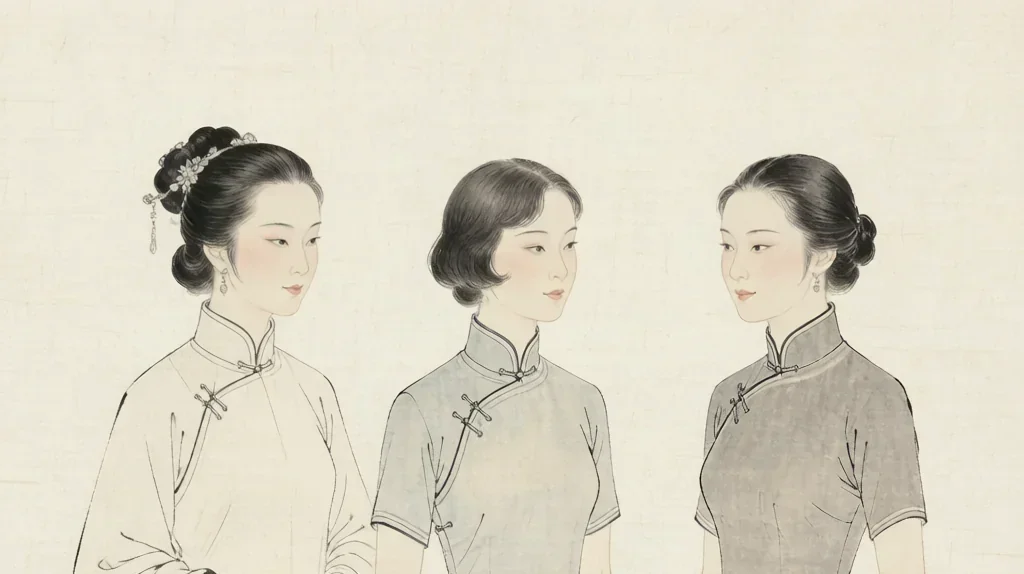
The qipao (旗袍), known in Cantonese as cheongsam, is arguably the most iconic garment in Chinese fashion — a form-fitting dress with a high mandarin collar, diagonal front opening, and side slits that has come to embody Chinese femininity in the global imagination. Yet its current form is a remarkably modern creation. The qipao's journey from the loose, floor-length robes of Manchu women to the body-hugging silk sheath of 1930s Shanghai is a story of cultural collision, political upheaval, and the constant renegotiation of what it means to be a modern Chinese woman. Today, the qipao is worn at weddings, diplomatic events, and fashion shows worldwide.
Manchu Origins: The Banner Gown
The qipao originated as the everyday dress of Manchu women during the Qing dynasty (1644–1912). The Manchus, who conquered China from the northeast, organized their society into Eight Banners (八旗, baqi) — hence the name qipao, literally "banner gown." The original qipao was a loose, straight-cut robe that fell to the ankles, with wide sleeves and a high collar, worn over trousers. It covered the body almost completely, reflecting both the cold climate of the Manchu homeland and the conservative norms of Qing society. Unlike the two-piece ensembles (jacket and skirt) favored by Han Chinese women, the Manchu qipao was a single-piece garment that emphasized vertical lines and unbroken silhouette. After the Qing court mandated Manchu dress for official occasions, the qipao gradually spread beyond the banner population, though Han women largely maintained their own clothing traditions until the dynasty's fall.
The evolution from Manchu banner gown to the modern qipao was neither linear nor inevitable. During the late Qing period, a transitional form known as the "Beijing-style qipao" emerged, which had a narrower cut and more tailoring than the original robe. This version was still loose by modern standards but showed the influence of Han Chinese dress aesthetics, particularly in its decorative embroidery and color choices. Meanwhile, in Guangzhou and Hong Kong, a different variant developed — the "cheungsam" — which featured higher slits and a more fitted silhouette, anticipating the radical transformations of the Shanghai era. These regional variations demonstrate that the qipao's modernization was not a single event but a gradual process occurring across multiple Chinese cities, each contributing its own design innovations to what would become the iconic garment of the 20th century.
Shanghai's Golden Age: The Modern Qipao Is Born
The qipao as we know it today was born in 1920s and 1930s Shanghai, the most cosmopolitan city in Asia. As China's educated elite embraced Western ideas of gender equality and individual expression, women's fashion became a battleground for modernity. Shanghai tailors radically redesigned the qipao: they narrowed the cut to follow the body's curves, raised the hemline from ankle to calf (and sometimes above the knee), added side slits for ease of movement, shortened the sleeves, and introduced Western darts and tailoring techniques to achieve a sculpted fit. The new qipao was worn by movie stars, socialites, and students — most iconically by Eileen Chang (张爱玲), the great writer whose personal collection of qipaos was legendary. Magazines like "Linglong" (玲珑) featured qipao fashion spreads, and the garment became synonymous with the modern Chinese woman: educated, independent, and glamorous.
Shanghai's fashion industry was uniquely positioned to create the modern qipao. The city's International Settlement and French Concession brought together Chinese tailors, Western dressmakers, and a clientele of wealthy Chinese, foreign expatriates, and glamorous courtesans who demanded the latest styles. Fashion houses on Nanking Road and the Bund competed to attract the most skilled seamstresses, many of whom had trained in the traditional Suzhou embroidery workshops before adapting their skills to modern garment construction. The Shanghai Qipao Guild, established in 1925, standardized sizing and quality while encouraging innovation in design. Photographs from the period show the extraordinary range of qipao styles: businesswomen in conservative navy blue wool qipaos with minimal decoration; socialites in brilliant silk satin qipaos featuring art deco patterns; and students in simple cotton qipaos that combined modesty with modernism. The qipao had become, in the space of a single decade, a universal garment that simultaneously expressed modernity and Chinese identity.
The Qipao in Cinema, Literature, and Global Pop Culture
The qipao's global image owes much to its representation in cinema and popular media. In the mid-20th century, Hollywood films set in mysterious, exotic China routinely dressed their leading ladies in qipaos — most famously Jennifer Jones in "Love Is a Many-Splendored Thing" (1955) and Nancy Kwan in "The World of Suzie Wong" (1960). These films, though often orientalist in their perspective, introduced the qipao to a worldwide audience and established it as the definitive symbol of Chinese femininity in the Western imagination. The garment's most impactful cinematic moment came with Wong Kar-wai's "In the Mood for Love" (2000), in which Maggie Cheung wears 23 different qipaos, each reflecting her character's emotional state. The film's sumptuous cinematography transformed the qipao from a nostalgic garment into a timeless fashion icon, inspiring designers from Prada to Tom Ford to create qipao-inspired collections.
Chinese literature has also played a crucial role in preserving and reimagining the qipao's cultural significance. Eileen Chang, who famously declared that "life is a gorgeous gown full of lice," wrote extensively about the social meanings of dress, and her own qipao choices were as carefully considered as her prose. Her essay "A Chronicle of Changing Clothes" traces the political history of China through the lens of fashion. Contemporary authors like Hong Ying and Li Yiyun continue to use the qipao as a symbol in their works. The garment appears not only in literary fiction but also in global pop culture: cartoon characters like Mulan wear qipao-inspired designs, video games from Street Fighter to Overwatch feature characters in qipaos, and the dress has become a staple of red-carpet fashion at international film festivals, worn by celebrities seeking to honor Chinese cultural heritage.
In Chinese cinema, the qipao has served as a powerful visual shorthand for specific periods and emotions. Zhang Yimou's "Shanghai Triad" (1995) used vividly colored qipaos to evoke the decadence of 1930s Shanghai gangster culture. Ang Lee's "Lust, Caution" (2007) featured Tang Wei in qipaos that shifted from innocent schoolgirl styles to sophisticated femme fatale designs, mirroring her character's psychological transformation. The television series "The Bund" (1980) and "Shanghai Bund" (2007) both made the qipao central to their visual identity, reinforcing its association with the glamour and danger of republican-era Shanghai. In each case, the qipao functions as more than costume — it is a character in itself, carrying the weight of history, desire, and cultural memory. The contemporary qipao designer Lu Kun has argued that the qipao contains the entire 20th-century history of Chinese women within its seams, from subjugation to liberation, and from tradition to modernity.
Decline, Persecution, and Survival
The qipao's fortunes reversed dramatically after the 1949 Communist Revolution. The new socialist regime associated the garment with bourgeois decadence, Western influence, and the "feudal" past. Millions of qipaos were destroyed, and the garment virtually disappeared from mainland China for a generation. Chinese women were expected to wear gender-neutral Mao suits (中山装) or simple blouses and trousers in dark, practical colors. However, the qipao survived in Hong Kong, where it remained the standard uniform for waitresses in high-end restaurants and the preferred attire for formal occasions. Tailors in Hong Kong and Shanghai's old French Concession preserved the craft, passing down pattern-making and embroidery techniques to younger generations.
Contemporary Revival and Global Influence
Since China's economic reforms in the 1980s and especially in the 21st century, the qipao has experienced a remarkable renaissance. It is now the garment of choice for Chinese brides (often a red silk qipao for the tea ceremony or banquet), for female diplomats and first ladies, and for celebrities walking international red carpets. Films like Wong Kar-wai's "In the Mood for Love" (2000), in which Maggie Cheung wears a different exquisite qipao in nearly every scene, reignited global fascination with the garment. Contemporary designers are pushing the qipao in new directions — using denim, leather, and neoprene; experimenting with asymmetrical cuts and deconstructed silhouettes; and designing qipao-inspired pieces for all genders. The garment has also become a focus of cultural pride among young Chinese: the "hanfu" and "new Chinese style" movements have embraced the qipao alongside earlier historical dress.