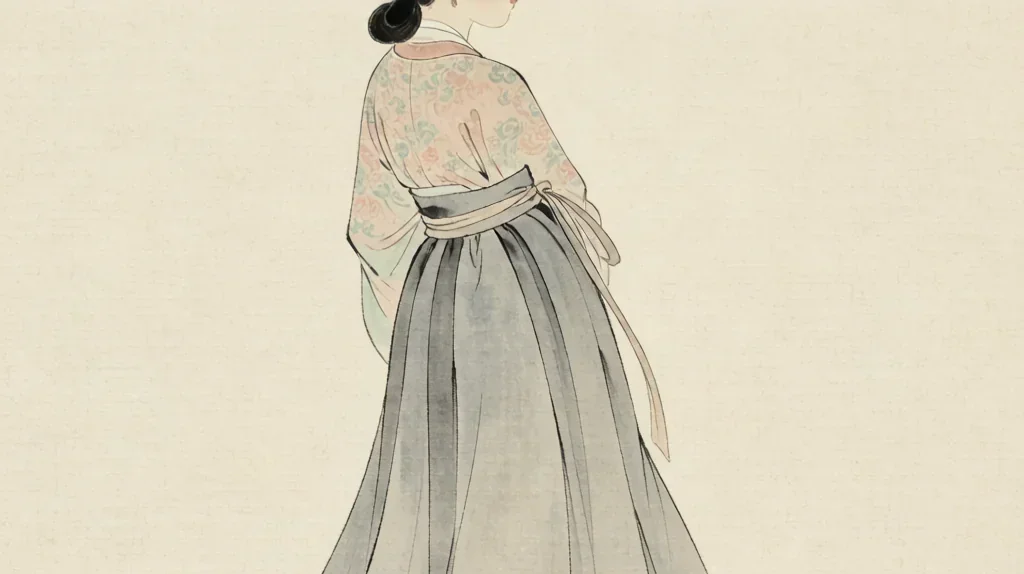
The mamianqun (马面裙), or "horse-face skirt," is one of the most distinctive and elegant garments in the history of Chinese women's fashion. Characterized by its unique structure — a skirt composed of two overlapping panels of fabric, each flat in the front and back but deeply pleated at the sides — the mamianqun was the standard formal skirt for Chinese women throughout the Ming (1368–1644) and Qing (1644–1912) dynasties. The name, which sounds somewhat peculiar in translation, derives from the flat, rectangular front and back panels that resemble the defensive bastions (马面, literally "horse faces") protruding from traditional Chinese city walls. In recent years, the mamianqun has experienced an extraordinary revival as part of the hanfu movement.
Structure and Craft: A Marvel of Textile Engineering
The mamianqun is a triumph of Chinese textile craftsmanship, constructed without a single curved seam. The skirt consists of two identical lengths of fabric, each folded into a series of knife-sharp pleats at the sides while maintaining a smooth, flat panel at the center front and back. The two pieces overlap, with the front panel wrapping to the right and fastening with ties at the waist. The pleating is extraordinarily labor-intensive: each pleat must be precisely measured, pressed, and stitched into place, and a single skirt can contain dozens or even hundreds of pleats. The waistband is typically made of a contrasting fabric and secured with long silk ribbons. The skirt's hem is often weighted — sometimes with small coins sewn into the lining — to ensure it hangs properly and sways gracefully with the wearer's movement. The result is a garment that appears simple from the front but reveals its complexity with every step, the pleats opening and closing like an accordion.
The engineering principles behind the mamianqun's construction are remarkably sophisticated. The flat front and back panels, called the "horse face" panels, are typically 15–35 centimeters wide and serve as the skirt's structural anchors. The pleated side sections, which can contain anywhere from 30 to over 200 individual pleats, provide both volume and freedom of movement. The pleats are organized in opposing groups — the left side pleats face inward while the right side pleats face outward, creating a balanced visual rhythm. The overlap of the two skirt panels is not merely decorative but structural: the overlapping creates a four-layer thickness at the front and back, ensuring modesty even during vigorous movement. The waistband is constructed from a separate piece of fabric, usually in a contrasting color, and is stiffened with multiple layers of fabric or bamboo strips to maintain its shape. The interior of the waistband is often lined with a softer fabric for comfort, while the exterior is made of the same or complementary material as the skirt body.
The Mamianqun Across Dynasties: Ming vs. Qing Variations
The mamianqun underwent significant stylistic evolution between the Ming and Qing dynasties, reflecting broader changes in fashion, textile production, and social norms. Ming dynasty mamianqun were characterized by their relatively modest proportions: the flat front panel was narrower, typically 15–20 centimeters wide, and the skirt hem fell just above the bound feet, revealing the tips of embroidered shoes. The pleating was finer and more numerous, with some surviving examples containing over 200 knife pleats per panel. Ming skirts were almost always made with a white waistband, symbolizing the purity of the garment's purpose. In contrast, Qing dynasty mamianqun became progressively wider and more elaborately decorated. The flat panels expanded to 25–35 centimeters, creating a more stately silhouette that complemented the increasingly ornate jackets and robes of Qing court fashion. The pleats became fewer but deeper, allowing for greater freedom of movement.
The decorative motifs also shifted between dynasties. Ming mamianqun favored naturalistic designs such as flowers, birds, and landscape scenes, executed in relatively restrained embroidery. Qing mamianqun, particularly those made for the court, became far more opulent, featuring the dense, all-over embroidery characteristic of late imperial Chinese decorative arts. The colors available also expanded dramatically during the Qing period, thanks to improvements in dyeing technology and increased trade in imported mineral and vegetable dyes. The finest Qing mamianqun were made from kesi (silk tapestry) fabric, in which the pattern was woven directly into the silk rather than embroidered on top — a technique so labor-intensive that a single skirt could take a weaver over a year to complete. These variations between dynasties make the mamianqun a valuable tool for dating textiles in museum collections.
The transition from Ming to Qing styles was not abrupt but gradual, with significant regional variation. In southern China, particularly in Suzhou and Hangzhou, Ming-style mamianqun persisted well into the early Qing period, as local weavers and embroiderers maintained their traditional techniques. In northern China, around the capital in Beijing, Qing court fashions influenced skirt design more rapidly, with larger panels and bolder colors becoming fashionable by the late 17th century. By the mid-Qing period, a distinctive "Beijing-style" mamianqun had emerged, characterized by extremely wide flat panels and elaborate "three-blue" embroidery — a technique using three shades of blue thread to create shaded, almost photographic effects. The evolution of the mamianqun thus provides a material record of the cultural negotiations between Manchu and Han aesthetic traditions, between court and regional styles, and between tradition and innovation in Chinese fashion.
Fabrics and Decoration: A Canvas for Art
Mamianqun were made in an extraordinary range of fabrics, from simple cotton and linen for everyday wear to sumptuous silks, satins, and brocades for formal occasions. The flat front and back panels served as canvases for elaborate decoration: gold-wrapped thread embroidery (金线绣) depicting dragons, phoenixes, peonies, and auspicious symbols; appliqué work (贴布绣) using contrasting fabrics; and the intricate "kesi" (缂丝) tapestry-weave technique, in which each color of the design is woven with a separate shuttle, creating patterns of astonishing detail. During the Ming dynasty, sumptuary laws regulated which colors, fabrics, and decorative motifs different social classes could wear — gold embroidery and five-clawed dragons were reserved for the imperial family, while commoners were restricted to simpler designs. These laws were frequently evaded, and the surviving mamianqun in museum collections testify to the irrepressible human desire for beauty regardless of social station.
The Mamianqun in Social Life
For over 500 years, the mamianqun was a universal element of Chinese women's formal dress. Paired with an ao (袄, a short jacket) in the Ming dynasty or with the more elaborate garments of the Qing court, the mamianqun was worn for weddings, festivals, ancestral rites, and visits to temples. The skirt's design was practical as well as beautiful: the side slits allowed freedom of movement for walking and the bound feet of elite women, while the overlapping panels provided modesty. The mamianqun was also an important marker of life stage and social status. Young unmarried women typically wore brighter colors and more elaborate embroidery; married women wore more subdued tones; and widows wore plain dark skirts without decoration. Bridal mamianqun were among the most spectacular, often featuring the "hundred children" (百子) motif — a pattern of playing boys symbolizing the wish for abundant offspring — executed in the finest silk and gold thread.
Modern Revival and Hanfu Culture
After the fall of the Qing dynasty in 1912 and the rapid Westernization of Chinese dress in the Republican era, the mamianqun largely disappeared from everyday wear. For most of the 20th century, it survived only in museum collections, traditional opera costumes, and the wedding attire of a few conservative communities. But in the 21st century, the mamianqun has returned with astonishing force as part of the hanfu (汉服) movement — a youth-driven cultural renaissance that reclaims pre-Qing Chinese clothing as a source of identity and pride. Young women across China now wear mamianqun not only for traditional festivals but as everyday fashion, pairing them with modern blouses, sneakers, and accessories in a style known as "new Chinese style" (新中式). The skirt's elegant lines and rich decorative possibilities have also attracted international attention, appearing on fashion runways from Paris to New York.
The hanfu revival has transformed the mamianqun from a historical artifact into a living fashion. Social media platforms like Douyin (TikTok) and Xiaohongshu (Little Red Book) feature thousands of posts tagged #马面裙, with young women showcasing their creative combinations of traditional skirts with contemporary clothing. The trend has spawned a thriving cottage industry of independent hanfu designers and workshops, many based in traditional textile centers like Suzhou and Hangzhou. These artisans are not merely copying historical designs but innovating within the tradition, creating mamianqun in new colors, fabrics, and lengths that appeal to modern tastes while respecting the garment's structural principles. The mamianqun's revival has also had economic impact: hanfu-related industries in China were valued at over 10 billion yuan in 2022, with mamianqun accounting for a significant share of sales. The skirt's journey from Ming dynasty formal wear to 21st-century fashion phenomenon demonstrates the enduring appeal of well-designed clothing and the power of cultural identity in the global age.