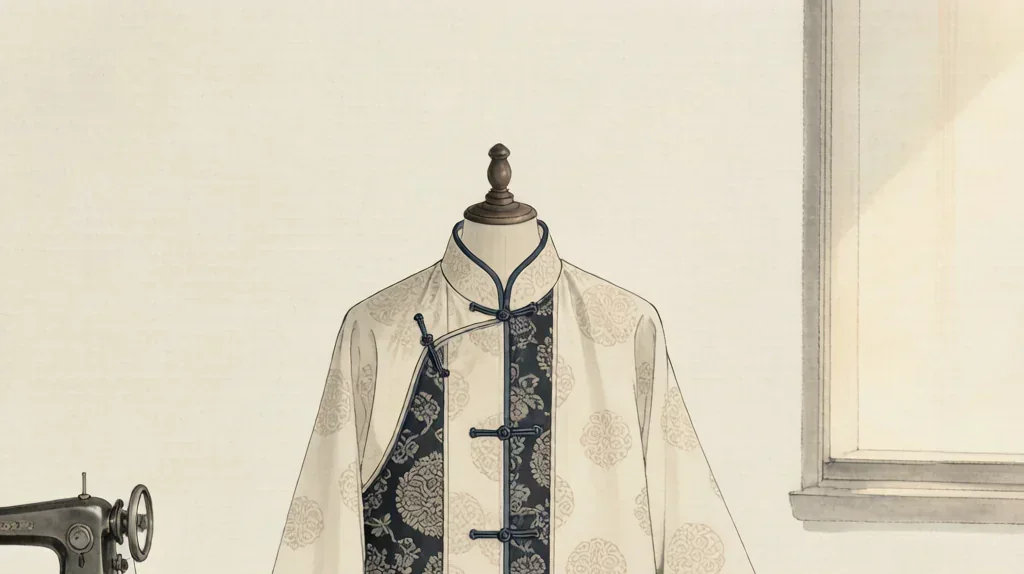
The Tang suit (唐装, tangzhuang) is one of the most recognizable symbols of Chinese cultural identity — a mandarin-collared jacket with distinctive knot-and-loop buttons (盘扣) that has become synonymous with Chinese formal wear. Despite its name, the garment has little direct connection to the Tang dynasty (618–907 CE): the term emerged among overseas Chinese communities, who referred to Chinatowns as "Tang People's Streets" (唐人街) and their traditional clothing as "Tang attire." The modern Tang suit is actually an evolution of the Manchu riding jacket (马褂, magua) of the Qing dynasty (1644–1912), transformed through Republican-era tailoring and 20th-century reinvention into a garment that represents Chinese heritage in the global imagination.
Origins: From Manchu Riding Jacket to Republican Fashion
The direct ancestor of the modern Tang suit is the magua, a short, front-opening jacket originally worn by Manchu horsemen during the early Qing dynasty. Made of sturdy fabrics and designed for ease of movement, the magua featured a standing collar, a straight front opening, and the distinctive knotted buttons known as pankou (盘扣) or "frog buttons." As the Manchu established their rule over China, the magua spread from military and court circles into broader elite fashion. By the 19th century, it had become standard formal wear for Chinese men, worn over a long gown (长袍, changpao). The garment's transformation from practical riding wear to formal attire illustrates the complex interplay of ethnic identity and fashion in imperial China: what began as a marker of Manchu identity became, over centuries, simply "Chinese."
The evolution from magua to Tang suit involved several key stylistic changes during the late Qing and Republican periods. The original magua had wide, horseshoe-shaped cuffs that could be turned down to cover the hands in cold weather, but these were gradually replaced by straight, tailored cuffs. The hemline was shortened from mid-thigh to waist length, creating a more practical and modern silhouette. The front closure evolved from simple fabric ties to the elaborate hand-tied pankou knots that would become the Tang suit's most distinctive feature. The collar, originally a low standing band, was raised and stiffened into the mandarin collar that frames the neck. These modifications were driven by both practical considerations and changing aesthetic preferences, as Chinese men increasingly encountered Western tailored clothing and sought a distinctively Chinese alternative that could hold its own alongside Western suits.
The Tang Suit in Overseas Chinese Communities
While the magua evolved within China, it was overseas Chinese communities that gave the garment its modern name and its global identity. Chinese emigrants who settled in Southeast Asia, the Americas, and Europe during the 19th and early 20th centuries brought their traditional clothing with them. In the new environments of Chinatowns across the world, the magua became a powerful symbol of cultural identity and continuity. It was worn during Chinese New Year celebrations, weddings, and community gatherings, serving as a visual reminder of the homeland left behind. The term "Tang suit" emerged in these diaspora communities, reflecting a sense of connection to the glorious Tang dynasty — a golden age of Chinese civilization often idealized by overseas Chinese. This naming choice was deliberate: by calling their clothing "Tang," diaspora communities asserted a cultural identity that transcended the political realities of the declining Qing dynasty and the tumultuous Republican period.
The garment's role in the diaspora was not merely nostalgic but also strategic. In countries where Chinese immigrants faced discrimination and pressures to assimilate, wearing traditional clothing became an act of cultural resistance. Community leaders donned Tang suits at public events to assert dignity and demand respect. In the United States, Chinese American organizations adopted the Tang suit as a uniform for official occasions, and photographs from the early 20th century show Chinese American community leaders wearing elaborately embroidered Tang suits alongside Western business attire. This dual wardrobe — switching between Western suits for professional life and Tang suits for cultural functions — became a metaphor for the bicultural experience of overseas Chinese, navigating between two worlds while maintaining a distinct identity. The Tang suit thus became not merely a garment but a portable homeland, a piece of China that could be worn anywhere in the world. Bush, Vladimir Putin, and Junichiro Koizumi — with matching Tang suits in vibrant colors. The image of the world's most powerful leaders standing together in traditional Chinese jackets was broadcast globally, sparking an immediate fashion craze. Suddenly, Tang suits appeared everywhere in China: at weddings, Lunar New Year celebrations, business functions, and even as everyday wear. Designers began experimenting with new fabrics (silk brocade, embroidered satin, even denim), colors (from classic red and gold to modern pastels and monochromes), and silhouettes (fitted women's versions, short-sleeved summer styles). The APEC moment transformed the Tang suit from a niche garment associated with elderly men and Chinatown nostalgia into a dynamic, contemporary fashion statement embraced by young Chinese as an expression of cultural pride.
The APEC summit's choice of the Tang suit was a deliberate act of cultural diplomacy. Chinese officials worked closely with Shanghai's master tailors for months before the summit, selecting the Song brocade fabric — a traditional silk weave from Suzhou that dates back over 1,000 years — and designing a jacket that balanced Chinese tradition with international formality. Each leader's jacket was individually tailored from measurements submitted by their embassies, ensuring a perfect fit regardless of body type. Bush), and gold for prosperity (worn by Vladimir Putin). The international media coverage of the summit generated an estimated $100 million in free publicity for Chinese textile and fashion industries, and within weeks of the summit, Tang suit factories in Shanghai and Suzhou were working around the clock to meet demand.
Design Elements and Symbolism
The classic Tang suit incorporates several distinctive design elements, each rich with cultural meaning. The standing mandarin collar (立领) is typically 3–5 centimeters high, framing the face and creating a dignified, upright silhouette. The pankou (frog buttons) are not merely fasteners but elaborate decorative knots, often made from the same silk cord as the garment's trim and hand-tied into intricate shapes — butterflies, flowers, and the endless knot (盘长) symbolizing longevity and continuity. The jacket is traditionally straight-cut with a front opening that fastens asymmetrically down the center or slightly to the side. Decorative motifs embroidered on Tang suits carry specific symbolism: dragons (龙) represent imperial power and masculine energy; phoenixes (凤) symbolize feminine grace and marital harmony; peonies (牡丹) signify wealth and honor; and the "shou" character (寿) wishes longevity. Color is equally meaningful — red (红) for celebration and good fortune, gold (金) for prosperity, black (黑) for formality, and blue (蓝) for scholarly refinement.
The fabrics used in Tang suit construction vary enormously in quality and cost, reflecting the garment's use across different social classes and occasions. The most luxurious Tang suits are made from Song brocade (Songjin), a silk tapestry weave that originated in Suzhou during the Song dynasty. Song brocade is characterized by its subtle color gradations and delicate geometric patterns, achieved through a complex weaving process that can take a single artisan several days to complete just a few centimeters of fabric. Yun brocade (Yunjin), from Nanjing, uses gold and silver threads woven through the silk, creating a fabric that shimmers with metallic light. For everyday Tang suits, cotton brocade, polyester blends, and velvet are common choices, offering durability and lower cost while maintaining the garment's distinctive appearance. The interior lining of a Tang suit is traditionally made of a contrasting fabric — often a lighter color or a finer weave — and careful tailors select linings that complement the outer fabric while providing comfort against the skin.
Contemporary Tang Suit Culture
Today, the Tang suit occupies a unique position in Chinese fashion. It is the default attire for Chinese New Year celebrations, wedding banquets (especially for the groom's father and other senior male relatives), and formal cultural events. International figures visiting China often don Tang suits as a diplomatic gesture of respect. The garment has also influenced global fashion: Western designers from Yves Saint Laurent to Ralph Lauren have incorporated mandarin collars and frog buttons into their collections, and the Tang suit's clean lines have resonated with minimalist aesthetics. A new generation of Chinese designers is reinterpreting the Tang suit, combining traditional tailoring with modern fabrics and cuts — cropped versions, deconstructed styles, and gender-fluid designs that challenge the garment's historically masculine associations. The Tang suit's journey from Qing riding jacket to global cultural icon demonstrates how clothing can carry memory, identity, and aspiration across centuries.