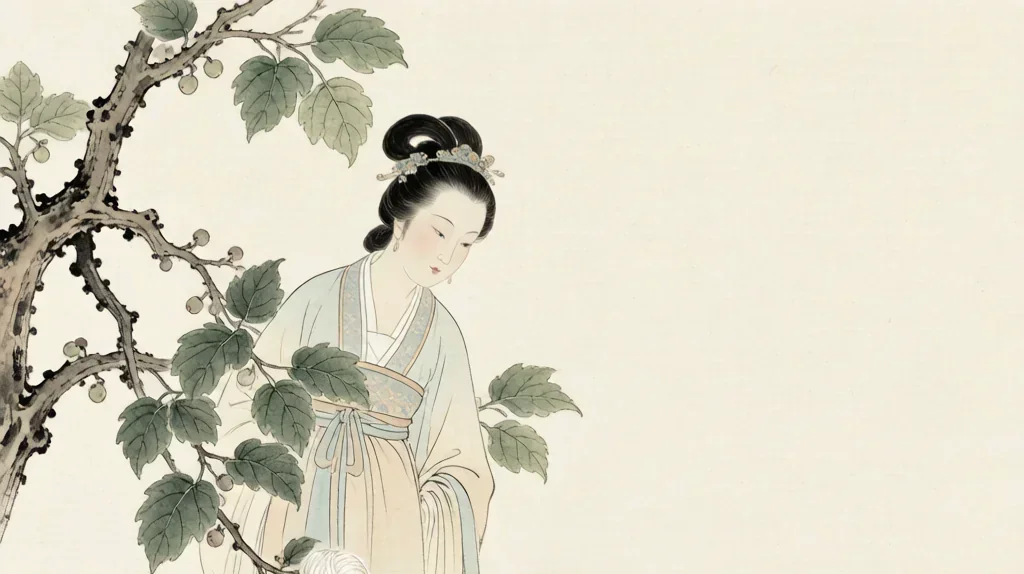
There is a Chinese legend that begins in a garden, with a cup of hot tea and a falling cocoon. The Empress Leizu (嫘祖), wife of the Yellow Emperor, was sitting beneath a mulberry tree when a silkworm cocoon dropped from the branches above and landed in her steaming tea. As she tried to fish it out, the cocoon began to unravel, and she found herself pulling a single, shimmering thread — impossibly fine, impossibly strong, impossibly beautiful. She had just discovered silk, and with it, she would change the course of human history.
Whether or not the tea story is true — and archaeologists have found silk fragments in China dating back to at least 3630 BCE, suggesting the discovery predates even the legendary Yellow Emperor — the Chinese monopoly on silk production would prove to be one of the most consequential technological secrets in world history. For over three thousand years, China alone knew how to make this luminous fabric, and the global hunger for silk would build empires, forge trade routes, and reshape civilizations across continents.
The Secret of Sericulture: A Technology Guarded for Millennia
The production of silk, known as sericulture (养蚕, yǎng cán), is one of humanity's most ingenious agricultural technologies. It begins with the domesticated silkworm, Bombyx mori, a creature so thoroughly shaped by human selection that it can no longer survive in the wild. The silkworm moth lays hundreds of tiny eggs, which hatch into larvae no larger than an eyelash. These larvae are fed a steady diet of fresh mulberry leaves, and over the course of about a month, they grow to ten thousand times their original weight, molting their skin four times as they expand.
When the silkworm is ready to pupate, it spins a cocoon around itself using a single continuous filament of silk — a thread that can stretch for over a kilometer in length. This is the miracle at the heart of sericulture: a single insect, no larger than a child's finger, produces a thread of extraordinary strength and luster from modified salivary glands. The cocoons are then heated to kill the pupae inside before they can emerge and break the filament, and the silk is carefully unreeled, several cocoons at a time, into the raw thread that will become fabric.
For millennia, the Chinese guarded the secrets of sericulture with extraordinary care. The penalty for smuggling silkworm eggs or mulberry seeds out of China was death, and the silk production process was treated as a state secret of the highest order. Foreigners who purchased Chinese silk had no idea how it was made — the Roman naturalist Pliny the Elder wrote that silk was combed from the leaves of trees, while other classical authors speculated that it grew like cotton or was harvested from giant spiders. The secrecy worked: China maintained a near-total monopoly on silk production until at least the sixth century CE.
The Silk Road: How a Fabric Connected the World
The name "Silk Road" (丝绸之路, sī chóu zhī lù) was coined by the German geographer Ferdinand von Richthofen in 1877, but the trade routes it describes had been carrying Chinese silk westward for over two thousand years by then. The Silk Road was not a single road but a sprawling network of caravan trails stretching over four thousand miles from the Chinese capital of Chang'an (modern Xi'an) through Central Asia, Persia, and the Middle East, finally reaching the Mediterranean and the markets of Rome.
Silk was the engine that drove this commerce. Roman aristocrats developed an insatiable appetite for Chinese silk, paying extraordinary prices — sometimes its weight in gold — for the shimmering fabric. The Roman Senate repeatedly tried to ban silk clothing, arguing that the fabric was indecently revealing and that the outflow of gold to the East was bankrupting the empire. The bans failed, of course. As the Roman moralist Seneca observed with exasperation, "I see silken clothes, if they can be called clothes, which can protect neither the body nor the modesty."
But the Silk Road carried more than fabric. Along with bolts of silk traveled ideas, religions, technologies, and diseases. Buddhism spread from India to China along the Silk Road, carried by monks and merchants who traveled the same routes as the silk caravans. Paper-making technology, gunpowder, and the compass — three of China's "Four Great Inventions" — made their way westward along these routes. The Silk Road was, in essence, the world's first great globalization project, and silk was its original currency.
The Many Faces of Silk: Types and Traditions
Not all silk is created equal, and Chinese sericulture developed an extraordinary range of silk types, each with its own characteristics and uses. The most luxurious variety is mulberry silk (桑蚕丝, sāng cán sī), produced by silkworms fed exclusively on mulberry leaves and prized for its uniform texture, natural luster, and the pure white color that takes dye brilliantly. This is the silk of imperial robes and haute couture.
Wild silk (野蚕丝, yě cán sī), also known as tussah silk, comes from silkworms that feed on oak and other leaves in the wild. The resulting fabric is coarser, less uniform, and naturally tan or beige in color, with a distinctive slubbed texture that some designers prize for its organic, earthy quality. Shantung silk, named for China's Shandong Province, is a type of wild silk with an especially pronounced texture that became popular in Western fashion during the mid-twentieth century.
Silk can be woven into an astonishing variety of fabrics. Silk satin (缎, duàn) has a glossy front surface and a dull back, making it ideal for formal wear. Silk chiffon is so light and transparent that it seems to float on air. Silk crepe has a crinkled, pebbled surface that drapes beautifully. Silk brocade (织锦, zhī jǐn) incorporates raised patterns woven directly into the fabric, often using gold and silver threads for the most luxurious examples. And silk velvet, with its dense, soft pile, has been prized for centuries as the ultimate fabric of luxury and power.
Silk in Chinese Culture: More Than Just Fabric
In Chinese culture, silk has always been more than a textile — it is a symbol of civilization itself. The Chinese character for silk, 丝 (sī), appears as a radical in hundreds of other characters related to textiles, binding, and connection. The Silk Road, in Chinese, is literally the "Road of Silk" — and the fabric's role as a connector of civilizations is embedded in the very language.
Silk also played a crucial role in the Chinese economy for millennia. Silk was used as currency, as tax payment, and as a store of value comparable to gold. During the Tang Dynasty, the government collected silk as tax from farmers and used it to pay officials' salaries. Silk bolts were standardized units of exchange, and the entire fiscal system of imperial China was, in a very real sense, woven from silk threads.
The fabric carried deep symbolic meanings as well. Silk was associated with purity, refinement, and moral cultivation — the smooth, unblemished surface of fine silk represented the ideal of a cultivated character. The phrase "衣锦还乡" (yī jǐn huán xiāng, "returning home in brocade robes") describes someone who has achieved success and returns to their hometown in glory. And the careful unwinding of a silkworm cocoon became a metaphor for patient, methodical work and the gradual revelation of hidden beauty.
Silk in Modern China: Tradition and Innovation
China remains the world's largest producer of silk, accounting for over seventy percent of global production. The provinces of Jiangsu, Zhejiang, and Sichuan are the historic heartlands of Chinese sericulture, and many rural families still practice the ancient cycle of raising silkworms each spring. The traditional sericulture regions around the Yangtze River Delta have been recognized by UNESCO for their cultural significance, preserving knowledge and techniques that stretch back thousands of years.
Yet Chinese silk production is far from a museum piece. Chinese scientists have mapped the silkworm genome, developed disease-resistant hybrids, and engineered silkworms that produce silk in colors without the need for dyeing. Researchers are exploring silk's potential in biomedical applications — silk proteins show promise for surgical sutures, tissue engineering, and drug delivery systems. The ancient fabric is finding new life in the laboratories of the twenty-first century.
For the rest of the world, Chinese silk continues to represent the pinnacle of textile luxury. The finest silk scarves, ties, and garments still come from the workshops of Suzhou and Hangzhou, where master weavers and dyers practice crafts passed down through generations. When you hold a piece of fine Chinese silk, you are holding more than fabric — you are holding the thread of a story that began in a legendary garden, traveled across deserts and mountains, built empires and connected civilizations, and continues to unfold with every passing year.
Silk as the Painter's Canvas
Silk was not only worn; it was written and painted on. The smooth, absorbent surface of thin silk called juan made it a favorite ground for portraits, Buddhist icons, and poetry scrolls for more than a thousand years. Because silk is stronger than paper when sized and mounted, important works could be hung, rolled, and re-hung for centuries without tearing. The same fiber that clothed an empress could therefore carry her portrait or a scholar's handwriting, so silk sits at the heart of both Chinese dress and Chinese art. A scroll and a robe, though used differently, began as the same thread from the same worm.
Dyes and the Color of Silk
Plain silk takes color brilliantly, which is why Chinese dyers built a deep vocabulary of plant and mineral dyes. Madder and sappanwood gave reds, indigo gave blues, gardenia and turmeric gave yellows, and overdyeing layered one hue upon another for richer tones. Certain colors carried rank or occasion, so the dye vat was almost as regulated as the loom. The famous brocades wove gold and silver thread directly into the cloth so the pattern shone without dye at all. To choose a silk was therefore to choose a color with social meaning, not merely a pretty shade.
Silk's Global Afterlife
Once the secret of sericulture left China around the sixth century, silk making spread to Byzantium, Persia, and later Europe, yet Chinese silk kept its prestige as the finest in the world. Italian and French weavers studied Chinese patterns and competed with imported bolts, and Chinese motifs such as dragons and peonies flowed into Western textile design. Today the workshops of Suzhou and Hangzhou still produce luxury silk that designers abroad seek out, so the fabric that once built empires now links China to a global fashion market. The road that carried silk outward has, in a sense, never closed.
❓ Frequently Asked Questions
📝 Chinese Vocabulary
- 丝绸 (sī chóu) — Silk; the luminous fabric produced from silkworm cocoons
- 养蚕 (yǎng cán) — Sericulture; the practice of raising silkworms for silk production
- 丝绸之路 (sī chóu zhī lù) — The Silk Road; the ancient trade network that carried Chinese silk to the West
- 嫘祖 (Léi Zǔ) — Leizu; the legendary empress credited with discovering silk and inventing the silk loom
- 衣锦还乡 (yī jǐn huán xiāng) — An idiom meaning "returning home in brocade robes," signifying a triumphant homecoming after achieving success
🎉 Fun Facts
- A single silkworm cocoon contains between 300 and 900 meters of continuous silk filament. It takes approximately 2,500 cocoons to produce one pound of raw silk.
- The secret of sericulture was finally smuggled out of China around 550 CE, reportedly by two Nestorian monks who hid silkworm eggs inside their hollow bamboo walking sticks and presented them to the Byzantine Emperor Justinian.
- Silk is stronger than steel of the same diameter — a single silk thread can support a weight of over 50 grams without breaking, and spider silk (a related protein fiber) has been studied for potential use in bulletproof vests.
- Silk's signature shimmer comes from the triangular shape of its fiber, which bends light at changing angles as the cloth moves.
- Chinese sericulture developed regional silkworm strains prized for the color and strength of their thread long before modern selective breeding.
- Tang dynasty court ladies wore layers of gossamer silk gauze so light that poets compared a whole robe to mist, a luxury that signaled both wealth and seasonal fashion.