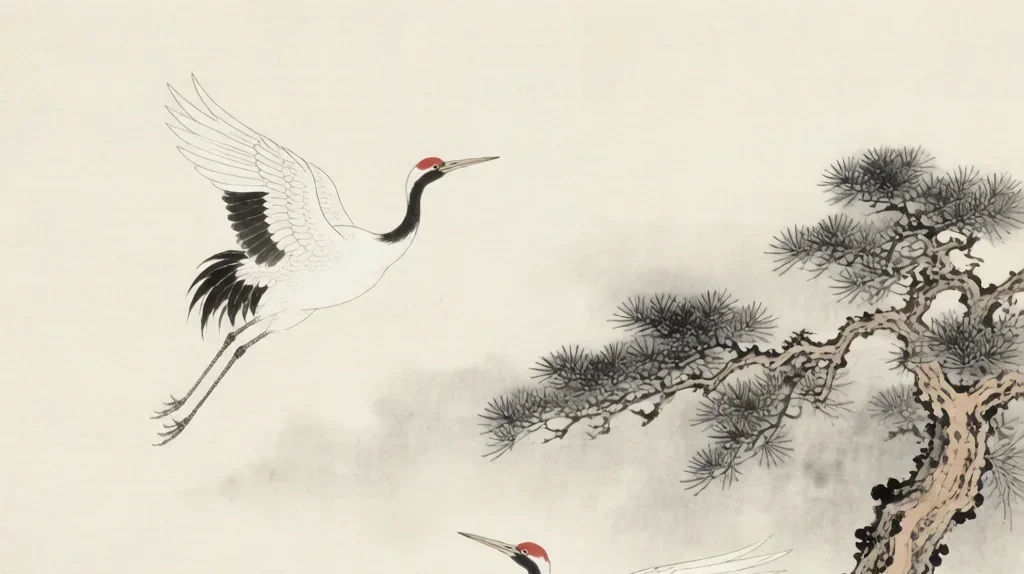
The crane (鹤, hè) is among the most revered birds in Chinese culture, a near-universal emblem of longevity, nobility, and spiritual transcendence. Its tall, white form and slow, deliberate movements suggested to classical observers a creature untouched by the ordinary decay of the world, and so the crane became the companion of immortals and the motif of birthday celebrations. Appearing on robes of the highest civil rank, in Daoist legend, and in countless paintings of pine and moon, the crane carries a wish for a long and dignified life. This article explores why a wading bird came to fly so high in the Chinese imagination.
The Crane as Emblem of Longevity
The crane's central meaning is long life. In folklore it is said to live for centuries, and pictures pair it with the pine (松, sōng), another longevity symbol, in the phrase 松鹤延年 (sōng hè yán nián, "pine and crane prolong the year"). Such images dominate birthday gifts for the elderly.
Unlike the peach of immortality or the elixir, the crane offers longevity through temperament: its calm, unhurried grace is presented as a model. To wish someone "crane longevity" is to wish not just years but composure within them.
The Crane and the Immortals
In Daoist mythology the crane is the mount or messenger of the immortals (仙人, xiānrén), carrying souls to the realms beyond or bearing the perfected ones through the clouds. A "crane rider" (鹤驭) became a poetic euphemism for death as transcendence rather than loss.
Taoist adepts kept cranes in monastery gardens and identified with the bird's detachment. The crane thus bridges the human and the celestial: a real animal that, by its bearing, seems already halfway to immortality.
Rank Badge of the First-Order Civil Official
Under the Qing dynasty's uniform system, the first-rank civil official wore a crane on his rank badge (补子, bǔzi), the highest bird insignia. This cemented the crane as a symbol of the most exalted scholarly service.
The choice reflected the crane's associations with refinement and long service; a senior minister "of crane rank" embodied the ideal of the cultivated statesman. The badge system made the bird's honor literal and visible on the body of the state.
Crane in Painting and Poetry
From the Tang onward, poets such as the "Eight Immortals of the Wine Cup" circle and painters of the literati tradition used the crane to signal lofty solitude. A lone crane over a moonlit river became a standard image of the unworldly scholar.
In bird-and-flower painting the crane is rendered with meticulous feather work, often beside water, pine, or rock. The composition is less about the bird's biology than its character—stillness, height, and age—making it a portrait of a virtue.
The Red-Crowned Crane
The red-crowned crane (丹顶鹤, dān dǐng hè), with its black neck and red cap, is the species most celebrated and the one depicted in art. It is among the rarest and most striking of cranes, native to northeastern Asia's wetlands.
Its Japanese name "tancho" and its status as a symbol across East Asia show the crane's shared cultural weight. In China the red crown adds a note of auspiciousness, the vermilion echoing festival color against the white body.
Crane Motifs in Decorative Arts
Beyond painting, the crane appears on lacquerware, cloisonné, embroidery, and porcelain, often in flight or dancing. Birthday scrolls and screens for the aged routinely feature a pair or a flock of cranes circling a pine.
The "thousand-crane" (千鹤) motif, folding cranes or repeating the image, extends the wish multiplicatively. Whether on a court robe or a grandmother's birthday banner, the form is consistent: white, long-necked, serene.
Crane and Turtle: Longevity Pair
The crane is frequently paired with the turtle (龟, guī), another long-lived creature, to double the longevity wish. Together they appear on birthday presents and on the carved rails of gardens and tombs.
Where the crane represents the soaring, spiritual pole of long life, the turtle represents its grounded, enduring pole. The pair balances aspiration and persistence, a neat summary of how the culture imagines a good long life.
Modern Symbolism
Today the crane remains a go-to symbol for longevity in Chinese greeting cards, especially at eightieth and ninetieth birthdays. Its image also appears in conservation messaging, as the red-crowned crane is endangered and beloved.
In diaspora communities the crane retains its meaning and gains new layers from the Japanese paper-crane peace tradition, yet in Chinese contexts it stays firmly a creature of long life and high character rather than a generic peace symbol.
Crane in Folk Celebration
Beyond elite painting, the crane animates folk performance. Crane-dance troupes in parts of north China wear white framed costumes with long necks, mimicking the bird's deliberate steps at temple fairs and harvest celebrations, carrying the longevity wish into the street.
Paper and cloth crane effigies also appear in community birthday pageants for the aged, where neighbors process with the bird to honor a long-lived member. The crane thus moves from scroll to sidewalk, its blessing shared collectively rather than kept private.
The Crane and Literati Identity
For the scholar-official, the crane modeled retirement with dignity. Poems imagine the aged official releasing a crane as he leaves office, the bird's freedom mirroring his own release from duty's cage.
This image made the crane a token of integrity: to keep cranes in one's garden was to declare oneself above petty ambition. The bird's long life thus also meant a long, unhurried freedom—the true reward of a principled career.
Crane Imagery in Daily Objects
Beyond scrolls, the crane appears on teapots, fans, and hairpins, carrying its wish into ordinary moments. A grandmother's crane-patterned blanket is both warmth and blessing, the symbol working quietly at home.
Such diffusion shows the crane is not only a high-cultural icon but a household familiar. Its white form recurs wherever Chinese families mark a long life worth celebrating, from the imperial robe to the humble birthday cup.
❓ Frequently Asked Questions
What does the crane symbolize in China?
The crane (鹤) primarily symbolizes longevity, nobility, and spiritual transcendence, and is a standard motif on birthday gifts for the elderly.
Why is the crane linked to immortals?
In Daoist myth the crane is the mount or messenger of the immortals, and "crane-rider" became a euphemism for a transcendent passing rather than ordinary death.
Which officials wore the crane badge?
Under the Qing dynasty, the first-rank civil official wore a crane on his rank badge (补子), the highest bird insignia of scholarly service.
What is 松鹤延年?
It means "pine and crane prolong the year," a common birthday image pairing two longevity symbols to wish a long, dignified life.
Which crane species is most depicted?
The red-crowned crane (丹顶鹤), with its black neck and red cap, is the celebrated species shown in painting and porcelain.
How is the crane used today?
It remains a longevity symbol on greeting cards and conservation emblem, while retaining its classical meaning of long life and high character in Chinese contexts.