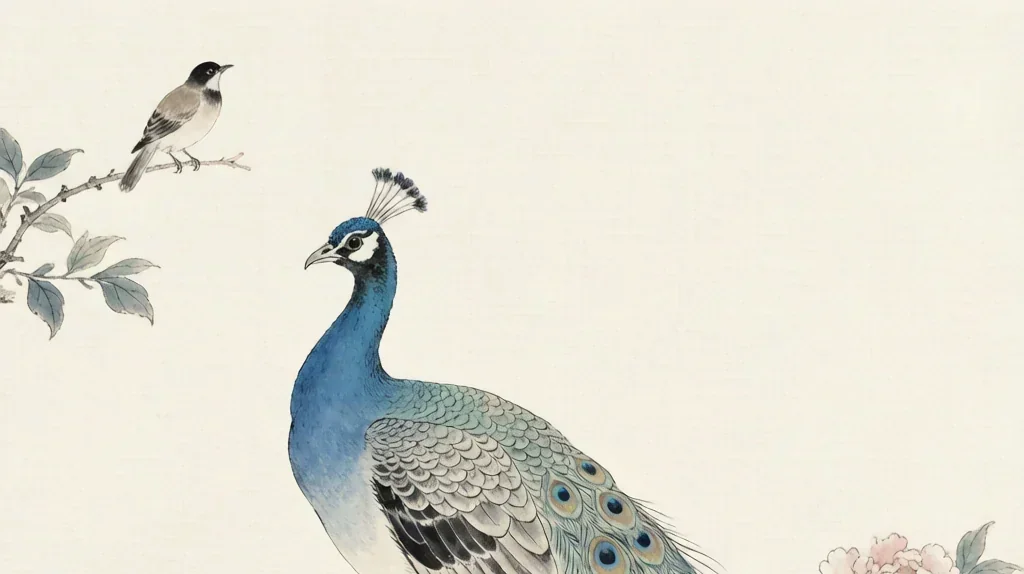
The peacock (孔雀, kǒngquè) occupies a distinctive niche in Chinese symbolism: a creature of dazzling beauty associated with dignity, nobility, and the brilliant display of talent. Though not native in the same deep-mythic sense as the dragon or phoenix, the peacock entered Chinese art and official culture through tribute and trade, eventually earning a place on rank badges, in court painting, and in folk embroidery. Its fanned tail of "eye" plumes reads as a symbol of discernment and protection, while its stately gait conveys aristocratic grace. This article follows the peacock from exotic import to emblem of honor in Chinese visual culture.
Arrival and Early Reception
Peacocks reached China from the south and southwest, including regions bordering present-day Yunnan and beyond into Southeast Asia and the Indian subcontinent. Historical tribute missions to imperial courts sometimes presented live peacocks, prized as wonders of the natural world.
By the Tang dynasty the bird appears in poetry and painting as an object of admiration for its plumage. Its exotic origin added to its prestige; to own or depict a peacock was to signal access to the wider world of tribute and luxury that surrounded the cosmopolitan Tang court.
The Peacock in Court Ranking
In the Qing dynasty, insignia for military officials included the peacock feather (花翎, huālíng), a plume awarded for merit and worn in the hat. The number and type of "eyes" on the feather marked levels of imperial favor, making the peacock literally a badge of distinction.
Civil officials used the crane, but the peacock's feather was a coveted military honor, conferred rather than inherited. To receive a peacock-feather award was a high recognition, and the bird thus became tied to state service and loyalty in the popular imagination.
The "Hundred Birds" Tradition
In Chinese decorative art the peacock often appears as the elegant centerpiece of a "hundred birds paying homage to the phoenix" (百鸟朝凤) composition, or surrounded by flowering branches. Its role is to embody refined beauty among the avian court.
Such scenes decorated screens, wedding chests, and official robes, where the peacock's splendor reinforced themes of harmony and prosperous rule. The bird's display becomes a metaphor for a well-ordered court in which talent is recognized and displayed.
Plumage and the "Eye" Symbol
The eye-spots on a peacock's train are read in Chinese symbolism as emblems of watchfulness and protection, sometimes linked to the "evil-warding eye." A fan of plumes suggests an all-seeing, guarding presence within the home.
Folk embroidery uses the tail feathers as a motif of beauty and good fortune, and the phrase 孔雀开屏 (kǒngquè kāipíng, "peacock spreads its tail") describes a sudden, glorious display—used figuratively of someone showing their finest abilities.
Peacock in Painting and Porcelain
Literati painters treated the peacock as a challenge of color and pattern, rendering its iridescent train with mineral pigments. It appears in both courtly and commercial painting, often paired with peonies to combine "king of flowers" with "king of birds" in a wealth-and-honor image.
On porcelain, especially export wares, the peacock was a favorite subject, its exotic appeal translating well to European markets. Domestic blue-and-white and famille-rose pieces also featured it, cementing the bird as a staple of decorative repertory.
Folklore and Anecdote
One well-known anecdote credits the peacock with "a hundred eyes but little brain," a rustic joke about beauty without wisdom, showing the bird was also fair game for humor. Yet more often it appears as a positive figure of grace.
In some regional tales the peacock is a messenger or a transformed maiden, echoing the widespread East Asian motif of bird-women. These stories add a tender, slightly magical layer to an otherwise courtly symbol.
Peacock vs Phoenix
The peacock is sometimes confused with the phoenix (凤凰, fènghuáng) because both are splendid tail-bearing birds, but they differ: the phoenix is a mythical composite creature of benevolent rule, while the peacock is a real bird elevated by beauty and rank.
Artists distinguish them by context—the phoenix pairs with the dragon in imperial weddings, the peacock with peonies in honor-and-wealth scenes. Knowing the difference prevents misreading a courtly badge as a cosmic omen.
Modern Decorative Use
Today the peacock remains a popular motif in Chinese interior design, fabric, and jewelry, valued for color and elegance rather than strict rank. Its image signals sophistication and a touch of traditional luxury.
Wedding and festival decor sometimes use stylized peacocks for their beauty, detached from the Qing military honor but retaining the aura of distinction. The bird's long cultural climb from tribute curiosity to household elegance is now complete.
Peacock in Embroidery and Textiles
The peacock's plumage made it a favorite of textile artists, who rendered its tail in satin stitch and couched gold thread on robes, bed curtains, and festival hangings. The difficulty of capturing the eye-spots honestly marked a skilled embroiderer, turning the bird into a test of craft.
On women's wedding attire the peacock sometimes replaced the phoenix among families who prized its real, visible splendor over myth. The motif signified that the wearer moved in a sphere of honor and refinement, her presence itself a kind of display worthy of the "king of birds."
Peacock as a Diplomatic Gift
Because of its rarity and splendor, the peacock was offered as tribute between courts, a living emblem of goodwill. Such exchanges elevated the bird from pet to political token, its beauty doing quiet diplomatic work.
Accounts of foreign envoys presenting peacocks survive in official histories, noting the marvel they caused at court. The bird's journey—from southern wilderness to imperial garden—mirrors the wider flow of tribute that knit the region's courts together.
Peacock in Garden Design
Strolling gardens of the south sometimes kept peacocks for their living color, the bird's display animating a静 (jìng, still) scene with sudden movement. The contrast of motion and calm suited the garden's philosophy of varied contemplation.
A peacock wandering a Suzhou court became a small spectacle for guests, blending zoological wonder with ornamental intent. The bird's presence turned the garden into a stage where nature performed the very splendor the paintings only suggested.
❓ Frequently Asked Questions
What does the peacock symbolize in China?
The peacock stands for dignity, nobility, and the brilliant display of talent, and its "eye" plumes suggest watchfulness and protection.
How was the peacock used in imperial ranking?
In the Qing dynasty, military officials wore a peacock-feather (花翎) in the hat, its eye-spots marking levels of imperial merit and favor.
Is the peacock the same as the phoenix?
No—the phoenix (凤凰) is a mythical composite bird of benevolent rule, while the peacock is a real bird elevated by beauty and court rank.
What does 孔雀开屏 mean?
It literally means "peacock spreads its tail" and figuratively describes someone displaying their finest abilities or splendor.
Why is the peacock paired with peonies?
The pairing combines the "king of birds" with the "king of flowers" to express honor, wealth, and prosperity in decorative art.
Where does the peacock appear in art?
It features in court and literati painting, porcelain (including export wares), embroidery, and "hundred birds" compositions as a symbol of refined beauty.