Incense, xiang (香), has perfumed Chinese life for more than two thousand years. More than a pleasant scent, it has been a bridge between the human and the divine, a tool of meditation, a marker of hospitality, a medicine, and a refined leisure pursuit of the educated elite. From Han dynasty博山 censers shaped like trembling mountains to the quiet "listening to incense" gatherings of Ming and Qing scholars, the burning of aromatic wood and herbs became one of the most cultivated arts of Chinese civilization, enshrined as one of the "four arts of the scholar" alongside qin music, calligraphy, and painting.
Early Origins and the Silk Roads
Aromatic substances entered China early, but the widespread use of incense accelerated with trade along the Silk Roads and maritime routes, which brought frankincense, sandalwood, and other resins from distant lands.
By the Han dynasty, imperial workshops cast elaborate censers, the most famous being the "hill-censer" (boshan lu) whose lid mimicked a mist-wreathed sacred mountain, with smoke rising through its peaks like clouds.
Incense thus arrived wrapped in cosmology: the censer was a miniature holy mountain, and its ascending smoke a visible prayer riding upward to the realm of the immortals.
Incense in Religion and Ritual
In both Daoist and Buddhist practice, burning incense is a basic offering, its fragrance carried upward as a sign of respect and a means of purifying a space. Temples have always been defined by their scent.
The "three incense" offered before an altar typically stands for body, speech, and mind, or for the Buddha, Dharma, and Sangha in Buddhist contexts, a simple gesture rich with meaning.
Ancestor halls in family homes kept a censer lit before the tablets, binding the daily act of lighting incense to filial devotion and the continuity of the lineage.
The Scholar's Art of Incense
During the Song, Ming, and Qing periods, incense appreciation became a gentlemanly pastime. Connoisseurs learned to blend and identify aromatic woods, especially chenxiang (agarwood), by scent alone.
The "four arts of the scholar" — qin, chess, calligraphy, painting — are often paired in discourse with the "three friends" of incense, tea, and painting, showing how central fragrance was to refined leisure.
"Listening to incense" (ting xiang) meant sitting quietly as a sliver of wood smoldered, attending to the changing notes of its smoke as one might attend to music, a training in patience and subtle perception.
Materials and Famous Aromatics
Agarwood, formed when aquilaria trees become infected and resistant, is the most prized incense material in the Chinese tradition, valued for its deep, complex, and long-lasting fragrance.
Sandalwood, clove, camphor, and various herb-and-resin blends round out the perfumer's palette, each with its own associations and proper occasion for use.
Incense came in several forms: coiled and stick incense for daily worship, and compressed "incense cakes" or powdered blends sprinkled over charcoal for the connoisseur's slow burn.
Incense Burners and Implements
The censer (lu) is the central implement, ranging from massive bronze temple braziers to tiny handheld warmers tucked in a sleeve to scent a room or a robe. Material signalled status and taste.
The scholar's incense set might include a burner, a box for the aromatic, tiny tweezers, and a "incense attendant" scoop, objects themselves often fine works of art in jade, cloisonné, or lacquer.
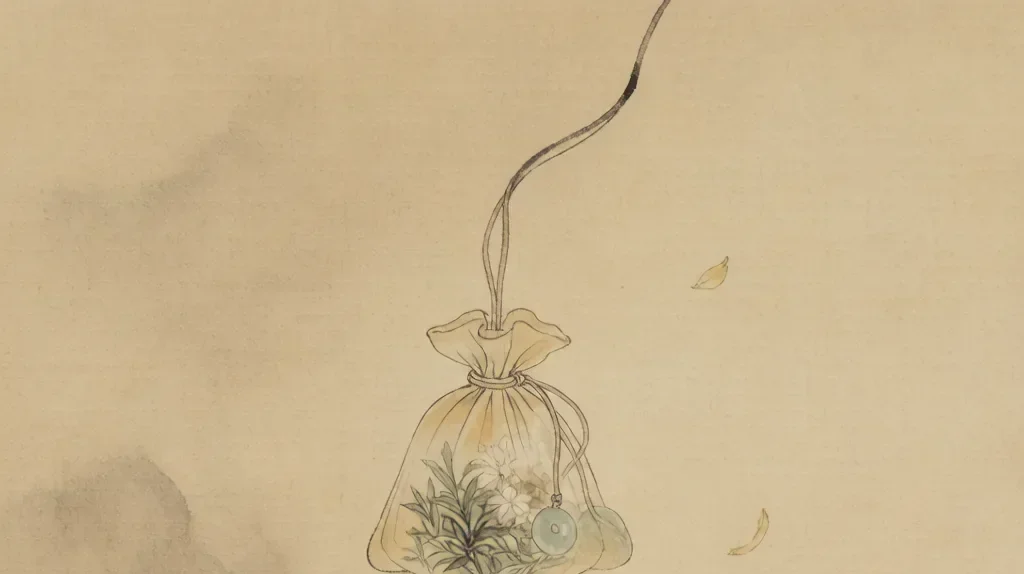
Miniature travel censers let a gentleman carry fragrance with him, and scented sachets (xiang nang) worn on the body extended the art from the room into the street.
Incense in Medicine and Daily Life
Traditional pharmacology classified many aromatics as warming, moving, and clarifying, used to "open the orifices," calm the spirit, and repel insects and dampness in the sickroom and the home.
Mosquito-coil-like incense and scented mats protected households in summer, while sachets of aromatic herbs were tied to children at the Dragon Boat Festival to ward off pests and illness.
The boundary between medicine, protection, and pleasure was fluid: the same substance might perfume a robe, cure a headache, and drive away a mosquito.
Incense and Timekeeping
Before mechanical clocks were common, coiled and calibrated incense sticks served as timers. A slowly burning stick marked the hours of night for scholars, monks, and watchmen alike.
Special "incense clocks" embedded markers in a long coil so that, as the burn reached each marker, a small weight dropped to chime the passage of time, marrying scent and measurement.
The poet who "burned an incense stick" to mark a stretch of reading or meditation left a record not only of fragrance but of the quiet architecture of the day.
Incense in Poetry and Emotion
Classical poetry returns again and again to incense: a lone burner in an empty hall, the scent of a departed lover's sachet, the late-night study lit by a single censer's glow.
The rising and vanishing smoke became a natural image for the fleetingness of life and the dissolution of desire, a motif Buddhist and Daoist poets exploited with restraint.
Because its presence was invisible yet palpable, incense suited the Chinese taste for suggestion, an experience felt more than seen.
Regional and Modern Practice
Temple incense remains a living custom across China and the Chinese diaspora, with visitors lighting sticks at New Year and on anniversaries to seek blessing and remember the dead.
Modern "incense roads" at popular pilgrimage sites sell every grade of stick and coil, and the connoisseur's appreciation of agarwood has revived among collectors interested in traditional material culture.
Whether in a village temple or a minimalist urban apartment, the simple act of lighting incense still carries a weight of continuity with two millennia of Chinese sensory and spiritual life.
❓ Frequently Asked Questions
Why is incense important in Chinese culture?
It serves as an offering to deities and ancestors, a tool of meditation, a mark of hospitality, a medicine, and a refined leisure art, bridging the human and the divine for over two millennia.
What is the "hill-censer"?
A Han dynasty censer whose lid is shaped like a mist-wreathed sacred mountain, with smoke rising through its peaks like clouds, turning the burner into a miniature holy mountain.
What is "listening to incense"?
A scholar's contemplative practice of sitting quietly as a sliver of aromatic wood smolders, attending to the changing notes of its smoke as one would attend to music.
How was incense used to tell time?
Calibrated coiled or stick incense burned at a known rate to mark hours at night, and some "incense clocks" dropped a weight at markers as the burn reached them.
What is the most prized incense material?
Agarwood, or chenxiang, a fragrant resin formed when aquilaria trees become infected, valued for its deep, complex, and long-lasting scent.
Is incense still used today?
Yes, temple incense remains a living custom for blessing and remembrance, and connoisseur appreciation of fine aromatics like agarwood has revived among collectors.