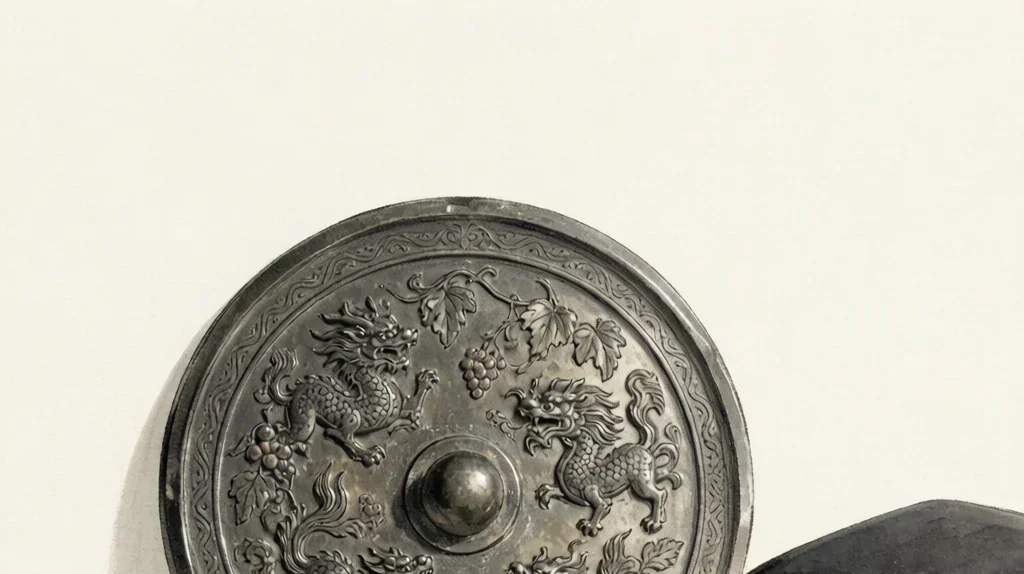
The Chinese bronze mirror, tongjing (铜镜), is far more than a polished disc for checking one's appearance. Produced continuously for over three thousand years, from the Shang and Zhou dynasties into the early modern period, the bronze mirror was a precision-cast object of daily grooming, a medium of art and belief, and a potent apotropaic instrument thought to reveal and repel unseen forces. Its back, typically decorated with cosmic diagrams, auspicious beasts, and inscriptions, makes the mirror one of the richest sources we have for the visual and spiritual imagination of pre-modern China.
Casting and Manufacture
Chinese bronze mirrors were not forged by smiths at an anvil but cast in piece molds, usually from an alloy of copper and tin that could be polished to a bright, reflective face. The back was designed with the decorative relief already in the mold.
Because the reflecting surface faced outward from a solid cast disc, mirrors were typically backed rather than framed, with a central boss and loop through which a cord could be threaded for hanging or handling.
The quality of the alloy and the fineness of the polish determined a mirror's usefulness, and workshops in different eras developed recognizable regional and dynastic styles that archaeologists now use to date tombs.
Early Mirrors of the Shang and Zhou
The earliest recognizable bronze mirrors appear in late Shang and Western Zhou contexts, small and simply decorated compared with later masterpieces. They were luxury items, probably confined to elites.
These early mirrors often bear geometric bands and simplified beast masks, linking them visually to other bronze ritual vessels of the period and marking them as objects of status as much as utility.
Their rarity in excavated contexts suggests that, at first, the mirror was both a precious good and a ritual-adjacent object rather than a household commonplace.
The Han Dynasty Flourishing
During the Han dynasty the bronze mirror became widespread, with standardized sizes, richer iconography, and inscribed wishes for longevity and protection. This is when the mirror entered ordinary elite domestic life.
Popular Han designs include the "four deities" (azure dragon, white tiger, vermilion bird, black tortoise) and the "TLV" pattern, whose enigmatic markings many scholars link to ancient cosmology and the board game of liubo.
Inscriptions on Han backs often read as blessings: wishes for long life, for the mirror to shine like the sun and moon, and for it to guard the household against evil.
Cosmic Symbolism on the Reverse
The mirror's round face naturally invited comparison with heaven, while its flat back with central boss suggested the axis of the world. Many backs map a miniature cosmos of cardinal directions, constellations, and cyclical time.
The "TLV" motifs, knotted clouds, and directional animals turn the mirror into a handheld model of the universe, an object that literally reflects the macrocosm when held up to the sky.
This cosmic framing is why mirrors were buried with the dead: a universe-in-miniature could accompany the soul and help orient it in the afterlife.
Mirrors as Protectors Against Evil
A core folk belief holds that a mirror reflects not only the face but hostile ghosts and malign influences, which cannot bear to see their own image and flee. The polished disc thus became a ward.
Mirrors were placed above doors, buried at thresholds, and hung in rooms to deflect wandering spirits. The custom survives today in the practice of hanging a mirror to "send back" bad energy at a gateway.
In fiction and legend, fox-spirits and other shape-shifters are revealed by a mirror's undeceived surface, which shows their true bestial form. The mirror is thus an instrument of truth against illusion.
The Mirror in Daoist and Buddhist Lore
Daoist adepts used mirrors in visualization and exorcism, believing a bright mirror could concentrate cosmic light and dissolve demonic forms. Some rituals involved "illuminating" a space with a mirror.
Buddhist lore contributed the idea of the "mirror mind," clear and unstained, a metaphor for enlightened awareness that reflects phenomena without attachment. This spiritualized the object's reflective nature.
Tales of "magic mirrors" that show distant events or hidden truths belong to a long literary tradition that treated the bronze disc as a threshold between visible and invisible worlds.
Mirrors in Daily and Romantic Life
Among the living, the mirror was an intimate grooming object and, in poetry, a poignant image of time: a woman noting silver strands before her mirror, or a traveler far from home.
Mirrors were common love gifts and were sometimes broken in two as tokens of parting, each lover keeping half against reunion, a practice echoing the gift of divided keepsakes.
The mirror's place on the dressing table made it a quiet witness to private life, and its shine a measure of youth and change in countless classical poems.
Later Dynasties and the Arrival of Glass
Tang mirrors are celebrated for their size, technical brilliance, and exuberant designs of flying apsaras, grapes, and foreign-influenced motifs carried along the Silk Roads.
Song and later workshops produced more restrained, elegant patterns and a flourishing of inscribed "scholar" mirrors with landscapes and literary lines suited to the desk.
From the Ming period onward, imported glass mirrors gradually displaced bronze for everyday use, and the cast bronze mirror became chiefly an antique, a ritual item, and a collector's curio.
Archaeology and Continuing Discovery
Bronze mirrors are among the most common fine objects recovered from Chinese tombs, and their stylistic evolution gives archaeologists a precise chronological tool across regions and dynasties.
Their inscriptions preserve ancient pronunciation, personal names, and popular wishes otherwise lost, making them valuable linguistic as well as art-historical evidence.
Museums worldwide now display Chinese bronze mirrors as both artworks and documents, their worn faces still catching the light after two or three thousand years.
Legacy in Symbol and Superstition
The belief in the mirror as a spiritual shield survived the shift to glass. Placing a mirror opposite a door, or carrying a small mirror as protection, continues a logic first encoded on bronze backs.
The mirror also lives in language: to "look into a mirror" is to examine oneself, and the "mirror of history" reflects the past for the present, metaphors rooted in the object's old authority.
From a Shang noble's toilette to a village doorway warding off ghosts, the Chinese bronze mirror remains a small, shining hinge between the practical and the supernatural.
❓ Frequently Asked Questions
How were Chinese bronze mirrors made?
They were cast in piece molds from a copper-tin alloy, with the decorative back formed in the mold and the front polished to a reflective shine. They were not forged at an anvil.
Why was the mirror considered protective?
Folk belief held that a mirror reflects and repels hostile ghosts and malign influences, which flee from their own image. Mirrors were hung at doors and thresholds to ward off spirits.
What is a TLV mirror?
A Han-dynasty mirror type marked by T, L, and V shaped lines, often linked by scholars to ancient cosmology and the board game liubo, and frequently inscribed with protective wishes.
Why were mirrors buried with the dead?
The round face and cosmic back made the mirror a miniature universe that could accompany and orient the soul in the afterlife, reflecting the macrocosm above.
When did bronze mirrors stop being used?
Glass mirrors introduced from abroad gradually replaced bronze for daily grooming from the Ming period onward, after which bronze mirrors became antiques and ritual items.
What did mirror inscriptions say?
They typically wished for long life, compared the mirror's shine to sun and moon, and asked it to guard the household, preserving popular blessings and even ancient pronunciation.