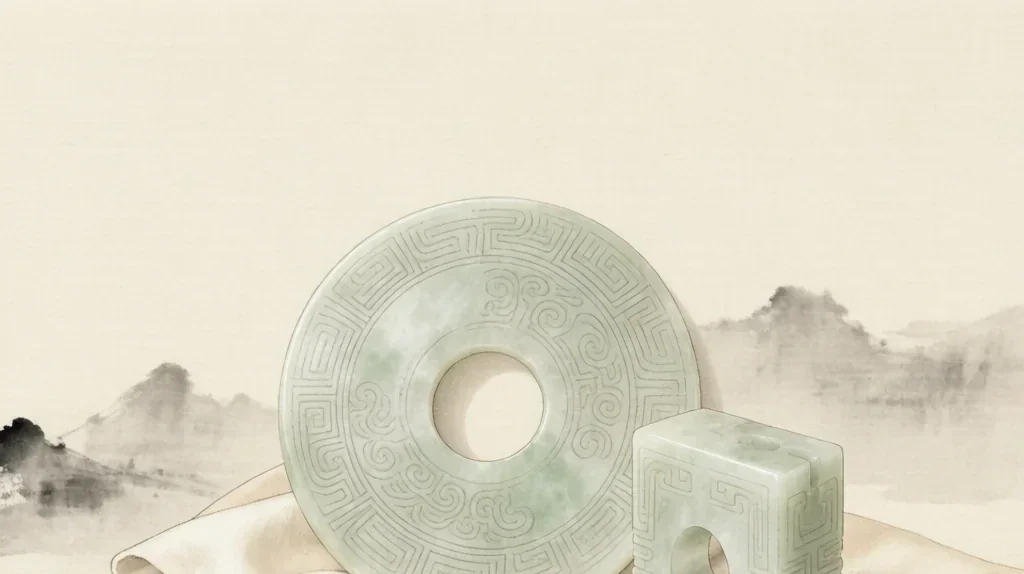
Jade culture, yu wenhua (玉文化), is one of the defining threads of Chinese civilization. For more than five thousand years the Chinese have treasured jade above almost any other material, not as a mere gem but as a substance imbued with moral, spiritual, and political meaning. The stone that is "more beautiful than any other, yet softer than metal" became a metaphor for the ideal gentleman, a medium for ritual communion with heaven and ancestors, and a portable emblem of rank and virtue. To understand China, many scholars argue, one must understand its enduring love of jade.
What Counts as Jade
In the Chinese tradition "yu" is a broad term covering several tough, fine-grained stones, principally nephrite and, from later periods, jadelite (jadeite). Both are valued for their smoothness, translucence, and subtle color.
Nephrite, a calcium magnesium silicate, was the jade of antiquity and imperial China, ranging from creamy white ("mutton-fat" jade) to deep green. Jadeite, harder and more vividly colored, entered from Burma in the later imperial era.
Crucially, Chinese jade is prized less for sparkle than for "warmth," a greasy, soft glow that connoisseurs read as the stone's living quality, distinguishing it from cold, flashing gemstones.
Neolithic Roots: Liangzhu and Hongshan
Some of the earliest jade objects come from the Liangzhu culture of the lower Yangtze, whose people carved elaborate cong (square tubes with circular bore) and bi (flat discs), likely used in ritual.
To the north, the Hongshan culture produced jade "pig-dragons" and curved ornaments, showing that jade's sacred and decorative roles were established millennia before written records.
The sheer labor of grinding jade with abrasive sand, without metal tools hard enough to cut it, tells us how valued these objects were: a single piece could take a craftsman years.
Jade in the Bronze Age Ritual Order
By the Shang and Zhou dynasties, jade was woven into the state ritual system. The bi disc was associated with heaven, the cong tube with earth, and together they structured sacrifices to the cosmos.
The Confucian-era "Rites of Zhou" describes a set of jade tablets of different shapes carried by officials to audiences, so that jade literally encoded the hierarchy of the court.
Buried jade suits, made of thousands of stitched plaques, were placed on elite corpses in the Han dynasty in the hope that jade would preserve the body from decay, a belief in the stone's protective power.
The Gentleman and the Virtues of Jade
Confucius and later moralists compared the gentleman to jade. The Book of Rites attributes specific virtues to its qualities: benevolence to its luster, wisdom to its clarity, righteousness to its angles that do not wound.
To "wear jade" (pei yu) was thus a daily ethical exercise; a gentleman's girdle pendant of jade rang softly as he walked, a sound meant to remind him of measured, courteous conduct.
This moral symbolism is why jade, not gold, was the truly noble material in the Chinese imagination: gold signaled wealth, but jade signaled character.
Jade as Rank and Authority
Imperial China used jade to mark supreme authority. The fabled "Heirloom Seal of the Realm," carved from a famous jade, was believed to legitimize whoever held it as true emperor.
Officials' rank badges and certain ceremonial objects incorporated jade, and the emperor's sacrificial vessels and personal seals were often of finest nephrite, setting the throne apart in stone.
Because jade was controlled, gifted, and inherited within elite circles, it also functioned as a store of value and a token of political trust across generations.
Carving Techniques and Forms
Jade is carved by abrasion, not cutting: artisans rotate drills and sweep gritty slurry against the stone, a slow process that rewards patience and planning. Openwork and undercutting display great skill.
Classic forms include the ruyi scepter, the gourd, the lotus, and the "mountain" paperweight carved in relief, as well as figurines of immortals, boys, and beasts conveying blessings.
The "assignment of form to substance" — letting the stone's natural color patches suggest a scene, such as a brown stain becoming a bird — is a prized artistry called "using the flaws."
Jade in Daily and Romantic Life
Beyond ritual, jade adorned the body as hairpins, bracelets, and pendant rings, and was given between lovers as a token of constancy, since jade does not tarnish or fade.
A jade bangle worn by a woman could mark her marital status or simply accompany her through life as a protective and beautiful object, often passed from mother to daughter.
Small jade "thumb rings" and toggle ornaments rounded out a culture in which nearly everyone, not only the elite, might own and cherish a piece of jade.
Jade in Language and Belief
The word yu appears in countless auspicious phrases: "jade body" for a respected person, "jade words" for precious advice, and "gold and jade" for a happy, intact marriage.
To "return jade intact" (wen run guo jia, often from the story of a man who protected a jade disc through peril) became an idiom of loyal safekeeping, the stone a stand-in for trust itself.
Folk belief also held that jade could absorb harm and even, in extreme tales, shed blood if its owner were in danger, a magical extension of its protective reputation.
Jade Today
Jade remains profoundly popular in China and among overseas Chinese, who buy bangles, pendants, and carvings both for beauty and as a living link to ancestral culture.
Myanmar jadeite commands high prices at auction, and fine nephrite from Hetian in Xinjiang is still sought as the "true" imperial stone, linking today's market to ancient sources.
Whether as a grandmother's bangle, a scholar's brush-rest, or a museum's ritual cong, jade still carries the long Chinese conviction that some stones are not merely pretty but good.
❓ Frequently Asked Questions
Q: What is the significance of fish in Chinese culture?
A: Fish (鱼, yú) are an important symbol in Chinese culture because the word for fish sounds like 'surplus' or 'abundance' (余, yú). The phrase '年年有余' (nián nián yǒu yú) means 'may you have abundance year after year,' often symbolized by fish imagery.
Q: What is the legend of the carp leaping over the Dragon Gate?
A: The legend of '鲤鱼跳龙门' (lǐ yú tiào lóng mén) tells of carps that swim upstream the Yellow River and leap over the Dragon Gate waterfall. Those that succeed transform into dragons. The story symbolizes overcoming obstacles and achieving success, especially in imperial examinations.
Q: Why is the koi fish so popular in Chinese art?
A: Koi fish (锦鲤) represent perseverance, strength, and ambition — qualities needed to transform into a dragon. In Feng Shui, koi are believed to attract wealth and good fortune. Koi ponds are common features in Chinese gardens and homes.
Q: Why is fish served whole at Chinese New Year dinners?
A: A whole fish served at New Year's Eve dinner symbolizes abundance and togetherness. The fish should be served with the head and tail intact to represent a good beginning and ending. The phrase '年年有鱼' (nián nián yǒu yú) is a New Year blessing for annual surplus.
Q: What is Chinese jade?
A: In China "yu" covers tough fine-grained stones, chiefly nephrite and later jadeite, valued for smoothness, translucence, and a warm greasy glow rather than sparkle.
Q: Why is jade so important in China?
A: For over five thousand years jade has been a ritual medium, a metaphor for the moral gentleman, a mark of rank, and a protective object, making it central to Chinese identity.
Q: How is jade carved?
A: Jade is shaped by abrasion, not cutting: craftsmen drill and sweep gritty slurry against the stone, a slow process rewarding patience and planning.
Q: What did jade mean for a gentleman?
A: Confucians compared the gentleman's virtues to jade's qualities, and wearing a jade pendant was a daily ethical reminder of benevolence, wisdom, and measured conduct.
Q: What are bi and cong?
A: The bi is a flat jade disc linked to heaven, and the cong is a square tube with a circular bore linked to earth, central to ancient cosmic ritual.
Q: Is jade still valued today?
A: Yes, jade bangles, pendants, and carvings remain highly popular in China and the diaspora, with fine Hetian nephrite and Myanmar jadeite fetching high prices at auction.