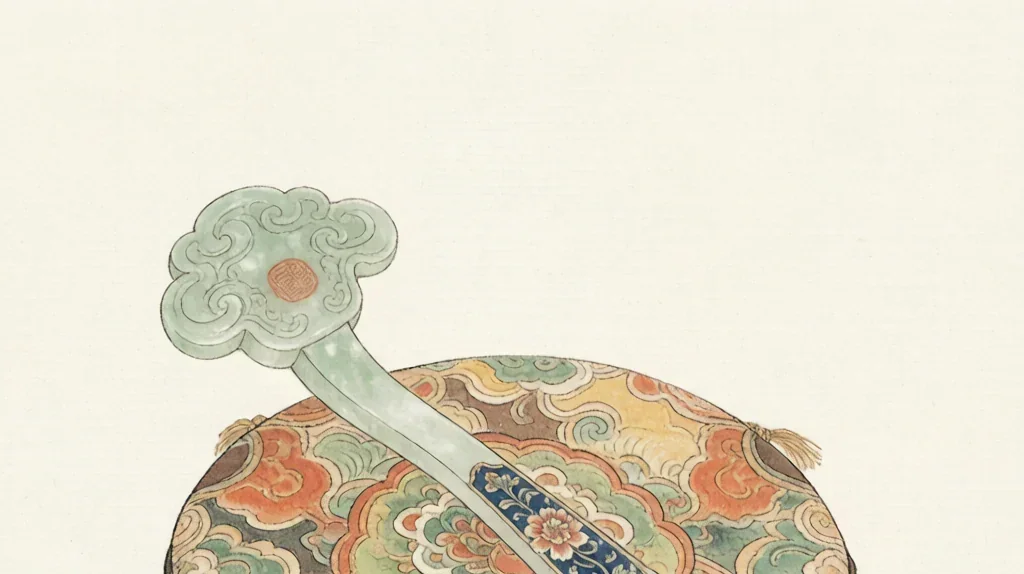
The ruyi (如意, "as you wish") is one of the most recognizable objects in Chinese material culture — a curved S-shaped scepter whose head resembles a lingzhi fungus or a cloud. Held by emperors, presented as auspicious gifts, and rendered in jade, gold, and lacquer, the ruyi is both a ceremonial object and a pun made solid. Its name alone is a blessing: to offer a ruyi is to say "may things go as you wish." Across a thousand years it has moved from a back-scratcher to a symbol of power, good fortune, and the gentle granting of desire.
The Name and Its Meaning
The word rú yì literally means "as [one] wishes" or "according to your heart's desire." The name is the object's entire program: it exists to express a wish that the recipient's will be fulfilled and life proceed smoothly.
Because the phrase is so common in blessings, the object became a portable good-luck charm. To own or give one was to traffic in goodwill itself.
This verbal root explains why ruyi appear at moments of hope — births, birthdays, New Year, and imperial audiences — where the wish "may it be as you desire" is most apt.
From Back-Scratcher to Scepter
Scholars trace the ruyi's shape to a practical handheld back-scratcher (爪杖, zhǎo zhàng) used in antiquity to reach an itch one could not scratch oneself. The long handle and curved head suited the purpose, and the comfort it brought linked it early to the idea of "getting what you want."
Over time the utilitarian tool was elegantified. Craftsmen lengthened and decorated it, and by the Tang and Song dynasties it had become a courtly object rather than a bathroom aid.
The transformation from scratch-tool to scepter is a neat example of how Chinese culture can ennoble a humble device into a carrier of meaning.
The Lingzhi and Cloud Head
The ruyi's head is typically shaped like a lingzhi (灵芝, líng zhī), the "spirit fungus" of Daoist lore believed to grant longevity or even immortality. It may also recall the ruyi-shaped auspicious cloud. Either way, the head stacks further blessings on top of the name.
Thus a single object combines three lucky ideas: the wish "as you desire," the immortality fungus, and the heavenly cloud. Small wonder it was prized.
The S-curve of the stem between head and handle gives the ruyi its recognizable silhouette, echoed in furniture legs, roof brackets, and cloud motifs.
Ruyi as Imperial Regalia
By the Qing dynasty the ruyi was a standard item of court ceremonial. Emperors held one during audiences, and sets of ruyi were presented to the throne on major occasions such as the Lunar New Year and an emperor's birthday.
The Qianlong emperor, a prolific patron and poet, owned and commissioned many ruyi in jade and cloisonné, and had them depicted in his portraits. The object signaled civilized authority.
Foreign envoys, too, received or observed ruyi, making it part of the visual diplomacy of the Qing court.
As a Gift and Auspicious Object
Presenting a ruyi was a refined way to wish someone well. A jade ruyi given at a wedding prayed for the couple's wishes to be granted; one given at a birth wished the child a smooth life.
Because the name is a blessing, the gift needed no wrapping of explanation — the object spoke for itself. It was the original "thinking of you" present.
Wealthy households displayed ruyi on scholar's desks or in niches, where they functioned as both décor and a standing wish for the home's prosperity.
Materials and Craftsmanship
Ruyi were made in every luxury material: jade (the most prestigious), cloisonné enamel, gold, lacquer inlaid with mother-of-pearl, ivory, and wood. The finest jade ruyi could take a master carver months.
Some were composed of a single piece of jade; others joined a head and handle of different stones. Imperial examples might be studded with precious gems.
The craftsmanship mattered because the ruyi was a gift of status; its material testified to the giver's respect as much as its meaning did.
Ruyi in Art and Pattern
The ruyi shape escaped the object itself and became a repeating ornament — the "ruyi pattern" (如意纹, rú yì wén) used on textiles, porcelain borders, and architecture. A row of ruyi heads could trim a robe or a temple eave.
Painters placed a ruyi in the hands of deities and immortals to mark them as granters of wishes. The fungus-headed scepter became a visual shorthand for "your desire is heard."
This pattern-life let the ruyi bless surfaces that could never hold a physical scepter, spreading the wish across an entire room.
The Ruyi in Modern China
Today the ruyi survives as a decorative motif on jewelry, brooches, and souvenirs, and as a name for products and places that want to sound fortunate. The shape is instantly legible as "Chinese auspicious."
In state and corporate gift culture, ruyi-inspired objects are still offered to signify respect and good wishes, a continuity of the old ceremonial role.
Though few people use a ruyi as a back-scratcher now, its name and curve remain a gentle, universal Chinese way of saying "may all go well."
Ruyi and the Culture of Blessing
The ruyi sits at the center of a Chinese habit of turning wishes into objects. Like the yuanbao (ingot), the bat (fortune), and the peach (longevity), it is a thing that means a hope.
What makes the ruyi special is that its blessing is open-ended — not "may you be rich" or "may you live long" but the broader "may your wishes come true." It is the most generous of the lucky objects.
To hold a ruyi, then, is to hold permission to want — a small, elegant license to hope.
❓ Frequently Asked Questions
What does ruyi mean?
Rú yì means "as you wish" or "according to your desire"; the object is named for the blessing it carries.
Where did the ruyi come from?
It likely began as a practical back-scratcher and was gradually elegantified into a courtly scepter by the Tang–Song period.
Why is the ruyi head shaped like a fungus?
The head resembles the lingzhi "spirit fungus" of longevity and the auspicious cloud, layering extra blessings onto the name.
How was it used by emperors?
Qing rulers held ruyi in audiences and received sets as New Year and birthday gifts, making it part of court ceremonial.
What materials were ruyi made from?
They were crafted in jade, cloisonné, gold, lacquer, ivory, and wood, with jade being the most prestigious.
Does the ruyi appear today?
Yes; its shape lives on in jewelry, souvenirs, and gift culture as a sign of respect and good wishes.