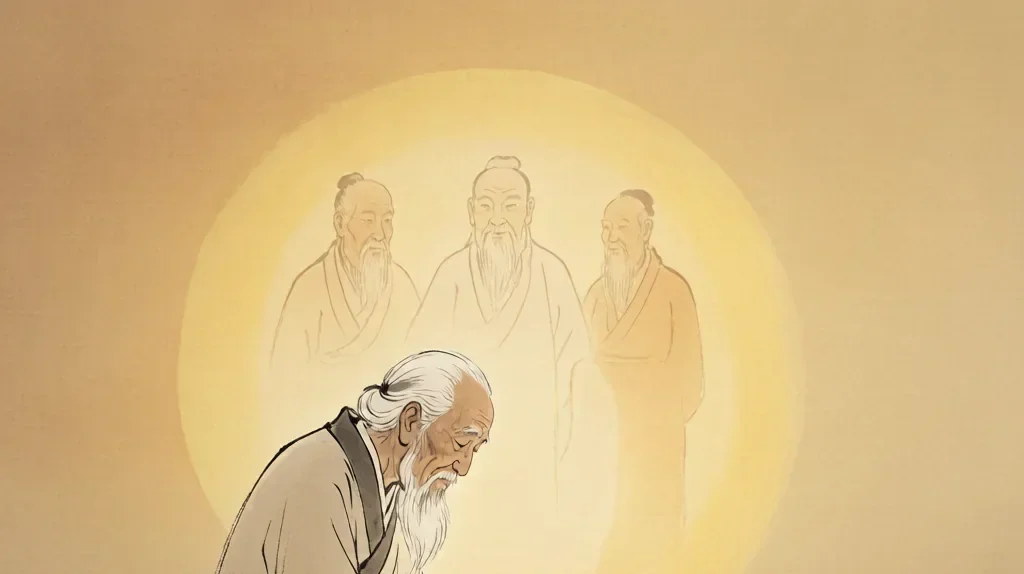
In the West, death is often understood as a definitive separation — a boundary beyond which the dead no longer participate in the lives of the living. In Chinese culture, no such boundary exists. Ancestor worship (祭祖, jìzǔ) is not merely a ritual obligation or a superstitious practice; it is a profound expression of one of the most enduring values in Chinese civilization: that the living and the dead remain bound together in an unbroken chain of mutual care, obligation, and love. This practice, which predates recorded history and has survived revolutions, modernization, and diaspora, reveals a fundamentally different understanding of what it means to be human — not as an isolated individual, but as a link in a chain stretching from the distant past into the unimaginable future.
The Philosophical Roots: Xiao and the Continuity of Being
The philosophical foundation of ancestor worship lies in the Confucian virtue of filial piety (孝, xiào). Confucius taught that respect and care for one's parents is the root of all virtue — if one cannot honor the source of one's own existence, how can one be expected to treat others with benevolence? This obligation, critically, does not end with a parent's death. "When parents are alive, serve them according to ritual; when they die, bury them according to ritual and sacrifice to them according to ritual," the Analects instructs. Death transforms the relationship but does not terminate it.
Beneath this ethical teaching lies an even deeper worldview: the Chinese concept of the soul as having two aspects. Upon death, the hun (魂) — the ethereal, intellectual soul — ascends to heaven, while the po (魄) — the corporeal, earthly soul — remains with the body in the grave. The hun receives offerings in the ancestral tablet placed on the family altar, while the po is sustained by offerings at the gravesite. If properly nourished through regular offerings, the ancestors become benevolent protective spirits who watch over their descendants. If neglected, they may become restless, hungry ghosts (饿鬼, èguǐ) — a prospect that fills Chinese families with genuine concern. This is not fear of the dead but a sense of continuing responsibility toward them, an extension of the same care one would show to living parents.
Ancestral Halls and Genealogical Records
The physical and institutional heart of ancestor worship is the ancestral hall (祠堂, cítáng). In traditional Chinese villages, the ancestral hall was the most important building after the temple — often the largest, most elaborately decorated structure in the community. Inside, wooden ancestral tablets (神主牌, shénzhǔ pái) bearing the names of deceased family members were arranged on altars in hierarchical order, with the founding ancestor of the lineage occupying the central, most honored position. The hall served multiple functions: a temple for conducting ancestor rites, a council chamber where lineage elders made decisions, a schoolhouse for educating clan children, and a social center where weddings and funerals were held.
Equally important were the genealogical records (家谱, jiāpǔ), meticulously maintained documents that traced a family's lineage back through generations — sometimes for centuries. These were not merely dry lists of names but elaborate records that included biographies of notable ancestors, clan rules, moral instructions for descendants, and records of migrations and achievements. A family without a genealogy was considered rootless, its members adrift in the world without a clear sense of who they were or where they came from. In traditional society, a person's identity was defined not by individual accomplishments alone but by their place within the lineage — the ancestors who came before and the descendants who would follow. The phrase "光宗耀祖" (guāngzōng yàozǔ), meaning "to bring glory to one's ancestors," captures the deep motivation that drove generations of Chinese to strive for success in the examinations, business, or public service.
The Three Great Festivals of Ancestral Remembrance
While ancestor veneration was a daily practice — with incense burned and food offered at the family altar every morning — three major festivals structured the ritual calendar, each with its own distinctive character and customs.
Qingming Festival (清明节), the "Clear and Bright" festival in early April, is the most important occasion for honoring ancestors. On this day, families visit the graves of their ancestors to sweep and clean the tombs (扫墓, sǎomù), remove weeds, repaint inscriptions, and make offerings of food, wine, incense, and paper money. The practice of burning joss paper (纸钱, zhǐqián) — imitation money made of coarse paper — reflects the belief that the dead require material goods in the afterlife. In recent years, the offerings have modernized: paper iPhones, paper cars, and even paper credit cards are now burned alongside traditional money. Qingming is also a time for the living to enjoy the spring weather, fly kites, and eat special foods like green rice balls (青团, qīngtuán).
Zhongyuan Festival (中元节), also known as the Hungry Ghost Festival, falls on the 15th day of the seventh lunar month (typically August). According to Chinese folk belief, the gates of the underworld open during the seventh month, allowing ghosts — both ancestral and unattached — to roam the world of the living. Families offer elaborate feasts, burn incense and paper goods, and stage operas and other entertainments to appease wandering spirits. Paper lanterns are floated on rivers to guide lost souls home. The festival combines ancestor veneration with Buddhist and Daoist rituals of universal salvation, reflecting the syncretic character of Chinese popular religion. Hanyi Festival (寒衣节), the "Winter Clothing Festival," falls on the first day of the tenth lunar month (late October or early November). As winter approaches, families burn paper clothing to ensure their ancestors stay warm in the afterlife — a practice that beautifully illustrates the intimate, familial character of Chinese ancestor veneration. The dead are not distant deities to be worshipped from afar but beloved family members whose comfort remains a living concern.
Confucian Orthodoxy and Folk Practice
Ancestor worship occupies a unique position at the intersection of elite Confucian philosophy and popular folk religion. For Confucian scholars, the rites were primarily an ethical practice — a way of cultivating filial piety, reinforcing family bonds, and maintaining social order. Confucius himself was famously agnostic about the supernatural. When asked about serving ghosts and spirits, he replied, "You are not yet able to serve people — how can you serve ghosts?" Yet he insisted on performing the rites with full sincerity, suggesting that their value lay in their effect on the living.
For ordinary Chinese, however, ancestor worship was — and remains — more than an ethical exercise. Folk belief holds that ancestors genuinely require sustenance and that their well-being directly affects the fortunes of their descendants. A prosperous family is evidence of contented ancestors; misfortune suggests neglect of ritual obligations. This worldview creates a powerful feedback loop: caring for ancestors is simultaneously an act of love, a moral duty, and a pragmatic investment in one's own future. Authorities have had an ambivalent relationship with ancestor worship over time, denouncing it as superstition during some periods while tolerating its revival in others. The practice has proven remarkably resilient, adapting to urbanization (with online ancestor worship platforms now available) and diaspora (with overseas Chinese communities maintaining ancestral halls in cities from Bangkok to San Francisco).
Daily Devotions at the Family Altar
Beyond the great festivals, ancestor veneration was historically a daily habit. Each morning the head of the household lit incense before the ancestral tablet, offered a cup of tea or a bowl of rice, and bowed to greet the family's dead. The altar was kept clean and the offerings fresh, because neglect was thought to leave the ancestors cold and restless. This routine embedded remembrance into ordinary time, so that honoring the dead was not a special event but the first act of the day. Even in busy modern apartments the rhythm survives in smaller form, a stick of incense at New Year or a photo with a cup of wine set before an empty chair. The daily gesture keeps the boundary between living and dead soft, a thin, warm line rather than a wall.
Women, Marriage, and Lineage Membership
Traditional ancestor worship was organized around the male line, and a woman's place within it shifted with marriage. Born into her natal lineage, she was worshipped there as a daughter; upon marriage she was expected to tend her husband's ancestral tablets and to be enshrined among his people after death. A son's birth secured a family's place in the genealogy, while daughters, though loved, were often recorded more briefly. These rules reflected a patrilineal logic in which continuity ran through sons. Today the strictness has loosened, and many families include daughters and their spouses in the records and the rites, but the older structure still shapes who is listed where, and why the birth of a son was once such a weighted event in the cycle of remembrance.
The Diaspora Keeps the Tablets
Wherever Chinese communities settled, they carried the ancestral tablet with them. From Bangkok to San Francisco, clan associations built halls to house the tablets of migrants who died far from home, ensuring the dead remained among their own people. These halls became anchors of identity, places where language, surname, and ritual were preserved across generations in unfamiliar lands. In the diaspora the tablet often did double duty, standing in for a grave that lay on another continent, and the hall became the site of both worship and mutual aid. The result is that ancestor worship, more than almost any other custom, travelled intact, because it answered the emigrant's sharpest need, to stay rooted to a homeland that could no longer be visited easily.
Ancestor Worship as Cultural Identity
In a rapidly changing society, venerating ancestors has come to signify something broader than religious belief: it marks a person as connected to Chinese tradition itself. The acts of bowing, offering, and recording names read as gestures of cultural belonging, performed by believers and non-believers alike. Schools and museums present the ancestral hall and the genealogy as heritage, and families proud of their roots display old tablets as heirlooms. This shift from doctrine to identity helps explain the custom's durability through revolution and modernization. To keep the ancestors is, in a sense, to keep a story of who one is, a story told not in creed but in the simple, repeated care of those who came before.
❓ Frequently Asked Questions
📝 Chinese Vocabulary
祭祖 — — Ancestor worship; the ritual veneration of deceased family members
孝 — — Filial piety; the Confucian virtue of honoring and caring for one's parents
祠堂 — — Ancestral hall; the clan temple where ancestral tablets are housed
家谱 — — Family genealogy; the written record of lineage and ancestry
清明节 — — Qingming Festival; the spring tomb-sweeping festival
神主牌 — : The ancestral tablet; the inscribed wooden plaque that houses a deceased family member's spirit.
中元节 — : The Hungry Ghost Festival, when the gates of the underworld open and offerings multiply.
寒衣节 — : The Winter Clothing Festival, when paper garments are burned to keep ancestors warm.
🎉 Fun Facts
- The largest ancestral hall in China, located in Guangdong Province, covers over 15,000 square meters and houses the tablets of more than 10,000 ancestors from a single clan. Many families buried their genealogies in secret, preserving them at great personal risk.
- In modern Hong Kong, some families hire professional mourners to weep at funerals, ensuring that the ancestors receive a properly dramatic sendoff — a practice that dates back to the Han Dynasty.
- Some southern lineages hold a grand reunion at the ancestral hall every few years where thousands of scattered descendants return to bow and update the genealogy together.
- In parts of Taiwan and Southeast Asia, families maintain a long-lit incense at the home altar that must never go out, symbolizing the unbroken presence of the ancestors.
- A few famous genealogies trace a single clan back more than a thousand years and run to dozens of volumes, functioning as local history as much as a family record.
- In many villages the oldest living member leads the offering and the youngest children copy the elder's bow, so the posture of reverence is passed down hand in hand with the genealogy.