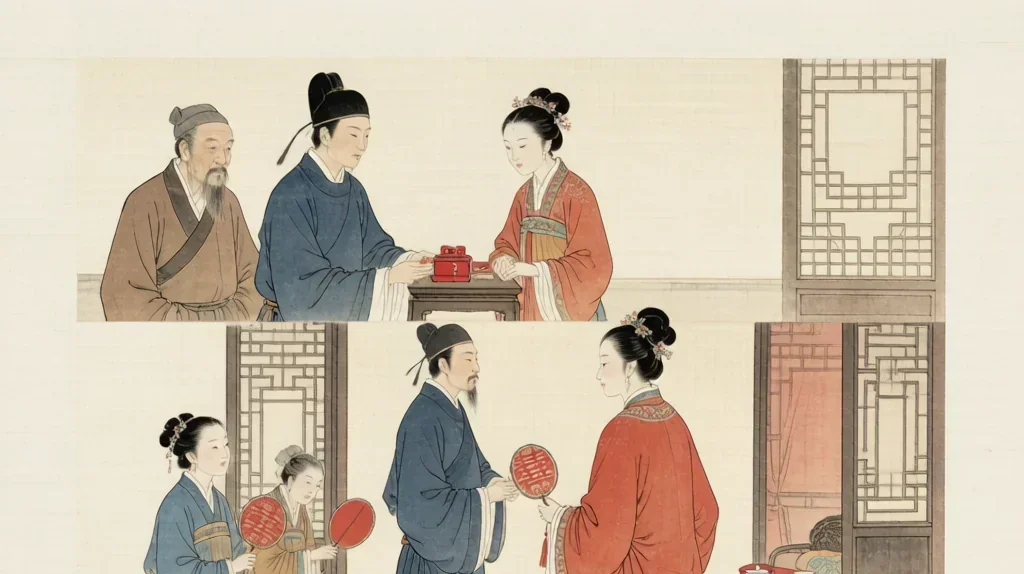
In Chinese culture, a wedding is far more than the union of two individuals — it is the joining of two families, two lineages, and two ancestral lines stretching back through generations. Traditional Chinese wedding customs (中式婚礼, Zhōngshì hūnlǐ), refined over thousands of years, form one of the most elaborate and symbolically rich ritual systems in the world. Every element — from the color of the bride's dress to the food served at the banquet, from the timing of the ceremony to the gifts exchanged — carries layers of meaning rooted in Confucian ethics, folk beliefs, and the deep Chinese reverence for family and continuity. While modern Chinese weddings have incorporated many Western elements, there is a growing revival of traditional practices as young couples seek to reconnect with their cultural heritage.
The Three Letters and Six Etiquettes: The Formal Framework
Traditional Chinese marriage was governed by the Three Letters and Six Etiquettes (三书六礼, sān shū liù lǐ), a formal protocol that originated in the Western Zhou Dynasty (1046–771 BCE) and was codified in the Book of Rites. This system transformed what could have been a simple private arrangement into a solemn, community-witnessed covenant.
The Six Etiquettes (六礼) formed the procedural backbone: 1) Proposal (纳采, nàcǎi) — the groom's family formally proposed to the bride's family, sending gifts that included a wild goose (symbolizing marital fidelity, as geese mate for life); 2) Name Inquiry (问名, wènmíng) — the groom's family obtained the bride's full name and birth date for divination; 3) Fortune Telling (纳吉, nàjí) — the couple's birth dates were compared against astrological charts to determine compatibility; 4) Betrothal Gifts (纳征, nàzhēng) — the groom's family presented substantial gifts, including money, jewelry, food, and cloth, to the bride's family — essentially the bride price; 5) Setting the Date (请期, qǐngqī) — an auspicious date was chosen after consulting the lunar calendar and astrological almanacs; 6) Fetching the Bride (亲迎, qīnyíng) — the groom traveled to the bride's home to escort her to the wedding ceremony. The Three Letters (三书) — the Betrothal Letter, the Gift Letter, and the Wedding Letter — served as formal documentation at each stage, giving the process legal and social weight.
The Red Bridal Sedan Chair and the Wedding Procession
On the wedding day, the most spectacular visual element was the bridal sedan chair (花轿, huājiào) — an ornate, red-lacquered palanquin decorated with embroidered silk, auspicious symbols, and flowers. Red was chosen because it represents joy, prosperity, and protection from evil spirits. The chair was carried by a team of bearers through the streets, accompanied by a noisy, joyful procession designed to announce the union to the community and scare away malevolent spirits with the clamor of firecrackers, gongs, and drums.
The bride, dressed entirely in red — a red silk gown embroidered with dragons and phoenixes, red shoes, and most famously, a red veil or bridal headscarf (红盖头, hóng gàitou) — was carried from her parents' home to the groom's house. The red veil was a powerful symbol: it concealed the bride's face until the wedding night, when the groom would lift it with a ceremonial stick, seeing his wife's face for the first time as a married man. On the journey, the bride's feet were not supposed to touch the ground, symbolizing her transition between families. Various rituals accompanied the procession: a young boy might be placed on the sedan chair to bring the blessing of male offspring; the bride's family would scatter rice and beans to ward off evil influences; and firecrackers would be lit at every significant transition point.
Bowing to Heaven and Earth: The Wedding Ceremony
The heart of the traditional Chinese wedding was the Baitang ceremony (拜堂, bàitáng) — the ritual bowing that formalized the marriage. Unlike Western weddings, which typically involve a religious officiant, the traditional Chinese ceremony was presided over by the couple's parents and witnessed by the community. The ceremony followed a precise sequence: First bow to Heaven and Earth (一拜天地) — acknowledging the cosmic order and the divine forces that govern the universe; Second bow to the parents (二拜高堂) — expressing gratitude and filial piety to both sets of parents; Third bow to each other (夫妻对拜) — the couple's mutual pledge of respect and devotion.
Following the bows came the tea ceremony (敬茶, jìngchá), one of the most emotionally significant rituals. The newlyweds knelt before the groom's parents and offered them tea, addressing them formally as "Father" and "Mother" for the first time. This act symbolized the bride's formal acceptance into the groom's family and the couple's pledge to care for the parents in their old age. The parents would drink the tea and present the couple with red envelopes (红包, hóngbāo) containing money or jewelry, often accompanied by words of blessing. The tea ceremony was then repeated for the bride's parents, either immediately or during a post-wedding visit. The choice of tea was significant: tea plants cannot be transplanted once rooted, symbolizing the permanence of the marriage bond.
Regional Variations: A Tapestry of Wedding Traditions
China's vast geography and ethnic diversity have produced a rich tapestry of regional wedding customs. In Fujian Province, the bride's family prepares a lavish dowry that includes gold jewelry, furniture, and even household appliances — a display of the family's wealth and a guarantee of the bride's status in her new home. In Guangdong, the bride's family gives her a symbolic comb decorated with gold, and a "good luck woman" — typically an older woman whose own life has been blessed with prosperity and children — combs the bride's hair while reciting auspicious verses.
Among the Miao (苗族) ethnic minority in southwest China, weddings involve elaborate silver headdresses weighing several kilograms, and the bride may wear multiple layers of embroidered skirts — sometimes more than a dozen — each taking years to complete. The Tibetan wedding ceremony includes the tying of a white silk scarf (哈达, hādá) around the couple's necks as a blessing, and the groom's family may travel on horseback to fetch the bride, maintaining ancient nomadic traditions. In Shanghai in the early 20th century, a uniquely modern fusion emerged: the bride might wear a Western white wedding dress for the ceremony but change into a traditional red qipao for the banquet, a practice that remains popular across China today." The typical Chinese wedding of the 1970s and 1980s was a simple affair: a civil registration, a small banquet, and perhaps a bicycle as a wedding gift. But since the 1990s, and especially in the past decade, there has been a dramatic revival of traditional wedding customs. Young couples, particularly in urban areas, are increasingly choosing to incorporate — or entirely base their weddings on — traditional rituals.
This revival is driven by several factors: a broader cultural renaissance that has seen renewed interest in traditional Chinese arts, fashion, and philosophy; the desire for weddings that feel more meaningful and culturally rooted than Western-style ceremonies; and the visual splendor of traditional weddings, which photograph beautifully and satisfy the modern demand for Instagram-worthy celebrations. Wedding companies now offer full-service traditional packages, complete with antique-style sedan chairs, period costumes, and master of ceremonies who guide the couple through every ritual. Some couples go further, holding their ceremonies in ancestral halls or historic buildings. The revival is not simply nostalgia — it represents a generation's desire to honor their heritage while creating something uniquely their own. As one bride put it, "A Western wedding feels borrowed. A Chinese wedding feels like coming home."
The Betrothal Gifts and Bride Price
Central to the betrothal is the delivery of caili, the gifts from the groom's family to the bride's. Historically this included money, jewelry, tea, alcohol, and pastries, and in modern times may also involve a house, a car, or a large cash sum. The gift served two purposes: it demonstrated the groom's ability to support the bride and it compensated her family for the loss of a daughter who would 'marry out' into another house. The amount was negotiated, and disputes over caili remain a lively topic of social debate in China today. Behind the bargaining lay a serious logic of two families joining, not merely two individuals, with the gifts formalizing mutual obligation.
The Wedding Banquet
The banquet, or hunyan, is the social heart of a Chinese wedding. Held in a large restaurant or hotel, it gathers the couple's extended families, friends, and colleagues at a dozen or more round tables. Courses arrive in lucky number and kind, seafood and duck symbolizing harmony, and a whole fish signaling a surplus for the year. The couple moves from table to table to toast each group, and guests mark their attendance with red envelopes recorded in a gift book. More than a meal, the banquet is the public proclamation that two lineages have become one, witnessed and blessed by the community over shared food.
Omens and Auspicious Symbols
A Chinese wedding is a festival of symbols. The double-happiness character is pasted on every door and mirror, while dragons and phoenixes on the gown pair the bride and groom as heaven's matched pair. The tea served at the ceremony is sweetened with lotus seeds, red dates, and longan, each a homophonic wish for fertility, sweetness, and a complete family. Even the color red works as omen, warding off misfortune and inviting joy. Together these signs turn a legal contract into a charmed event, surrounding the couple with visible good wishes meant to carry into their married life.
From Matchmaker to Modern Couple
The classical wedding depended on a matchmaker who carried proposals and birth charts between families, and the full Six Rites could stretch over a year. Today most couples meet on their own, and the rites are compressed into a betrothal and a single wedding day, yet the old bones remain. The tea ceremony, the red envelopes, the banquet, and the double-happiness character survive almost everywhere, now layered with a Western white gown and a ring exchange. This blend shows a culture unwilling to abandon its rites even as it modernizes, keeping the meaning of family union while letting young people choose their own partners.
❓ Frequently Asked Questions
📝 Chinese Vocabulary
三书六礼 — — The Three Letters and Six Etiquettes; the formal protocol of traditional marriage
拜堂 — — The ceremonial bowing to heaven, parents, and spouse during the wedding
花轿 — — The ornate red bridal sedan chair used in wedding processions
红盖头 — — The red bridal veil or headscarf, lifted by the groom on the wedding night
敬茶 — — The tea ceremony; the ritual offering of tea to parents and elders
龙凤褂 — : The dragon-phoenix gown, an embroidered jacket and skirt worn by the bride, pairing the dragon of the groom with the phoenix of the bride.
跨火盆 — : The custom of the bride stepping over a brazier at the threshold to burn away ill fortune from her old home.
交杯酒 — : Cross-cupped wine, drunk by the couple with linked arms to seal their union on the wedding night.
🎉 Fun Facts
- In traditional Chinese culture, the bride's wedding dress must never be white, as white is the color of mourning and funerals. Red is the mandatory color for all wedding attire.
- The character 囍 (xǐ), meaning "double happiness," is the universal symbol of Chinese weddings. It consists of two 喜 (happiness) characters side by side and is pasted on doors, walls, and wedding gifts.
- In some regions of China, the bride's friends would hide her shoes before the groom arrived, and he would have to negotiate — often with red envelopes — to get them back before the ceremony could proceed.
- The wedding date is chosen by an astrologer using the lunar calendar and the couple's birth charts, often avoiding the seventh lunar month and other inauspicious periods.
- Firecrackers at the wedding are not only celebration; their noise is meant to scare away malicious spirits and announce the union to the whole community.
- In some regions the bride's family performs a 'crying marriage' (kujia) on the wedding morning, singing laments that mix sorrow at her leaving with blessings for her future.