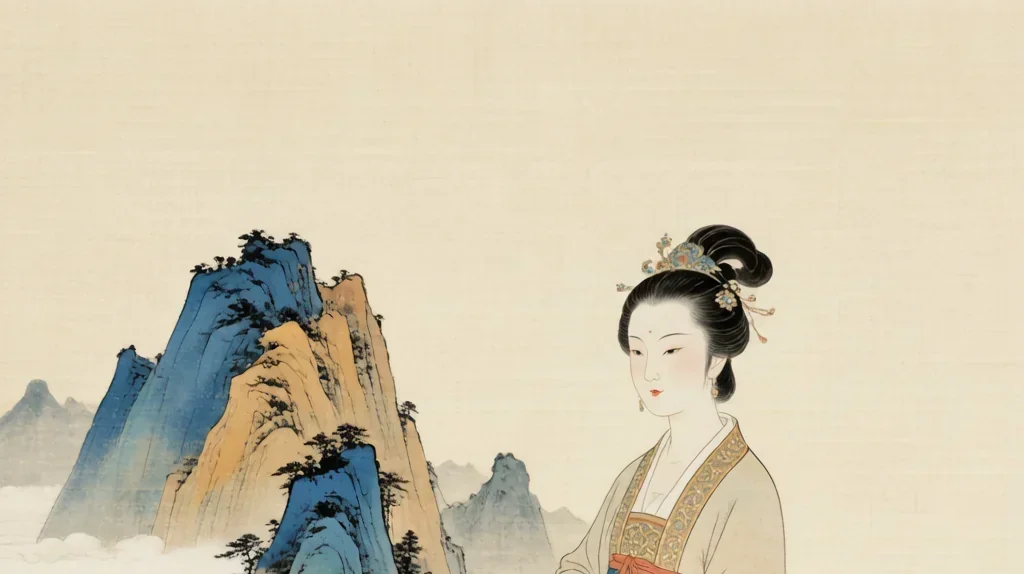
Bixia Yuanjun (碧霞元君), often translated as the "Azure Cloud Perfected Consort" or the "Celestial Immortal of Mount Tai," is one of the most beloved female deities in Chinese popular religion. Known affectionately as Taishan Niangniang (泰山娘娘), the "Lady of Mount Tai," she is revered above all as a protectress of women, infants, and childbirth, and as the spiritual mistress of China's sacred eastern mountain. Centered on her cliff-side temple near the summit of Mount Tai in Shandong, her cult grew from a local mountain spirit into a nationally worshipped goddess whose pilgrimage fairs once drew hundreds of thousands of devotees each spring.
Origins and Early Identity
The roots of Bixia Yuanjun lie in the ancient veneration of Mount Tai as the eastern sacred peak and the gateway between the world of the living and the world of the dead. Early texts speak of a "Jade Maiden" (玉女) dwelling on the mountain, a chaste mountain spirit associated with clouds, fertility, and the dawn light of the east. Over the centuries this diffuse maiden figure was gradually individualized and given the honorific title Yuanjun, a Taoist rank for a female immortal of high attainment.
By the medieval period the Jade Maiden of Mount Tai had merged with a broader current of goddess worship, and court and commoners alike began to address her as Bixia Yuanjun, "She of the Azure Clouds." The name evokes both the mist that wraps the peak and the compassionate, nurturing quality attributed to her care over human lives.
Mount Tai and the Eastern Peak
Mount Tai (泰山), the "Eastern Marchmount" (东岳), has been the most revered of China's five sacred mountains since antiquity. Emperors performed sacrificial rites there to announce their mandate to heaven, and the mountain was believed to govern longevity, destiny, and the soul's journey after death. Bixia Yuanjun's authority is closely tied to this landscape: she is the benevolent feminine counterpart to the awesome Dongyue Dadi, the Great Emperor of Mount Tai, who judges the dead.
Where the Great Emperor inspires awe and fear, Bixia Yuanjun inspires intimacy and trust. Devotees approach her not as a judge but as a motherly figure who answers pleas for healthy children and safe deliveries, a contrast that helped her cult flourish among women who were otherwise excluded from many formal rituals.
Historical Development Through the Dynasties
The cult of Bixia Yuanjun gained imperial patronage during the Song dynasty, when a temple to the Jade Maiden was restored on Mount Tai and the goddess was granted official titles. Later dynasties, including the Yuan, Ming, and Qing, continued to honor her, and Qing empresses in particular are recorded as patronizing her shrine, reinforcing her association with female piety and maternal protection.
As printing and pilgrimage networks expanded, her image spread far beyond Shandong. Local "Lady of Mount Tai" temples appeared across north China, often served by female mediums and lay organizations of women who pooled resources for collective pilgrimages, turning devotion into a rare form of female social organization.
Iconography and the Azure Cloud Temple
Bixia Yuanjun is usually depicted as a serene, richly robed woman seated on a throne, often flanked by attendant maidens who hold symbols of fertility and childhood. Her principal shrine, the Bi Xia Ci (碧霞祠), or Azure Cloud Temple, sits just below the South Peak of Mount Tai and remains a major site of worship. The temple's gilded bronze roofs and incense-filled halls testify to centuries of continuous devotion.
In statuary she may hold a scroll or a ruyi scepter, and her headdress marks her rank as a perfected consort. Color symbolism is central: the azure and cloud motifs link her to the eastern sky and to the life-giving rains associated with the spring equinox.
Protector of Women and Children
The goddess's central role is as guardian of mothers and babies. For much of Chinese history, childbirth was perilous, and women prayed to Bixia Yuanjun for conception, an easy labor, and the survival of infants through the dangerous early years. Votive plaques, embroidered shoes, and small robes offered at her temples record countless petitions answered.
Because she watches over the vulnerable, she is also invoked for the general well-being of the family. Many households kept a small image or printed charm of the Lady of Mount Tai, and midwives and grandmothers would whisper her name during delivery as a form of spiritual reassurance.
Pilgrimage and the Mount Tai Temple Fair
The pilgrimage to Mount Tai formidably shaped local religious life. Each year devotees, especially women, climbed the mountain's thousands of stone steps, stopping at way-stations to burn incense and pledge offerings to the goddess. The ascent itself was understood as an act of merit and penance.
At the mountain's foot and around the temple, great temple fairs (庙会) grew up, combining worship with markets, opera performances, and folk entertainment. These fairs became important economic and cultural events, and similar fairs honoring the Lady appeared wherever her cult took root.
Rituals, Offerings, and Vows
Worship of Bixia Yuanjun centers on incense, prostration, and the making of vows (还愿) that are fulfilled once a prayer is granted. Common offerings include incense, candles, fruit, and embroidered goods. Devotees may commission a plaque bearing the characters for "answer to prayer" (有求必应) to hang in her hall.
A distinctive practice is the dedication of "longevity locks" and children's garments to the goddess, symbolically placing the child under her protection. Such objects blur the line between gift and charm, materializing the bond between devotee and deity.
Bixia in Popular Literature and Opera
As a familiar household name, Bixia Yuanjun appears in vernacular fiction, baojuan (precious scrolls) sermons, and regional operas that dramatize her origins and miracles. These stories often cast her as descending to rescue suffering women or to punish those who scorn the vulnerable, reinforcing her moral as well as maternal dimensions.
Through such media her cult reached audiences who might never make the climb to Shandong, embedding the Lady of Mount Tai in the shared imaginative world of Chinese folk religion alongside other popular deities.
Relations With Other Deities
Bixia Yuanjun sits within a crowded pantheon of protective figures. She is distinct from Guanyin, the Buddhist goddess of mercy, though the two are sometimes prayed to for similar needs, and from the Queen Mother of the West, a more cosmic sovereign of immortality. Her closest institutional partner is the Great Emperor of Mount Tai, with whom she shares the mountain's ritual jurisdiction.
In village temples she is frequently enshrined alongside the God of the Hearth, the City God, and the Gods of Wealth and Longevity, a constellation that addressed the full arc of a family's hopes: food, protection, offspring, and long life.
Modern Legacy and Continuity
Today the Azure Cloud Temple remains an active site, especially during the annual Mount Tai cultural and tourism festivals that also preserve older pilgrimage customs. While scholarly and touristic framings now surround the goddess, ordinary worship continues, and women still ascend the mountain to pray for children and family safety.
The figure of Bixia Yuanjun thus bridges imperial religion, folk devotion, and contemporary heritage. She endures as a rare major deity defined by care rather than by force, a maternal presence in a pantheon often ruled by stern male authority.
❓ Frequently Asked Questions
Who is Bixia Yuanjun?
She is the Taoist goddess of Mount Tai, revered as a protectress of women, infants, and childbirth, and known popularly as the Lady of Mount Tai.
Where is her main temple?
Her principal shrine, the Azure Cloud Temple (碧霞祠), stands near the summit of Mount Tai in Shandong province.
What do people pray to her for?
Devotees primarily ask for conception, safe delivery, and the health and survival of young children, as well as general family well-being.
How is she different from Guanyin?
Guanyin is a Buddhist figure of universal mercy, while Bixia Yuanjun is a native mountain goddess focused on motherhood and the household.
Is her cult still active today?
Yes. The Azure Cloud Temple remains a living site of worship, and women still climb Mount Tai to pray, especially during spring fairs.
What is a "vow" in her worship?
A vow (还愿) is a promise of offering made in exchange for a granted prayer, fulfilled by presenting plaques, incense, or embroidered goods.