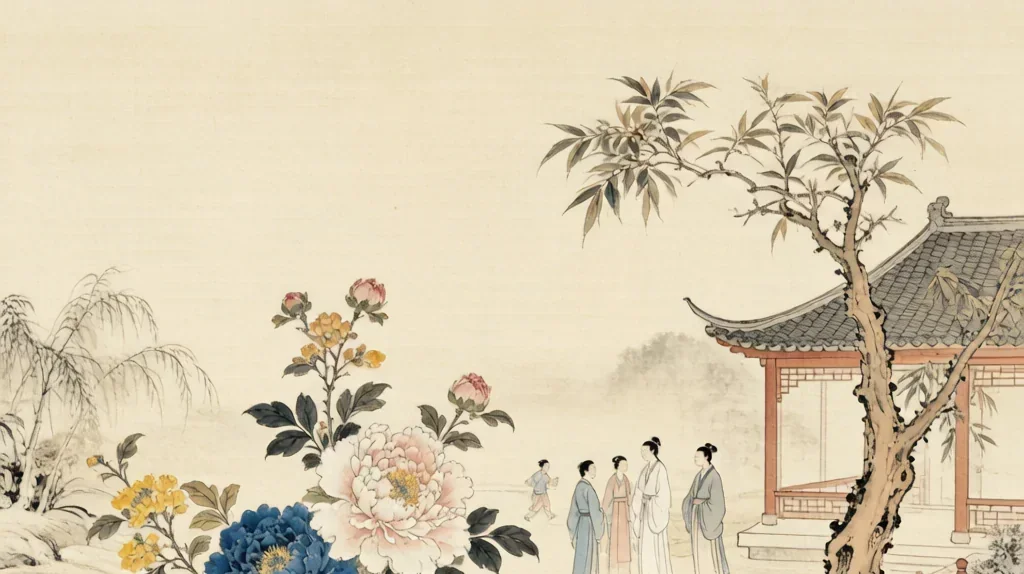
The Flower Festival, or Huazhao (花朝), is a traditional Chinese celebration of flowers and the coming of spring, often called the "birthday of the hundred flowers." Observed in the second lunar month, it honors the blossoming world and the goddesses who preside over it. Once a lively occasion for outings, poetry, and girls' adornment, it faded in the modern era but has been quietly revived in recent years as people rediscover seasonal folk customs.
When the Festival Falls
Huazhao has never had a single fixed calendar date. Different regions celebrated it on the second, twelfth, fifteenth, or sometimes the twenty-fifth day of the second lunar month, with the choice varying by locality and era.
This flexibility reflected local climate and agricultural rhythm: the festival was meant to coincide with the first flush of blossoms, so communities timed it to their own flowering season rather than a uniform rule.
Origins and Early History
The custom can be traced to the Tang dynasty, when spring flower appreciation was already a refined pastime of the court and literati. It grew more popular in the Song dynasty, spreading into wider society as a day of leisure and worship.
By the Ming and Qing periods, Huazhao was listed among the year's notable folk festivals, with gazetteers recording local rites of flower worship and spring excursions in considerable detail.
The Flower Goddesses
Central to the festival is the worship of the "flower goddesses" or Baihua Niangniang (百花娘娘), protectors of blossoms and, by extension, of growth and fertility. In some traditions each month's flower has its own patron goddess.
Temples and household Altars might receive offerings of incense and food, and women would pray for beauty, children, and a flourishing household — concerns naturally linked to the blooming season.
Girls and Spring Adornment
One charming feature of Huazhao was the decoration of young women's hair with fresh flowers or bright hairpins, a way of harmonizing oneself with the revitalized world. Girls might also make and exchange small flower-themed ornaments.
This practice connected the festival to broader ideas of feminine vitality and renewal, and it appears in classical paintings and fiction as a marker of the season's gentle, celebratory mood.
Outings and Poetry
Like the better-known Double Ninth climb or the Qingming outing, Huazhao prompted families and friends to leave the city for gardens and countryside. Scholars composed poems on the spot, a literary game that fed centuries of spring verse.
Gazing at blossoms while drinking wine was considered both pleasurable and mildly profitable for the spirit, fitting a culture that prized the alignment of human feeling with the turning seasons.
Planting and Tending
Because the day honored plant life, it was considered especially auspicious for planting trees and flowers, and for the careful pruning and fertilizing of garden stock. People avoided damaging living plants on this date.
In agricultural communities the festival also served as a gentle reminder that the growing season had arrived, linking aesthetic enjoyment to the practical calendar of the fields.
Regional Variations
In the south, where flowers bloom earlier, the festival often leaned toward garden parties and the worship of local flower spirits. In parts of the north it merged with other second-month customs and the veneration of specific deity Birthdays.
Some places paired Huazhao with the "flower market" tradition, where vendors sold flowering branches and potted plants for the home, a custom still visible in southern cities today.
Decline and Revival
Through the early twentieth century, urbanization and social change eroded many local festivals, and Huazhao largely disappeared from public life. It survived mainly in scattered rural habits and literary memory.
Recently, heritage enthusiasts and rural tourism initiatives have revived it, organizing flower fairs, goddess rites, and poetry meetings that reintroduce the festival to new generations curious about seasonal tradition.
Connection to the Lunar Calendar
Huazhao belongs to a family of "birthday of things" festivals tied to the lunar month — much like the Dragon Head-Raising Festival of the same second month. These observances reveal a worldview in which nature's cycles are honored as living presences.
Seen this way, the Flower Festival is less a quaint garden party than a small ritual of belonging: a day to acknowledge that human life rises and falls with the blossoming world.
Huazhao in Classical Literature
The Flower Festival left a clear trace in Chinese poetry, where spring blossom-viewing poems often nod to the "flower morning" as a measure of the season's mood. Tang and Song writers used the occasion to reflect on transience, for the bloom that is honored today fades within weeks.
This bittersweet note — celebrating beauty precisely because it passes — sits at the heart of much Chinese nature poetry. Huazhao thus became not only a folk date but a literary topos, a fixed point against which poets measured mortal time.
Gazetteers and local records further preserve the festival's customs, giving modern historians a documentary base for recovering how ordinary people actually spent the day, beyond the polished verses of the educated class.
Regional Flower Markets Today
In southern cities the spirit of Huazhao survives in the spring flower markets, where vendors sell blossoming branches of peach, plum, and azalea for the home, echoing the old "flower market" custom.
These markets are both commerce and continuity: families choose a plant not merely for beauty but as a token of the season's renewal, a small domestic observance of the festival's intent.
Heritage organizers have begun pairing such markets with goddess rites and poetry meetings, consciously reviving Huazhao for urban dwellers disconnected from the agricultural calendar that once set its date.
❓ Frequently Asked Questions
What is the Flower Festival?
Huazhao is a traditional Chinese spring festival honoring flowers, often called the birthday of the hundred flowers, celebrated in the second lunar month.
Why does its date change?
Different regions fixed it to the 2nd, 12th, 15th, or 25th of the second lunar month to match their local flowering season.
Who are the flower goddesses?
They are protective spirits of blossoms and fertility, sometimes one per month, honored with incense and offerings during the festival.
How did people celebrate?
With spring outings, poetry, wearing flowers in the hair, worship of flower goddesses, and planting trees or flowers.
Is the festival still observed?
It largely faded but has been revived in recent years through flower fairs, goddess rites, and heritage events.
How is Huazhao linked to the lunar calendar?
It belongs to a family of "birthday of things" rites tied to lunar months, reflecting a worldview that honors nature's cycles.