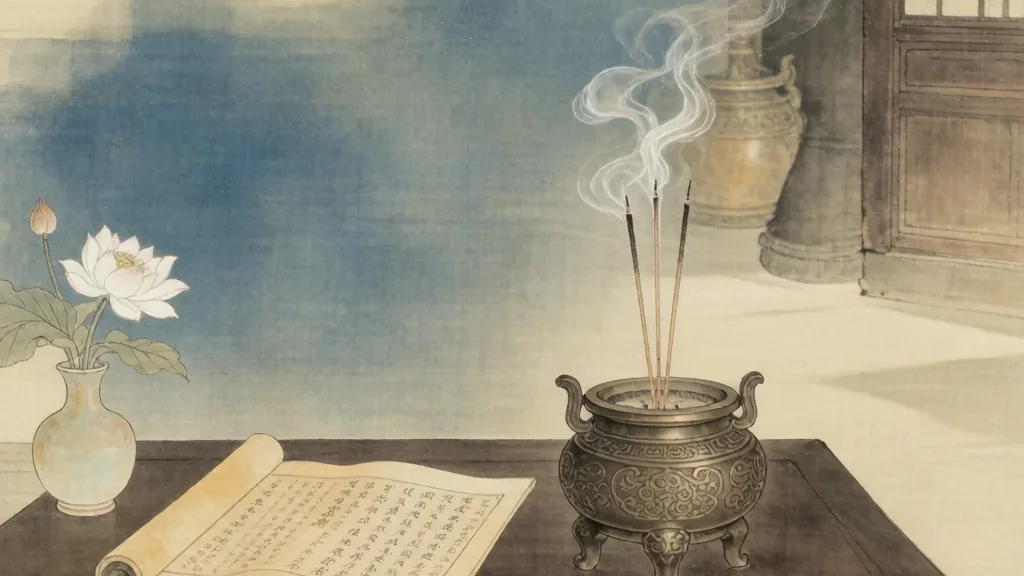
Close your eyes and imagine the interior of an ancient Chinese temple. What do you sense? The cool stone underfoot, the dim light filtering through carved windows, the murmur of chanting monks — and, above all, the fragrance. Incense, with its complex, layered aroma, is the olfactory signature of Chinese spiritual life. It rises from bronze censers in Buddhist temples, wafts through Daoist ceremonies, and drifts from the ancestral altars of family homes. For over three thousand years, incense has been an essential medium connecting the human world to the divine.
But Chinese incense culture extends far beyond religion. It encompasses a sophisticated secular tradition of fragrance appreciation — the scholar's incense ceremony, the connoisseurship of rare aromatic woods, the art of blending complex incense recipes. In the refined world of the Chinese literati, the appreciation of incense was ranked alongside poetry, calligraphy, painting, and tea as one of the essential arts of a cultivated life. To understand Chinese incense culture is to enter a world where fragrance becomes a path to wisdom, beauty, and inner peace.
Three Thousand Years of Fragrance
The use of incense in China dates back to the Neolithic period. Archaeological excavations have uncovered evidence of aromatic plants being burned in ritual contexts as early as 4000 BCE. The earliest written records of incense use come from the Shang Dynasty, when oracle bone inscriptions mention the burning of aromatic woods in religious ceremonies. The Chinese character for incense — 香 — appears in these early texts, its form depicting grain being offered to the gods, suggesting the ancient association between fragrance and the sacred.
During the Zhou Dynasty, incense use became more sophisticated. The Rites of Zhou describes the use of aromatic herbs in purification rituals and the burning of incense as part of the ceremonies honoring ancestors. The connection between incense and ancestor worship was particularly important — the rising smoke of incense was believed to carry prayers and offerings to the spirits of the deceased, creating a bridge between the worlds of the living and the dead.
The introduction of Buddhism to China during the Han Dynasty transformed incense culture. Buddhist practice placed great emphasis on incense as an offering to the Buddha and as an aid to meditation. The fragrance of incense was believed to purify the environment, calm the mind, and create an atmosphere conducive to spiritual practice. Buddhist temples became centers of incense culture, and the demand for high-quality incense materials drove trade networks that stretched from Southeast Asia to the Middle East.
Agarwood: The Emperor of Fragrances
At the apex of Chinese incense culture stands agarwood — chenxiang — the most precious and sought-after aromatic material in Chinese history. Agarwood is not a species of tree but a resinous substance produced by certain trees of the genus Aquilaria when they become infected with a specific type of mold. The tree produces the dark, fragrant resin as a defense mechanism, and over many years — sometimes decades or even centuries — the resin-saturated wood develops its extraordinary aroma.
The rarity and beauty of agarwood made it one of the most valuable commodities in pre-modern China. The finest grades of agarwood were worth more than their weight in gold. Agarwood was used in the imperial court, in the most important religious ceremonies, and by the wealthiest connoisseurs. The trade in agarwood connected China to the tropical forests of Southeast Asia, where the Aquilaria trees grow, creating commercial networks that spanned the South China Sea.
The appreciation of agarwood became a specialized field of connoisseurship. Experts could distinguish between dozens of different types of agarwood based on their origin, color, density, and aromatic profile. The most prized variety was qinan, a particularly dense and aromatic form of agarwood that was so rare it was reserved almost exclusively for the imperial family. The burning of a single sliver of high-grade agarwood could fill an entire room with a complex, evolving fragrance that unfolded over hours.
The Scholar's Incense Ceremony
During the Song Dynasty, incense culture reached its zenith as a secular art form. The scholar-official class elevated the appreciation of incense to a refined pursuit, developing elaborate rituals and protocols for the preparation and enjoyment of fragrance. The scholar's incense ceremony — xiangdao — became one of the "Four Arts of the Chinese Scholar," alongside tea ceremony, flower arrangement, and painting appreciation.
The incense ceremony was not about burning large quantities of incense to fill a room with fragrance. It was about the mindful appreciation of subtle aromas, the cultivation of sensory awareness, and the creation of a meditative atmosphere. The ceremony involved a series of precise, deliberate actions: selecting the incense, preparing the censer, heating the charcoal, placing the incense on the heated surface, and then sitting in quiet contemplation as the fragrance slowly emerged.
Each step of the ceremony was an opportunity for mindfulness and aesthetic appreciation. The incense utensils — the censers, the ash presses, the incense boxes, the spatulas and tweezers — were works of art in themselves, crafted from bronze, porcelain, jade, or lacquer. The incense was often blended according to complex recipes that combined multiple aromatic ingredients, each contributing its own note to the overall fragrance. The goal was not simply to smell something pleasant but to enter into a state of heightened awareness and tranquility.
Incense in Daily Life
Beyond the temple and the scholar's study, incense permeated Chinese daily life. It was used to perfume clothing and living spaces, to repel insects, to mark the passage of time (incense clocks burned at a known rate), and to create a pleasant atmosphere for social gatherings. Different occasions called for different types of incense: fresh, light fragrances for summer; warm, rich fragrances for winter; specific blends for weddings, funerals, and festivals.
Incense played an important role in traditional Chinese medicine. Different aromatic materials were believed to have different therapeutic properties, and incense was used to treat conditions ranging from respiratory problems to emotional distress. The warming, dispersing quality of many incense ingredients was thought to promote the flow of qi and blood, relieve stagnation, and calm the spirit. The line between incense as luxury and incense as medicine was often blurred — a fine agarwood incense was both a sensual pleasure and a health-promoting practice.
In the intimate spaces of women's quarters, incense took on special significance. Women used incense to perfume their clothing and living spaces, and the art of incense appreciation was one of the cultural accomplishments expected of a well-bred woman. The image of a beautiful woman burning incense in her chamber, the fragrant smoke curling around her like a veil, became a recurring motif in Chinese poetry and painting, symbolizing refinement, sensuality, and the private world of feminine culture.
The Decline and Revival
The fall of the Qing Dynasty and the tumultuous twentieth century dealt severe blows to Chinese incense culture. The traditional literati class, who had been the primary patrons and practitioners of the incense arts, was disrupted by political and social change. The material culture of incense — the rare woods, the exquisite utensils, the complex recipes — was lost or dispersed.
Yet incense culture did not disappear entirely. In Taiwan, Hong Kong, and overseas Chinese communities, the tradition was preserved. Buddhist and Daoist temples continued to burn incense in their rituals. And in recent decades, as China has experienced a cultural renaissance, incense culture has experienced a remarkable revival. A new generation of enthusiasts has rediscovered the scholar's incense ceremony, studied the classical texts on incense, and revived the art of blending traditional incense recipes.
The revival of incense culture is part of a broader re-engagement with traditional Chinese arts and lifestyles. Alongside the revival of tea ceremony, classical music, and traditional clothing, the incense arts have found new audiences among young Chinese seeking connection to their cultural heritage. Incense workshops, ceremonies, and exhibitions draw enthusiastic participants, and the market for high-quality incense materials and utensils has grown rapidly. A tradition that once seemed on the verge of extinction is once again flourishing.
The Art of Fragrance Today
In contemporary China, incense culture exists in multiple forms. In temples, the ancient tradition of incense offering continues, with worshippers lighting bundles of incense sticks and bowing before statues of the Buddha and bodhisattvas. In private homes, a simplified version of the incense ceremony is practiced by those who find in it a refuge from the stresses of modern life — a few minutes of quiet contemplation with a favorite incense can be a powerful antidote to the constant stimulation of the digital age.
The global appreciation of incense has also grown. The Japanese incense ceremony — kodo — which developed from Chinese influences, has gained international recognition. Western aromatherapy has drawn on traditional knowledge of incense materials for their therapeutic properties. And the growing interest in mindfulness and meditation has introduced many people to the use of incense as an aid to contemplative practice.
The enduring appeal of incense culture lies in its engagement with the most neglected of the human senses. In a world dominated by visual and auditory stimulation, the cultivation of olfactory awareness offers a different kind of experience — slower, more subtle, more intimate. The fragrance of incense cannot be captured in a photograph or a recording. It must be experienced directly, in the present moment. In this sense, incense culture is not just an art form but a practice of mindfulness, a way of being fully present to the world through the most ancient and primal of our senses.
Incense and the Cultivation of Smell
Chinese incense culture is unusual in treating smell as a refined aesthetic sense on par with sight and sound. Where the West long favored the visual, the Chinese literati built a practice around fragrance for its own sake, training the nose to follow a scent as it opens, peaks, and fades. This mirrors the contemporaneous arts of tea and music, all of which prize subtle, slow perception over immediate impact. To sit with a heated sliver of agarwood was to practice attention itself, noticing what a hurried life misses. In this light incense is not decoration but a discipline of sensory awareness, a deliberate slowing that makes the present moment, and its quiet aromas, the whole point of the exercise.
Incense Utensils as Collectible Art
The objects of the incense ceremony were never mere tools. Censers of bronze and cloisonne, ash presses, tweezers, and boxes for storing sticks or powder were crafted by premier workshops and often signed by famous makers. A fine censer might bear a reign mark or a poet's inscription, and collectors prized the patina that years of use bestowed. Because the utensils sat in the scholar's study and on the altar alike, they joined the world of art and the world of ritual, and the best examples passed between connoisseurs like paintings. The care lavished on these small things shows how seriously the culture took the framing of fragrance, treating the vessel almost as highly as the scent it released.
❓ Frequently Asked Questions
📝 Chinese Vocabulary
- 香文化 (xiāng wénhuà) — Incense culture; the art and tradition of fragrance appreciation
- 沉香 (chénxiāng) — Agarwood; the most precious incense material in Chinese culture
- 香道 (xiāngdào) — The Way of Incense; the scholar's incense ceremony, one of the Four Arts
- 奇楠 (qínán) — Kyara; the highest grade of agarwood, reserved for the imperial family
- 香炉 (xiānglú) — Incense burner or censer; the vessel used for burning incense
🎉 Fun Facts
- The highest grades of agarwood have historically been worth more than their weight in gold, and a single gram of top-quality kyara can sell for thousands of dollars today.
- During the Song Dynasty, the incense ceremony was considered one of the "Four Arts of the Chinese Scholar," alongside the tea ceremony, flower arrangement, and painting appreciation.
- Incense clocks — calibrated sticks or coils of incense that burned at a known rate — were used in ancient China to measure time, with different fragrances marking different hours of the day.
- The incense seal could be pressed into long connected patterns so a single coil of powder burned for a measured time, doubling as a timer.
- In the Song dynasty, connoisseurs held blind 'incense competitions' to identify a wood's origin and grade, much like tea or wine tastings.
- Sandalwood from southern China and India was a major trade good along the maritime routes, linking Chinese incense culture to the Indian Ocean world.