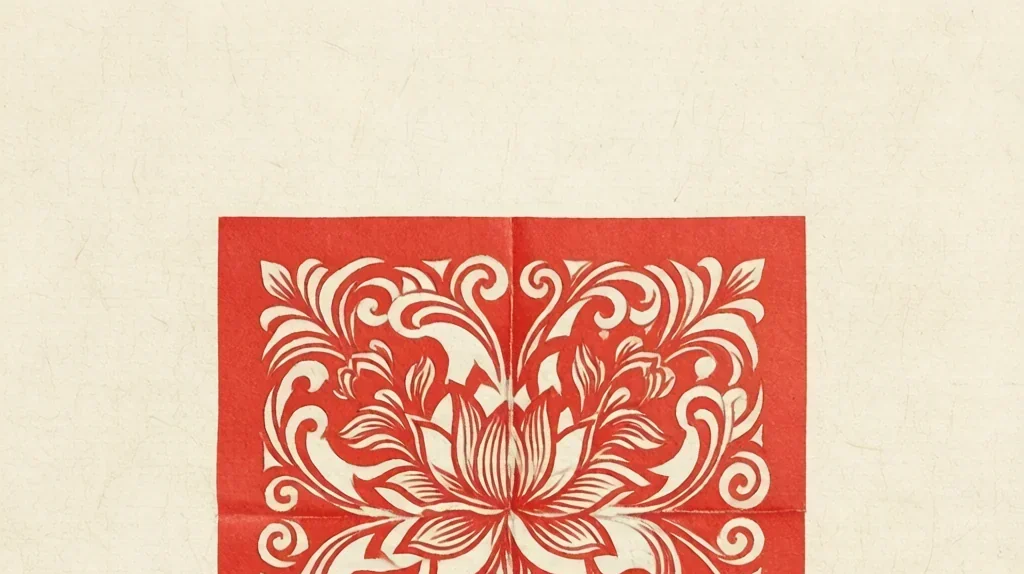
Take a square of red paper, fold it once or twice, and begin cutting with small, decisive snips of the scissors. When you unfold it, a butterfly appears. Or a peony. Or the double-happiness character 囍 glued to a wedding mirror. Or a fat, grinning baby holding a fish, pasted onto a farmer's window to invite a prosperous new year. This is 剪纸 (jiǎn zhǐ), "paper cutting" — one of the most beloved and most widely practiced folk arts in China, and one of the simplest to begin. All you need is paper, scissors, and patience.
For over fifteen hundred years, Chinese paper cuttings have brought color and meaning to homes, temples, and celebrations. They appear on windows, lanterns, ceilings, and gifts. They tell stories of gods and heroes. They carry wishes for fertility, longevity, wealth, and peace. And in 2009, UNESCO inscribed Chinese paper cutting on its Representative List of the Intangible Cultural Heritage of Humanity — recognizing what every village grandmother already knew: that a pair of scissors, in the right hands, can be a magic wand.
A Craft Born from Paper Itself
Paper was invented in China. Tradition credits a Han Dynasty court eunuch named Cai Lun (蔡伦) with the process in 105 CE, though archaeologists have found paper fragments dating even earlier. Once paper existed, it was almost inevitable that someone would begin to cut it. The earliest surviving paper cuttings come from the 6th century CE, unearthed at the Astana Tombs in Xinjiang: symmetrical floral patterns in blue and red, remarkably well preserved in the dry desert climate.
But the craft likely began centuries before. During the Han Dynasty, people cut thin sheets of silk, leather, and gold leaf into decorative patterns — and the moment paper became affordable, the same techniques moved to the new material. By the Tang Dynasty (618–907), paper cutting was a flourishing art. The poet Du Fu (杜甫) mentioned it in verse, and Tang women cut elaborate "flower hairpins" from colored paper to wear in their hair on festival days.
The craft reached its greatest sophistication in the Ming and Qing dynasties, when regional styles matured. The north of China developed bold, vigorous designs — heavy scissors cutting through layers of red paper to make window decorations for Spring Festival. The south produced more delicate, lacelike work, sometimes cut with a knife on a wooden board rather than with scissors. Every region, every village, had its own motifs and its own masters — most of them women, working in the long winter evenings when the fields were frozen.
Why Red Paper? The Color of Joy and Protection
Look at almost any Chinese paper cutting, and one color dominates: red. Red is the color of joy in Chinese culture, the color of wedding dresses, New Year couplets, lanterns, and firecrackers. It is also a color of protection — believed to frighten away the mythical beast Nian (年) and other ill-meaning spirits. A paper cutting on a window does not just decorate; it blesses.
That said, paper cuttings are not always red. In some regions, white paper cuttings are used in funerary and ancestral rites. Green, purple, and gold appear in different local traditions. But for festivals and weddings, red is so dominant that the Chinese phrase for paper cutting almost implies the color. The contrast of brilliant red against the pale wood of a window frame or the white of a paper lantern is one of the iconic images of Chinese folk life.
The tradition of pasting cuttings on windows — called 窗花 (chuāng huā), "window flowers" — has a practical origin. Old Chinese windows were made of oiled paper stretched over a wooden lattice. The lattice let in cold drafts, and pasting paper cuttings over the joints both insulated and decorated. Over time, the decorative function overtook the practical one, and today even homes with glass windows continue the tradition of 窗花 at Spring Festival.
The Queen Who Was Cured by Paper
One of the most charming legends in the history of paper cutting concerns a Han Dynasty empress. According to tradition, Empress Chen (陈皇后), the consort of Emperor Wu (r. 141–87 BCE), fell ill with a strange affliction: she could not sleep, lost her appetite, and grew pale and weak. The imperial physicians were helpless. The emperor, deeply fond of her, offered a fortune to anyone who could cure her.
A young woman named Zhao, skilled with scissors, came forward. She took a sheet of fine paper and cut an image of the Empress as she had been before her illness — beautiful, radiant, full of life. She then lit a candle and burned the paper cutting, letting the ashes fall into a cup of wine. "Drink this," she told the Empress, "and your spirit will return to you." Empress Chen drank the wine, slept deeply for the first time in weeks, and woke restored. Whether the cure was in the paper, the wine, or simply the imaginative power of the ritual, no one could say — but from that day, the story goes, paper cuttings were believed to carry a healing, protective power, and the craft spread from the palace to the common people.
Historians debate the tale — Empress Chen is a real figure, but the story may be a later embroidery. What is certain is that paper cuttings have always been associated with protection, blessing, and the channeling of good fortune. A cutting of the character 福 (fú, "fortune") pasted upside down on a door invites luck to "pour out" (the word for "upside down" sounds like "arrive"). A cutting of the double fish invites abundance, because the word for fish (鱼, yú) sounds like "surplus." Every shape has a meaning.
The Symbolic Language of Paper
A trained eye can read a paper cutting like a sentence. Common motifs and their meanings include:
· The bat (蝠, fú) — sounds identical to 福 (fú, "fortune"). Five bats together represent the Five Blessings: long life, wealth, health, virtue, and a peaceful end.
· The peach (桃) — symbol of longevity, from the peaches of immortality in the garden of the Queen Mother of the West.
· The pomegranate (石榴) — bursting with seeds; symbol of fertility and many sons.
· The peony (牡丹) — the "king of flowers," symbol of wealth, honor, and feminine beauty.
· The dragon and phoenix (龙凤) — paired on wedding cuttings to represent the harmonious union of husband and wife.
· The "double happiness" character 囍 — two copies of 喜 joined together; the universal emblem of weddings, cut in red and pasted on mirrors, pillowcases, and bridal chests.
Often the motifs combine into elaborate rebuses. A cutting might show a boy riding a large fish: "boy" (童) plus "fish" (鱼, yú) plus "year after year" (年年) yields "年年有余" — "may you have surplus year after year." The artistry is not only in the cutting but in the wit of the wordplay.
Regional Styles: From Shaanxi Boldness to Yangzhou Lace
China's paper cutting traditions vary sharply by region. Shaanxi Province in the northwest is famous for bold, primitive designs — fat animals, oversized figures, and strong red shapes that read clearly from across a courtyard. The style reflects the loess plateau's harsh landscape and the practical need to be seen from a distance. Shanxi and Hebei produce similar vigorous work, often featuring fat babies and livestock.
In contrast, Yangzhou in Jiangsu is known for exquisite, lacelike cuttings executed with a small knife on a wax board rather than with scissors. The lines can be finer than a hair, depicting flowers, birds, and scenes from classical opera with the precision of a master engraver. Foshan in Guangdong developed a unique technique of cutting colored foil — copper, gold, and silver leaf backed with paper — producing glittering decorations for temples and dragon boats.
What unites all these traditions is the practice of cutting many layers at once. A skilled artist folds the paper into four, eight, or sixteen layers, then cuts through all of them in a single pass — producing identical copies to distribute to neighbors, paste on every window, or sell at the temple fair. The community dimension of paper cutting is part of what makes it so enduring: it is an art made to be shared.
Paper Cutting Today
In modern China, paper cutting is taught in primary schools, practiced by hobbyists, and preserved by master artists designated as national intangible cultural heritage inheritors. Contemporary cuttings appear on stamps, posters, fashion, and animation — most notably in the opening sequence of the 2008 Beijing Olympics, where a paper-cut style animation introduced the world to the games. The craft has also traveled: Chinese communities in Southeast Asia, the Americas, and Europe continue the tradition, and Western artists have adopted paper cutting as a fine art in its own right.
For the curious beginner, paper cutting is one of the most accessible of all Chinese arts. A pair of small sharp scissors, a packet of red paper, and a simple printed pattern are enough to begin. The discipline is not in the materials but in the hand: the cut must be clean, the curves smooth, and the negative space — the empty paper left behind — as carefully considered as the lines themselves. In paper cutting, as in so much of Chinese art, what is removed is as important as what remains.
Techniques: Scissors, Knife, and Negative Space
The craft divides into two main techniques. Scissor cutting, the older and more widespread method, folds the paper and snips symmetrical motifs freehand, the cut lines becoming the picture. Knife cutting, favored in Yangzhou and other southern workshops, lays the paper on a soft wax or tallow board and pushes a fine blade through many layers at once, achieving hairline detail impossible with scissors. In both methods the unused paper matters as much as the removed paper. The negative space between shapes is deliberately shaped, so a finished cutting reads as much by its voids as by its lines. Mastery lies in controlling that emptiness, a discipline that turns a humble sheet into a lattice of meaning. This attention to what is left out is what gives paper cutting its airy, almost architectural grace.
Paper Cutting in Performance and Pop Culture
Beyond the window and the wedding mirror, paper cutting has long fed Chinese performance and modern media. Shadow-puppet theatre and certain opera backdrops borrow its silhouette language, and itinerant street artists still cut a customer's portrait in seconds for a few coins. In the twentieth and twenty-first centuries the idiom migrated into book illustration, poster design, animated film, and fashion, most famously in the paper-cut style prologue of the 2008 Beijing Olympics. Contemporary artists exhibit large cuttings as gallery works, while craft cooperatives sell them as souvenirs that fund the training of new inheritors. The form thus straddles folk ritual and commercial design, proving that a village art can keep its symbolism while speaking a modern visual language.
❓ Frequently Asked Questions
📝 Chinese Vocabulary
剪纸 — : paper cutting; the folk art of cutting decorative patterns from paper, usually red, using scissors or a small knife.
窗花 — : "window flowers"; paper cuttings pasted on windows, especially during Spring Festival, originally to insulate wooden lattice windows and now a beloved decoration.
囍 — : "double happiness"; two copies of the character 喜 joined together, the universal emblem of Chinese weddings, always cut in red.
福 — : fortune, blessing, happiness; the single most auspicious character in Chinese culture, often cut in paper and pasted upside down to invite luck to "arrive."
刻刀 — : carving knife; the small blade used to cut fine paper cuttings from a wax- or wood-backed block, favoring precision over the scissors.
团花 — : round or medallion paper cutting; a circular design pasted at the center of a ceiling or window as a symbol of unity and completeness.
鞋花 — : shoe-pattern paper cutting; small motifs used as templates for embroidering the uppers of traditional cloth shoes.
门笺 — : door banner; a fringed paper hanging cut with auspicious characters and fixed above a doorway at New Year to invite luck.
🎉 Fun Facts
- The earliest surviving Chinese paper cuttings date from the 6th century CE, found preserved in the dry Astana Tombs in Xinjiang — but the craft is believed to be far older, originally practiced on silk, leather, and gold leaf before paper became affordable.
- The character 福 is traditionally pasted upside down on doors at Spring Festival, because the word for "upside down" (倒, dào) sounds identical to the word for "arrive" — so an upside-down blessing becomes an arriving blessing.
- Master paper cutters often cut through eight or sixteen layers of folded paper at once, producing identical copies to share with neighbors — a tradition that turns a solo art into a community ritual.
- In 2009 UNESCO inscribed Chinese paper cutting on its Representative List of the Intangible Cultural Heritage of Humanity, recognizing a craft practiced in villages for over fifteen centuries.
- The opening sequence of the 2008 Beijing Olympics used a paper-cut style animation to introduce the games to a worldwide television audience.
- Besides festive red, some regional traditions use white paper cuttings for funerary and ancestral rites, a reminder that the art carries sorrow as well as celebration.