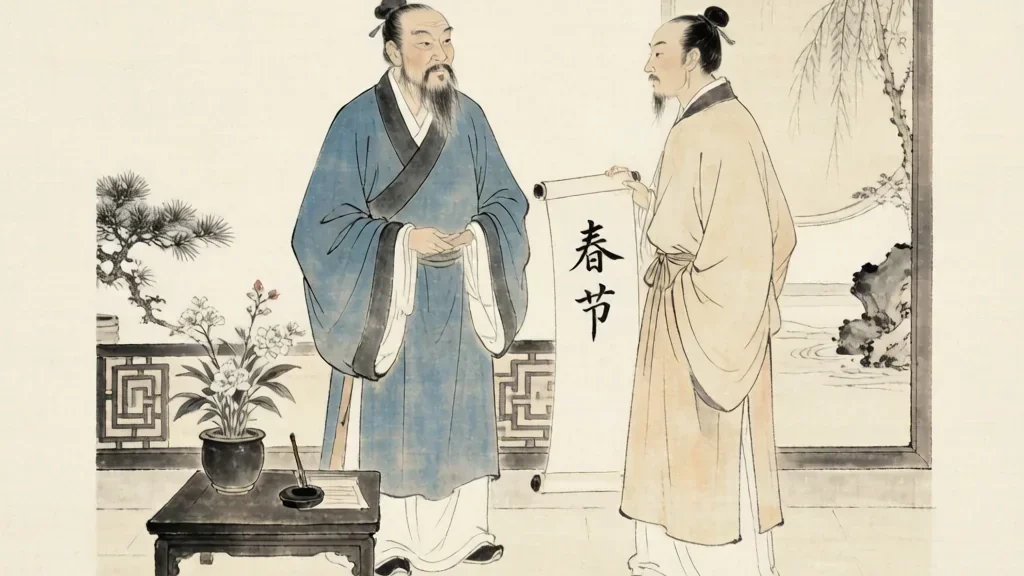
Long before the red paper couplets that now grace every Chinese door at New Year, there were 桃符 (Táo Fú), "peachwood charms," the ancient talismans hung at gateways to keep evil away. Made of peach wood inscribed with the names or images of two door-protecting gods, these charms were the direct ancestors of today's spring couplets. To study Táo Fú is to follow a single idea, that the threshold is a sacred boundary, through more than two thousand years of Chinese history, from shamanic wood to literary art. It shows how a protective object can slowly turn into a cultural ornament without losing its original wish for safety.
The Peachwood Charm
Táo Fú were typically rectangular slabs of peach wood, one hung on each side of a gate, bearing the names of the gods Shen Tu and Yu Lei, or later the generals Qin Qiong and Wei Zheng, who were believed to guard the portal against wandering demons. Peach wood was chosen because it was thought to possess innate power against evil, a belief reaching back to myth. The charm did not decorate so much as stand watch.
In form the early Táo Fú were roughly the size of a small plank and unadorned except for carved or written names. Their job was defensive: to block misfortune at the point of entry, exactly where households are most exposed. The pair of charms thus acted as invisible sentries, one left, one right, mirroring the paired guardians of later tradition.
The Myth of the Peach Tree
The power of peach wood comes from an old legend of the mythical Emperor Ku or, in another version, the god who ruled the spirit world, who set Shen Tu and Yu Lei to guard a great peach tree on the mountain of ghosts. These two gods caught and devoured harmful spirits, and because they stood by a peach tree, peach wood became associated with the power to repel ghosts. People carved their names on peach planks to summon that protection.
This myth explains why the charm is specifically peach, not any wood. The tree itself was the original talisman, and the carved slab was its portable stand-in. Over centuries the association hardened into custom: no peach wood, no reliable guard. The natural world, in Chinese folk belief, was a pharmacy of protections, and the peach was among its strongest medicines.
From Charm to Couplet
By the Five Dynasties period, the written names on Táo Fú began to give way to auspicious phrases, and the scholar-emperor Li Houzhu is credited with writing the first "couplet" on peachwood boards. During the Ming dynasty, the Hongwu Emperor reportedly ordered households to paste pairs of auspicious verses on their doors at New Year, accelerating the shift from protective names to poetic lines. Red paper eventually replaced wood, and the spring couplet, chunlian, was born.
The transition is a beautiful example of how Chinese ritual evolves: the object kept its place and purpose, shed its wooden body, and gained literary grace. What began as a ghost-repelling name became a polished couplet wishing prosperity and spring. The magic did not vanish; it was simply rewritten in the language of poetry, which the culture prizes as its own kind of power.
Ritual of Hanging at New Year
In the era of Táo Fú, households would replace the old charms with new ones on the eve of the new year, a renewal of protection timed to the calendar's turning. The act of taking down the weathered plank and hanging a fresh one mirrored the broader new-year theme of clearing the old and welcoming the new. Position mattered: one charm left, one right, symmetric and alert.
Even after paper couplets took over, the timing and placement carried forward, the new verses pasted where the old wood had hung. The continuity let people keep the comfort of the ancient guard while enjoying the wit of the new words. Threshold protection, it turns out, is one of the most conservative impulses in Chinese domestic life, changing its costume but never its post.
Survival in Folk Custom
Though peachwood charms are no longer everyday door furniture, they survive in several forms. Taoist talismans and spirit-writing practices still use peach wood, and in some rural areas small peach charms or peach-shaped ornaments appear at festivals. The peach itself remains a symbol of longevity and warding, appearing in art, medicine, and New Year imagery as a direct descendant of the Táo Fú idea.
The charm's true heir, the spring couplet, now hangs on hundreds of millions of doors each year, its red paper a modernization of the red-painted wood of old. To read a couplet is thus to read a palm-sized history of Chinese religion: shamanic guardian, imperial decree, poetic blessing, all compressed into two vertical lines flanking the entrance.
The Threshold as Boundary
Underlying Táo Fú is a spatial philosophy: the door is where inside meets outside, where the known family meets the unknown world, and therefore where protection is most needed. Chinese custom lavishes attention on this boundary, door gods, couplets, mirrors, and thresholds all serve to manage what crosses. The peach charm is simply the oldest documented member of this guardian family.
That the charm evolved rather than disappeared suggests how deeply the boundary instinct runs. Modern city dwellers may not believe in demon-catching gods, yet they still like a fresh red couplet each year, if only for cheer. The Táo Fú taught the door to speak a wish, and the door has been speaking ever since, in wood first, then in verse.
Peachwood in Taoist Ritual
The protective power attributed to the peach made it a staple of Taoist exorcism. Priests inscribed talismans on peachwood slips and seals, believing the wood itself suppressed demons that no ordinary material could bind. Peachwood swords and arrows appear in liturgical kits used to sweep a house clear before a rite, and the wood features in the legends of the demon-catching judge Zhong Kui. This ritual use explains why the humble Táo Fú was never merely decorative: it was a portable piece of the exorcist's toolkit, and the doorway was its front line. The charm thus belongs to a wider Taoist technology of protection in which the right material and the right name together hold the boundary.
From Wood to Paper: The Couplet's Form
The shift from peachwood plank to red paper couplet is a study in how form changes while function stays. The early charm was a solid object inscribed with guardian names; the later couplet is a flat sheet printed with auspicious verse. What persisted was placement at the gate, renewal at the new year, and the wish to block misfortune and invite blessing. Red paper was cheaper, easier to write on, and visually festive, so it displaced wood without breaking the custom's logic. Reading a modern spring couplet therefore means reading an object whose body is new but whose office is ancient, a small example of Chinese ritual's talent for keeping its meaning while swapping its costume across the centuries.
❓ Frequently Asked Questions
📝 Chinese Vocabulary
桃符 — : peachwood door charm, forerunner of couplets.
桃 — : peach, a wood believed to ward off evil.
春联 — : spring couplet displayed at New Year.
门神 — : door gods who guard the threshold.
神荼郁垒 — : the two mythic guardian gods of the peach tree.
桃木板 — : A peachwood plank, the material from which the original door charms were cut.
桃印 — : A peachwood seal or talisman used in exorcism and protection rites.
桃人 — : A peachwood effigy placed at gates or corners to guard a dwelling.
🎉 Fun Facts
- The Táo Fú are considered the direct ancestors of the modern spring couplet.
- Peach wood was believed so protective that it featured in Taoist exorcism talismans.
- A scholar-emperor of the Five Dynasties is credited with writing the first couplet on peachwood.
- The custom of renewing door charms at New Year is over a thousand years old.
- In some early records peachwood figures were buried at the four corners of a house or set at the gate to anchor the protective boundary against stray spirits.
- The peach's protective reputation was so strong that peachwood arrows were sometimes hung to symbolically shoot approaching evil.