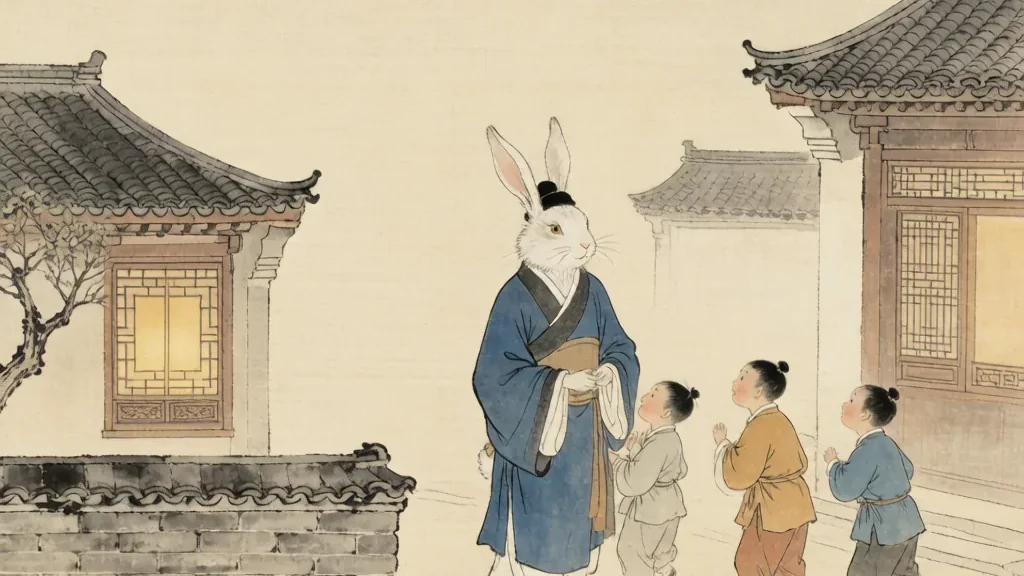
Tu'er Ye (兔儿爷), often translated as the "Lord Rabbit" or "Rabbit God," is a beloved figure of Beijing folk culture, especially associated with the Mid-Autumn Festival. He is a clay or dough figurine shaped like a rabbit — standing upright, dressed as a general or court official, sometimes seated on a tiger or lotus — and was traditionally bought by families as a children's toy and a small household deity to honor the moon. Part toy, part tutelary spirit, Tu'er Ye captures the playful, domesticated side of Chinese popular religion, where even a humble hare can be elevated to a gentle god who brings peace and good weather.
Origins in the Moon Hare Legend
Tu'er Ye grows out of the ancient East Asian myth of the Moon Hare (Yù tù, 玉兔), the jade rabbit who lives on the moon pounding the elixir of immortality with a mortar and pestle. This image appears in poetry and art for well over a thousand years, linking the rabbit to the moon, to Chang'e the moon goddess, and to theMid-Autumn festival of moon-viewing.
The leap from moon-hare to a humanized "Lord Rabbit" seems to have crystallized in the Beijing area, where during times of plague the rabbit was imagined as a healing deity. A well-known legend says that during an epidemic the hare descended from the moon disguised as a doctor, cured the sick, and was then honored as Tu'er Ye — a story that explains his medical and protective role.
Tu'er Ye as a Beijing Specialty
By the Qing dynasty, Tu'er Ye had become a distinctive product of the capital. Vendors sold the figurines in the run-up to the Mid-Autumn Festival at temple fairs and markets, and making them became a recognized Beijing craft. The figures were affordable, so almost any family could own one, which helped root the custom firmly in the city's popular memory.
Old Beijingers recall "Tu'er Ye stalls" lining the streets before the eighth lunar month, with rows of rabbits in every size. The figurine was less a solemn idol than a seasonal companion — a sign that autumn and the moon festival had arrived, much as a Christmas figure marks the winter holiday in the West.
Appearance and Iconography
A classic Tu'er Ye is a rabbit's head on an upright human body, long ears intact, wearing the armor or robes of a general or official, and frequently mounted on a tiger, lotus, or elephant. The contrasts — a soft prey animal in martial dress — are deliberate and comic, signaling protection through gentle rather than fearsome power.
The figurines were painted in bright mineral pigments: white or pink face, gold trim, a red robe. Some deluxe versions were quite elaborate, with multiple heads or a whole "rabbit family" arranged as a tableau. The mixture of the cute and the august is exactly what made Tu'er Ye endearing to children and reassuring to adults.
Role in the Mid-Autumn Festival
During the Mid-Autumn Festival families set out mooncakes, fruits, and a Tu'er Ye on a table in the courtyard to "worship the moon" (jì yuè). After the rite, the figure often passed into the hands of the children as a toy, blurring the boundary between offering and plaything in a way characteristic of Chinese domestic ritual.
Because the Moon Hare is tied to the elixir of longevity, Tu'er Ye also carried wishes for health and family reunion — the central themes of Mid-Autumn. The figurine thus did quiet cultural work: it made the cosmic moon tangible and friendly for the youngest members of the household.
Craft Techniques and Materials
Traditional Tu'er Ye were molded from clay or made from a dough-like paste, then painted by hand. Artisans used two-piece molds to shape the body quickly, allowing mass production for the festival rush, while the facial details and robes were individualized with a brush.
In the twentieth century molded plaster and other materials appeared, and some makers turned to painted clay with finer detail. The craft was recognized as an item of Beijing intangible cultural heritage, and master artisans have been documented demonstrating the old molding and painting methods for new generations.
Decline and Revival
Tu'er Ye figurines nearly vanished in the mid-twentieth century as old festivals were discouraged and the handcraft lost customers. For a time the "Lord Rabbit" survived mainly in elderly Beijingers' memories and in old photographs and museum collections of festival objects.
Since the revival of traditional festivals in the late twentieth and early twenty-first centuries, Tu'er Ye has returned as both a heritage craft and a popular souvenir. Contemporary artists produce designer versions, and the figure appears on posters, stamps, and café merchandise, once again a cheerful emblem of Beijing autumn.
Tu'er Ye in Contemporary Culture
Today Tu'er Ye functions as a mascot of Beijing identity. The round-eared general shows up in city tourism campaigns, children's books, and animated shorts, recast as a friendly local hero rather than a religious object. This softening mirrors the broader fate of many folk deities in modern China.
Yet for many residents the figurine still carries a whisper of its old meaning: a small guardian who keeps the household safe as the moon grows full. Whether bought as a toy, a souvenir, or a quiet offering, Tu'er Ye remains a rare example of a folk god who never stopped being a child's friend.
The Rabbit in Broader Chinese Culture
Tu'er Ye draws on a deep well of affection for the rabbit in Chinese culture. The hare is one of the twelve zodiac animals, associated with the moon, gentleness, and longevity, and it appears in countless folk tales, paintings, and festival decorations. Its link to the moon goddess and the elixir of immortality made the rabbit a natural symbol of healing and peace, traits that Tu'er Ye absorbed when the moon hare was recast as a protective household deity in Beijing.
This broader cultural status helps explain why Tu'er Ye remains endearing rather than obscure. Unlike many local minor gods, the rabbit is a familiar and beloved figure across China, so the Beijing "Lord Rabbit" reads as a friendly cousin to a widespread cultural symbol. Seasonal and zodiac art featuring rabbits finds an eager audience every year, and Tu'er Ye benefits from that affection. The figurine thus sits at the meeting point of a universal Chinese fondness for the moon hare and a specifically Beijing craft tradition, a combination that has carried the "Lord Rabbit" from temple fair stall to heritage mascot.
❓ Frequently Asked Questions
What is Tu'er Ye?
Tu'er Ye is the "Lord Rabbit," a Beijing clay figurine of a rabbit dressed as a general, used at Mid-Autumn as both a children's toy and a small household moon deity.
Where did Tu'er Ye come from?
He derives from the Moon Hare legend and a Beijing plague-healing folktale, becoming a distinct capital craft by the Qing dynasty.
When is Tu'er Ye displayed?
He is set out for the Mid-Autumn Festival moon-worship rite, then typically becomes a child's plaything afterward.
What does Tu'er Ye look like?
A rabbit's head on an upright human body in official or martial robes, often seated on a tiger or lotus, painted in bright colors.
Is Tu'er Ye still made today?
Yes. The craft was revived as Beijing intangible heritage, and both traditional and modern designer versions are sold as souvenirs.
Is Tu'er Ye a real god?
Historically he was a minor folk deity of protection and healing; today he is mostly a cultural mascot and festival toy.