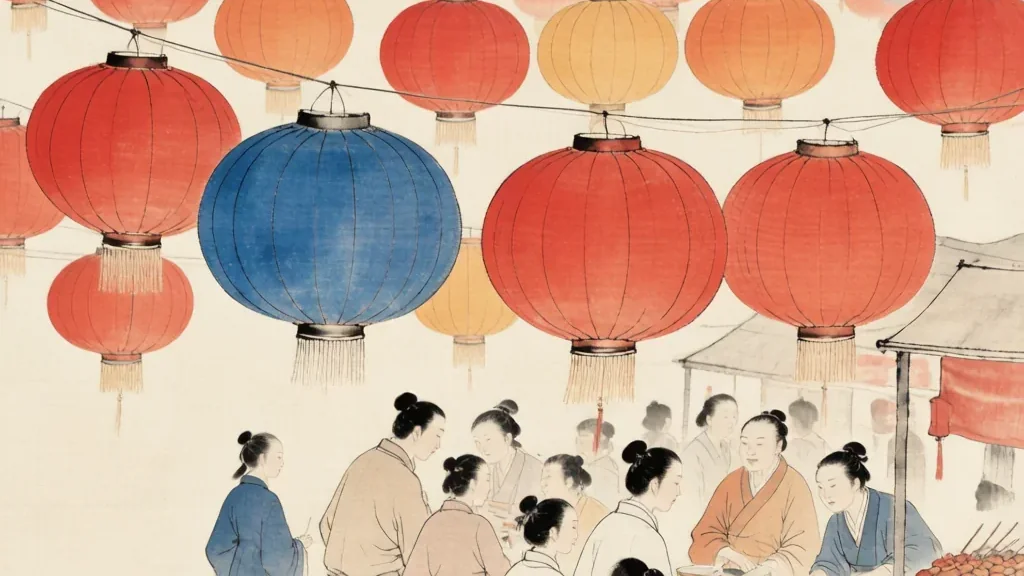
Imagine walking through a sea of red lanterns, the air thick with the aroma of sizzling skewers and sweet candied hawthorn. Drums beat in the distance as a dragon dance weaves through the crowd. Children clutch sugar paintings of their zodiac animals while elderly couples browse stalls selling papercuts and calligraphy scrolls. This is a Chinese temple fair — miaohui — one of the most vibrant and enduring traditions in Chinese folk culture, where the sacred and the secular dance together in a celebration that has been bringing communities together for over a thousand years.
Temple fairs originated as religious gatherings at Buddhist and Daoist temples during festival days. Worshippers would come to burn incense, offer prayers, and participate in rituals, and vendors would gather outside the temple gates to sell food, crafts, and entertainment to the crowds. Over time, the commercial and entertainment aspects grew until temple fairs became major social events that drew people from miles around, regardless of their religious inclinations. Today, the temple fair tradition continues to thrive, particularly during the Spring Festival (Chinese New Year), when some of the largest and most spectacular temple fairs in the world draw millions of visitors.
Ancient Roots
The origins of temple fairs can be traced back to the Han Dynasty, when Buddhist and Daoist temples began to hold regular gatherings on significant religious dates. These gatherings served multiple purposes: they were opportunities for worship and ritual, but they also functioned as markets where farmers could sell their produce, craftspeople could display their wares, and traveling performers could entertain the crowds. The Chinese term miaohui literally means "temple gathering," reflecting this dual nature — part religious observance, part community festival.
During the Tang and Song dynasties, temple fairs flourished. The great Buddhist monasteries of the capital cities hosted elaborate fairs that attracted not only local residents but also pilgrims and merchants from distant provinces. The famous temple fair at the Xiangguo Monastery in Kaifeng, described in vivid detail in Song Dynasty records, featured everything from antiques and books to exotic foods and performing monkeys. These early temple fairs established patterns that would persist for centuries: the mixing of social classes, the blurring of sacred and secular space, and the creation of temporary communities united by shared celebration.
In the Ming and Qing dynasties, temple fairs became even more elaborate. The growth of urban centers created larger audiences, and the development of folk art forms like Beijing opera, shadow puppetry, and acrobatics provided new forms of entertainment. Each temple developed its own specialty fair on its designated festival day, and a calendar of fairs emerged that allowed vendors and performers to travel a circuit throughout the year, much like the medieval fairs of Europe.
The Spring Festival Temple Fairs
While temple fairs occur throughout the year, the Spring Festival temple fairs are by far the most important and spectacular. During the first fifteen days of the lunar new year, temples across China open their gates for celebrations that combine religious devotion with the festive spirit of the season. These fairs are an essential part of the New Year experience for millions of Chinese people, as integral to the holiday as family reunion dinners and red envelopes.
Beijing's temple fairs are particularly famous. The Ditan (Temple of Earth) Fair, held in the historic altar complex where emperors once performed sacrifices, is one of the largest, drawing over a million visitors during the Spring Festival period. The Changdian Temple Fair, with a history dating back over 400 years, is known for its antiques, books, and traditional crafts. The Baiyun Guan (White Cloud Temple) Fair, at one of China's most important Daoist temples, combines religious rituals with folk entertainment in a uniquely atmospheric setting.
What do visitors experience at a Spring Festival temple fair? The variety is staggering. Red lanterns and New Year couplets are for sale alongside traditional toys like pinwheels and shadow puppets. Folk performers demonstrate skills passed down through generations: stilt-walkers tower above the crowd, acrobats balance on towering poles, and storytellers recount tales of ancient heroes. Food stalls offer every imaginable treat, from lamb skewers seasoned with cumin to bowls of hot wonton soup to the quintessential temple fair snack — tanghulu, candied hawthorn berries on a stick, their glossy red coating catching the winter light.
Folk Performances and Living Traditions
The performing arts on display at temple fairs represent some of China's most cherished folk traditions. The lion dance and dragon dance are almost always present, their colorful costumes and athletic performances drawing the largest crowds. The lion dance, performed by two dancers inside a lion costume, requires extraordinary coordination and strength, while the dragon dance, with its team of performers manipulating a long fabric dragon on poles, is a mesmerizing display of collective rhythm.
Other traditional performances vary by region. In northern China, Yangge dancers in bright costumes perform a lively folk dance with handkerchiefs and fans. In Shaanxi, shadow puppet masters manipulate intricately carved leather figures behind illuminated screens, telling stories from history and legend. In Sichuan, face-changing performers from the local opera tradition dazzle audiences by instantaneously switching between colorful masks with a flick of the wrist. Each region contributes its own distinctive flavor to the temple fair experience.
Perhaps most importantly, temple fairs serve as a venue for folk arts and crafts that might otherwise disappear. Papercut artists create intricate designs with scissors and red paper. Sugar painters use molten sugar to create edible sculptures of animals, flowers, and mythological figures. Dough figurine makers mold colorful dough into miniature characters from opera and folklore. Kite makers display their elaborate creations, some small enough to fit in a child's hand, others large enough to require several people to launch. The temple fair gives these traditional crafts an audience and a market, helping to preserve skills that have been passed down through generations.
Sacred Space, Secular Joy
Despite the carnival atmosphere, temple fairs retain their religious core. Many visitors begin their fair experience by entering the temple to burn incense and offer prayers. At Buddhist temples, they may light incense sticks and bow before statues of the Buddha and bodhisattvas. At Daoist temples, they may seek blessings from the gods and consult fortune tellers about the year ahead. The religious dimension of temple fairs is not separate from the festive dimension — the two are intertwined, each enriching the other.
One of the most distinctive temple fair rituals is the practice of "touching the auspicious." At many temple fairs, certain objects are believed to bring good luck if touched. Visitors line up to touch a particular stone carving, a bronze statue, or a temple door, believing that physical contact will transfer the object's auspicious power. At some fairs, people throw coins at a bell or gong, with a successful hit signifying good fortune for the coming year. These rituals, blending folk belief with playful interaction, are a unique feature of Chinese temple fair culture.
The temples themselves are often architectural and artistic treasures. Many temple fairs take place at historic sites that have been centers of worship for centuries. The architecture — with its curved eaves, painted beams, and guardian lion statues — provides a magnificent backdrop for the festivities. For many visitors, the temple fair is an opportunity to experience China's cultural heritage in a living, breathing context, rather than as a museum exhibit.
Temple Fairs in Modern China
The twentieth century was not kind to temple fairs. War, revolution, and political campaigns against "feudal superstition" led to the closure of many temples and the suppression of temple fair traditions. It seemed possible that this thousand-year-old tradition might be lost forever.
But temple fairs proved remarkably resilient. Since the 1980s, they have experienced a dramatic revival. Temples have been restored, folk arts have been revived, and temple fairs have once again become a central feature of Chinese cultural life. The revival has been supported by government cultural policies that recognize the value of intangible cultural heritage, as well as by the deep popular affection for temple fair traditions. Today, temple fairs are bigger and more elaborate than ever, drawing visitors from around the world.
The modern temple fair has also adapted to contemporary tastes. While traditional performances and crafts remain central, fairs now also feature modern amusements — Ferris wheels, haunted houses, video game booths — alongside the stilt-walkers and shadow puppeteers. Food stalls offer both traditional snacks and international treats. This blending of old and new has helped temple fairs remain relevant to younger generations while preserving their essential character.
The Community Spirit
At their heart, temple fairs are about community. They are occasions when neighbors gather, families reunite, and strangers become companions in shared enjoyment. In an increasingly urbanized and digitized society, temple fairs provide a rare opportunity for face-to-face community celebration. They are spaces where the social hierarchies of everyday life are temporarily relaxed, where children and grandparents, locals and tourists, rich and poor mingle in the common pursuit of pleasure.
The temple fair is also a space of cultural transmission. Grandparents teach grandchildren how to make papercuts. Parents explain the stories behind the opera performances. Children learn, often without realizing they are learning, about the traditions that have shaped their culture. In this sense, every temple fair is a living classroom, passing on knowledge and values from one generation to the next.
For overseas Chinese communities, temple fairs have taken on additional significance as sites of cultural preservation and identity affirmation. Chinatowns around the world hold their own temple fairs during the Spring Festival, adapting the tradition to local conditions while maintaining its essential spirit. These diaspora temple fairs serve as bridges between generations and between cultures, introducing Chinese traditions to wider audiences while providing a sense of home for those far from their ancestral land.
Food: The Taste of the Temple Fair
For many visitors the temple fair is first experienced through the nose. Stalls line the paths with sizzling skewers, steaming buns, and the glossy red of tanghulu, candied hawthorn berries that catch the winter light. Regional specialties appear as the fair travels: in the north, lamb rubbed with cumin and bowls of hot wonton; in the south, rice cakes and sweet soups. Food at the fair is more than sustenance, it is part of the festival's generosity, something to buy for a child, to share with an elder, or to carry home as a small trophy of the day. Vendors compete cheerfully for the loudest sizzle and the longest line, and the crowd's grazing from stall to stall becomes its own slow procession. In this way the fair feeds both body and mood, and the taste of a particular snack can summon the whole memory of a New Year.
A Living Museum of Folk Craft
Temple fairs have long acted as a open-air school for China's disappearing folk arts. Paper-cutters work red sheets with small scissors, sugar painters drizzle molten sugar into edible animals, and dough-figure makers pinch miniature opera heroes that fit in a child's palm. Kite makers show creations from pocket-sized to needing several people to launch, and calligraphers write couplets to order. Because the fairs draw large, mixed crowds, these crafts find both an audience and a market that they rarely meet elsewhere, and masters can pass skills directly to apprentices and curious onlookers. In an age of machine printing and digital entertainment, the fair remains one of the few places where a child can watch a traditional object made by hand in minutes. That living demonstration is why the fair is often called a museum without walls.
❓ Frequently Asked Questions
📝 Chinese Vocabulary
- 庙会 (miàohuì) — Temple fair; literally "temple gathering"
- 糖葫芦 (tánghúlu) — Candied hawthorn berries on a stick; the quintessential temple fair snack
- 舞龙 (wǔ lóng) — Dragon dance; a traditional performance featuring a long dragon manipulated by a team
- 踩高跷 (cǎi gāoqiāo) — Stilt-walking; a traditional folk performance
- 烧香拜佛 (shāo xiāng bài fó) — To burn incense and worship the Buddha; the religious aspect of temple visits
🎉 Fun Facts
- The Ditan Temple Fair in Beijing draws over one million visitors during the Spring Festival period each year, making it one of the largest cultural events in China.
- The Changdian Temple Fair in Beijing has a history dating back over 400 years to the Ming Dynasty, making it one of the oldest continuously operating festivals in the world.
- The 'touching the auspicious' ritual lets visitors queue to touch a stone, bronze statue, or temple door believed to transfer good luck to whoever contacts it.
- In the past, professional vendors and performers followed an annual circuit of temple fairs across regions, much like the traveling fairs of medieval Europe.
- Sichuan temple fairs may feature 'face-changing' performers who switch painted masks in an instant, a dazzling local opera skill.
- Overseas Chinatowns stage their own Spring Festival temple fairs, carrying the tradition abroad as a link between generations and cultures.