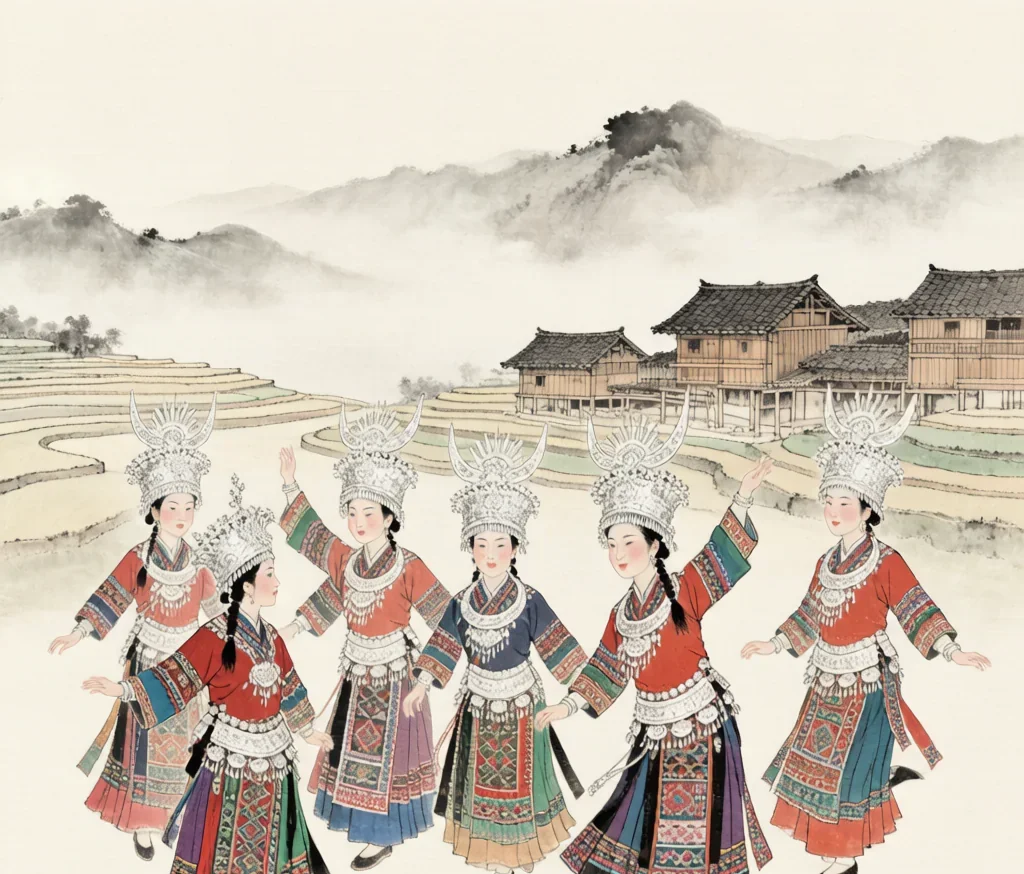
In the mist-shrouded mountains of southwestern China, where terraced rice fields cascade down hillsides and wooden villages cling to steep slopes, the Miao people have preserved one of Asia's most visually spectacular cultures. Known in Chinese as 苗族 (Miáo zú), the Miao are renowned throughout the world for their silver ornaments, intricate embroidery, and vibrant festivals. With a history stretching back over four thousand years, the Miao are among China's most ancient ethnic groups, and their culture represents a living link to the prehistoric civilizations of the Yangtze River basin.
A History Written in Silver
The Miao people trace their origins to the legendary Chi You, a tribal leader who fought against the Yellow Emperor in China's mythological prehistory. After Chi You's defeat, the Miao ancestors began a long migration southward, driven by pressure from expanding Chinese civilization. Over millennia, they moved from the central plains into the mountainous regions of what are now Guizhou, Hunan, Yunnan, and Guangxi provinces — a migration that is still commemorated in Miao oral traditions, songs, and the intricate patterns of their textiles.
Silver holds a position in Miao culture that is unique among the world's peoples. The Miao are not merely fond of silver — they have built an entire aesthetic around it. A Miao woman's festival costume can include over fifteen kilograms of silver ornaments: elaborate headdresses that frame the face in cascading chains, neck rings stacked from shoulder to chin, bracelets covering both arms from wrist to elbow, and intricate breastplates that cover the entire torso. The cumulative effect is dazzling — when hundreds of Miao women gather for a festival, the sound of their silver ornaments chiming with every movement creates a music all its own.
The cultural significance of silver extends far beyond decoration. Historically, silver was portable wealth — when the Miao were forced to migrate, they could carry their family's fortune on their bodies. Silver is also believed to have protective properties, warding off evil spirits and disease. Miao babies are given silver bracelets and anklets, and silver ornaments are an essential part of wedding dowries. The craft of silversmithing is passed from father to son, and master silversmiths enjoy high status in Miao communities.
The techniques of Miao silversmithing are ancient and sophisticated. Silver ingots are melted, hammered into thin sheets, and then worked through a combination of repoussé (hammering from the back to create relief), chasing (engraving from the front), filigree (soldering fine wires into patterns), and casting. The designs draw from a rich repertoire of Miao symbols: the butterfly mother (a creator figure in Miao mythology), the dragon (a benevolent water spirit rather than a fearsome monster), fish (symbols of fertility and abundance), and geometric patterns that may encode the history of Miao migrations.
Embroidery: The Language of Thread
If silver is the Miao's wealth, embroidery is their history book. Miao women begin learning embroidery as young girls and continue throughout their lives, producing garments of astonishing complexity. A single festival jacket can require years of work, incorporating dozens of different stitches and techniques. The embroidery is not merely decorative — it is a visual language, encoding Miao history, mythology, and identity in patterns that can be read by those who know the code.
Miao embroidery techniques are among the most diverse in the world. Cross-stitch, satin stitch, and chain stitch are used alongside uniquely Miao techniques. "Stacked embroidery" involves layering multiple pieces of cut fabric to create three-dimensional relief patterns. "Braid embroidery" uses silk cords couched onto fabric in swirling patterns. "Tin embroidery" incorporates thin strips of tin into the stitching, creating a metallic shimmer. Each Miao subgroup has its distinctive embroidery style, making it possible to identify a woman's home village by the patterns on her clothing.
The motifs of Miao embroidery tell the story of the Miao people. The butterfly appears everywhere, referencing the Miao creation myth in which the Butterfly Mother (蝴蝶妈妈, hú dié mā ma) gave birth to the ancestors of all living things. Geometric patterns represent the rivers crossed and mountains climbed during the great migrations. Spiral patterns symbolize the continuity of life and the cycles of nature. Through their embroidery, Miao women preserve and transmit the collective memory of their people.
The Lusheng Dance and Festival Life
Music and dance are central to Miao social life, and no instrument is more important than the lusheng (芦笙, lú shēng), a free-reed mouth organ made of bamboo pipes inserted into a wooden wind chamber. The lusheng produces a rich, reedy sound that can be heard across entire valleys, and its music accompanies all major Miao celebrations. Lusheng ensembles range from small groups of three or four players to massive orchestras of dozens, and the repertoire includes pieces for every occasion — courtship, harvest, funerals, and festivals.
The lusheng dance (芦笙舞, lú shēng wǔ) is a spectacular display of physical skill and communal spirit. Young men play the lusheng while executing complex dance movements — spinning, leaping, and crouching — all while maintaining a steady stream of music. Young women, dressed in their full silver regalia, dance in circles around the musicians, their ornaments chiming in rhythm with the music. The dance serves as a courtship opportunity, with young people using the festival atmosphere to meet potential partners from other villages.
Miao festivals mark the agricultural and social calendar with celebrations that can draw thousands of participants from surrounding villages. The Miao New Year (苗年, miáo nián), celebrated at different times by different subgroups but typically in the tenth or eleventh lunar month, is the most important. Families prepare special foods — glutinous rice cakes, smoked meat, and rice wine — and the celebrations continue for days. The Sisters' Meal Festival (姊妹节, zǐ mèi jié), celebrated in the spring, is a courtship festival in which young women prepare colorful glutinous rice dyed with wild plants and offer it to young men they favor.
Batik: Wax and Indigo
Miao batik (蜡染, là rǎn) represents one of the world's oldest and most sophisticated textile decoration traditions. The technique involves drawing patterns on white cloth with hot wax, then dyeing the cloth in indigo. The wax resists the dye, and when it is removed, the original white pattern remains against the deep blue background. The process requires extraordinary skill — the wax must be applied at exactly the right temperature, and the patterns must be drawn freehand with a copper-tipped tool called a canting.
The designs of Miao batik, like those of Miao embroidery, draw from a deep symbolic repertoire. The patterns are geometric and abstract, but they reference the natural world and Miao cosmology. The "ice crackle" effect — fine lines of dye that penetrate where the wax has cracked — is not considered a flaw but a desired feature, adding texture and depth to the design. Each piece of Miao batik is unique, bearing the individual touch of its maker.
In recent decades, Miao batik has gained international recognition as a fine art form. Contemporary Miao artists have expanded the tradition, creating large-scale batik paintings that address modern themes while remaining rooted in traditional techniques. At the same time, efforts to preserve traditional batik-making in Miao villages have intensified, with cooperatives and training programs ensuring that young Miao people continue to learn the art.
The Stilted Houses and Mountain Life
Miao villages are architectural wonders in their own right. The traditional Miao house is a wooden structure built on stilts (吊脚楼, diào jiǎo lóu), adapted to the steep mountain terrain. The ground floor, open to the elements, houses livestock and storage. The upper floors, reached by external staircases, contain living quarters. The roofs are covered with dark grey tiles or thatch, and the wooden walls are left unpainted, weathering to a silvery grey that blends with the mountain mist.
Village layout reflects Miao social organization. Villages are typically built on hillsides, with houses clustered closely together for mutual support and defense. A central plaza serves as the gathering place for festivals, markets, and community decisions. Rice terraces cascade down the slopes below the village, each terrace a feat of engineering that has been maintained for centuries. The terraces are not merely agricultural infrastructure but a cultural landscape, shaped by generations of Miao farmers working in harmony with the mountain environment.
The Miao people, despite centuries of pressure and marginalization, have preserved their culture with remarkable tenacity. Their silver still gleams in the mountain sunlight. Their embroidery still tells the stories of migrations and myths. Their lusheng still echoes across the valleys. In a rapidly changing China, the Miao offer a powerful example of cultural resilience — the ability to maintain identity and tradition while adapting to the modern world.
Miao Subgroups and Regional Diversity
Although often spoken of as one people, the Miao encompass many subgroups distinguished by language, costume, and local custom. In Guizhou, Hunan, Yunnan, Sichuan, and Guangxi, different communities celebrate different New Year dates, favor different embroidery motifs, and wear silver in distinct arrangements. Some subgroups are known for black-and-red textile schemes, others for indigo batik or for towering headdresses. This diversity reflects centuries of migration and adaptation to varied mountain environments. For the visitor, the 'same' festival can look quite different from one village to the next. Recognizing this internal variety is essential to understanding Miao culture, which is less a single tradition than a family of related highland cultures.
The Sisters' Meal Festival
The Sisters' Meal Festival (姊妹节) is among the most beloved Miao celebrations and a key occasion for courtship. Held in spring, it centers on glutinous rice dyed in vivid colors using wild plants. Young women prepare the rice and offer it to young men, with hidden tokens — a clove or a chili — encoding a playful message. Singing and the lusheng accompany the exchanges as villages gather to eat, dance, and matchmake. More than a simple feast, the festival dramatizes Miao ideals of sociability, hospitality, and the role of women in initiating romance. It remains especially lively in southeastern Guizhou, where it draws participants from surrounding communities each year.
Miao Cuisine and Daily Life
Daily Miao life revolves around the rice terraces that stair-step down mountain slopes. Glutinous rice is the staple, steamed in bamboo or wooden vessels and eaten with sour soups, pickled vegetables, and smoked or cured meats. The Miao are known for 'sour' flavors — sour fish, sour cabbage, and sour broth — preserved without refrigeration in the humid highlands. Chili, wild herbs, and fermented seasonings lend dishes their character. Meals are communal, and hospitality means pressing food and rice wine on guests. Festivals intensify this abundance with special cakes and dishes. Through their cooking, the Miao turn the products of terrace, forest, and stream into a cuisine as distinctive as their silver and embroidery.
❓ Frequently Asked Questions
The Miao people (苗族, Miáo zú) live mainly in Guizhou, Hunan, Yunnan, Sichuan, and Guangxi provinces, with the largest population in Guizhou.
Miao silver jewelry is an iconic part of their culture. A woman's festival costume can include over 15 kg of silver ornaments — headdresses, neck rings, and bracelets.
Miao embroidery is a sophisticated textile art that encodes their history, as the Miao have no traditional written language. Different patterns tell stories.
The most important festival is the Miao New Year (苗年, Miáo Nián), celebrated with the spectacular Lusheng dance and feasting.
The Miao are internally diverse, comprising many regional subgroups that speak related languages and differ in dress and custom. They are among China's largest ethnic minorities, concentrated especially in Guizhou.
The 鼓藏节 (Drum Festival) is a major Miao ancestral rite held every few years in some communities. It centers on a sacred drum believed to house ancestral spirits and includes sacrifices, feasting, and lusheng music.
📝 Chinese Vocabulary
- 苗族 (Miáo zú) — The Miao ethnic group
- 芦笙 (lú shēng) — Lusheng; the Miao free-reed mouth organ
- 蜡染 (là rǎn) — Batik; the wax-resist dyeing technique
- 蝴蝶妈妈 (hú dié mā ma) — Butterfly Mother; the creator figure in Miao mythology
- 吊脚楼 (diào jiǎo lóu) — Stilted house; traditional Miao mountain architecture
🎉 Fun Facts
- A complete Miao festival costume can weigh over 15 kilograms (33 pounds), and the silver headdress alone can weigh 5 kilograms — wearing it for an entire day of dancing requires considerable physical endurance.
- The Miao have no traditional written language, so their embroidery patterns function as a form of historical record, with different motifs representing specific events, migrations, and cultural concepts.
- In some Miao villages, the Lusheng Festival features competitions in which young men play the instrument while performing acrobatic feats — including playing while doing handstands or hanging upside down from trees.
- The Miao comprise numerous subgroups, each with its own dialect, costume style, and festival calendar, so the single name 'Miao' covers great internal diversity.
- Miao women's silver headdresses are often assembled from dozens of separately crafted pieces, each carrying symbolic meaning.
- The Sisters' Meal Festival (姊妹节) is a spring courtship event in which young women offer colored glutinous rice to men they favor.