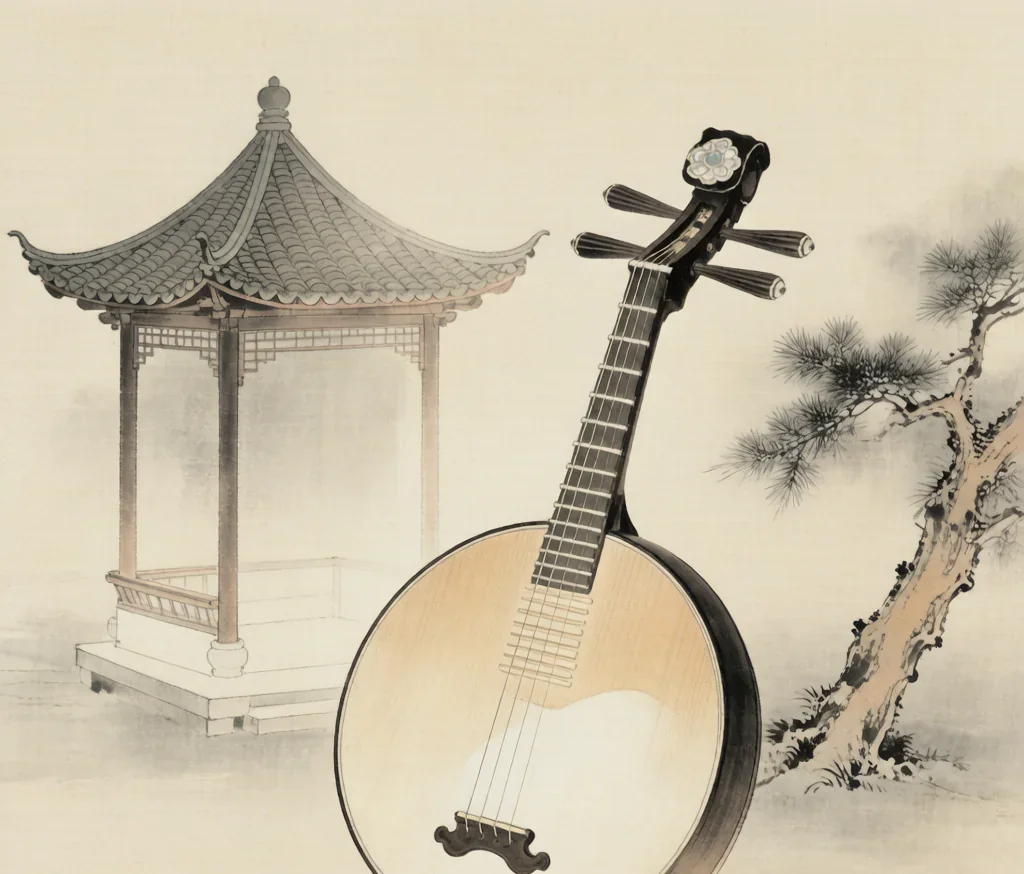
The 阮 () is the round-bodied Chinese lute, a plucked string instrument with a full moon-shaped soundbox, a long fretted neck, and a tone often described as mellow, round, and gentle. Named after a famed musician and scholar of the Jin dynasty, the ruan has sounded in Chinese ensembles for well over a thousand years, from the courthouses of ancient capital cities to the modern concert stage. Its cousin the pipa may be more famous for fire and drama, but the ruan is the warm, steady voice that gives ensemble music its center. This article follows the ruan's history, its construction, the way it sounds and is played, its family of sizes, and its place in Chinese music today.
A Name Borrowed from a Musician
The instrument's name comes from Ruan Xian, a scholar-musician of the third and fourth century who belonged to the celebrated group of free-spirited intellectuals known as the Seven Sages of the Bamboo Grove. Ruan Xian was so closely linked with his lute that later players began to call the instrument after him, and the name stuck. Images from the Tang dynasty show the round-bodied lute clearly, and a famous wall painting from the Dunhuang caves depicts a celestial musician holding just such an instrument, evidence of how widely it was known along the Silk Road.
Before it carried Ruan Xian's name, the instrument belonged to a broader family of round lutes played in China for centuries, some of which arrived with travelers and traders from Central Asia. Over time the Chinese form settled into the pear- or round-bodied, long-necked lute we now call the ruan. Its long life means the ruan has been part of Chinese musical life through the Tang golden age, the shifts of later dynasties, and the modern effort to build a national orchestra in the twentieth century.
Construction of the Round Box
The ruan's most visible feature is its soundbox, a flat circular or slightly oval wooden disc that gives the instrument its nickname as the moon lute. The top is a thin wooden soundboard, usually of paulownia, with a round sound hole or sometimes a decorative rosette at its center. A long neck extends from the box and carries a fingerboard with raised frets, traditionally of bamboo and today often of metal, set to approximate the notes of the Chinese scale across several octaves.
Most ruan have four strings, tuned in pairs of courses or as four single strings, and they are played with a plectrum or with the fingers. The bridge sits on the soundboard and transmits the strings' vibration to the box. Compared with the pipa's shorter neck and sharply bent head, the ruan's straight, longer neck makes for a more open, singing fretboard, and its round body yields a warmer, less percussive attack. The whole instrument is built for smoothness rather than shock, which explains its calming role in ensembles.
The Sound and How It Is Played
The ruan's tone is rounded, soft, and lyrical, with a gentle decay that flatters slow, singing melodies. Players pluck with a pick or with the fingernails, producing notes that are clear but never harsh, and they use the fretted neck to slide between pitches in the vocal, sliding style typical of Chinese melody. Because the strings are relatively thick and the body is large, the bass forms of the ruan can sound almost like a Chinese cello, while the smaller forms sparkle in the upper register.
Technique includes single plucks, tremolo achieved by rapid alternation of the fingers or the plectrum, and damping the strings with the left hand to shape rhythms. The ruan is especially valued for sustained, flowing lines and for steady accompaniment, and its even tone blends well with both bowed strings and struck strings. A good ruan player aims for a singing legato, treating the lute less like a percussion instrument and more like a quiet human voice carried on the air.
The Ruan Family of Sizes
One of the ruan's practical strengths is that it comes in a whole family of sizes, much like the violin family in the West. The gaoyin ruan is the smallest and highest, the xiao ruan a step larger, the zhong ruan the standard mid-size workhorse, the da ruan the large bass voice, and in some modern groups an even lower di ruan. Together these form a plucked-string choir that can carry melody, harmony, and bass within the Chinese orchestra.
This family design was largely systematized in the twentieth century as musicians sought to give the national orchestra a balanced, Western-style section structure. By standardizing sizes, tunings, and ranges, reformers turned what had been a single old lute into a flexible section. The result is that a single player might move from zhong ruan to da ruan over a career, and an ensemble can field a wall of ruan voices that hum beneath the brighter pipa and liuqin above them.
The Ruan in Ensemble and Solo
In the modern Chinese orchestra the ruan section sits at the heart of the plucked strings, providing the warm middle and low colors that keep the texture from becoming all brightness on top. It partners naturally with the yangqin, the pipa, and the liuqin, and it can be heard threading sustained lines through the rhythm of the percussion. In regional and court-derived music the ruan also appears as a solo or small-ensemble voice, especially in the genteel repertoires of central and southern China.
As a solo instrument the ruan has a growing repertoire of both rearranged old tunes and newly composed concert pieces. Its calm, vocal quality suits lyrical showpieces, and composers have written ruan concertos that explore its ability to sing long phrases. Because it is less flashy than the pipa, the ruan sometimes gets less attention, but players and listeners who spend time with it often come to prize exactly that restraint: it is an instrument that rewards listening closely rather than watching virtuosically.
Learning and Appreciating the Ruan
For a beginner the ruan is approachable because its fretted neck makes the notes easy to find and its four strings are not overwhelming. Starting on a zhong ruan gives a comfortable middle range, and early practice focuses on clean plucking, even tremolo, and smooth left-hand movement along the frets. As with any lute, building calluses and steady rhythm takes weeks, but the instrument is forgiving of mistakes and pleasant to hear even when played simply.
To appreciate the ruan, listen first to a slow solo where a single line seems to breathe and fade like a thought, then to a full ensemble where the ruan section underpins everything like a warm foundation. Its history, from a Jin-dynasty scholar's favorite to a standardized section of the national orchestra, mirrors the broader story of Chinese music: old forms preserved, then thoughtfully reorganized for new purposes. The round-bodied lute asks little for itself and gives much to the whole, which may be why, more than seventeen centuries after Ruan Xian, it still sounds at the center of the music.
❓ Frequently Asked Questions
📝 Chinese Vocabulary
阮 — : the round-bodied Chinese lute.
中阮 — : the standard mid-size ruan.
大阮 — : the large bass ruan.
品 — : the fret on the neck.
阮咸 — : Ruan Xian, the Jin-dynasty scholar-musician who gave the instrument its name
高音阮 — : the high (soprano) ruan, the smallest member of the family
月琴 — : the yueqin, a related round-bodied moon lute often grouped with the ruan family
竹林七贤 — : the Seven Sages of the Bamboo Grove, the group Ruan Xian belonged to
🎉 Fun Facts
- The ruan is named after Ruan Xian, a scholar-musician who was one of the Seven Sages of the Bamboo Grove.
- A Tang-dynasty mural at Dunhuang shows a celestial musician playing a round lute much like the modern ruan.
- The ruan comes in a whole family of sizes, from a high soprano to a deep bass, like the violin family in the West.
- Though less famous than the pipa, the ruan often forms the warm center of the Chinese orchestra's plucked-string section.
- Before it took Ruan Xian's name, the instrument was also known as the 'Qin pipa,' linking it to the long-necked lutes of earlier centuries.
- The ruan's steady, singing tone makes it a natural choice for slow lyrical works, and several modern concertos have been written to show off its long, breathing phrases.