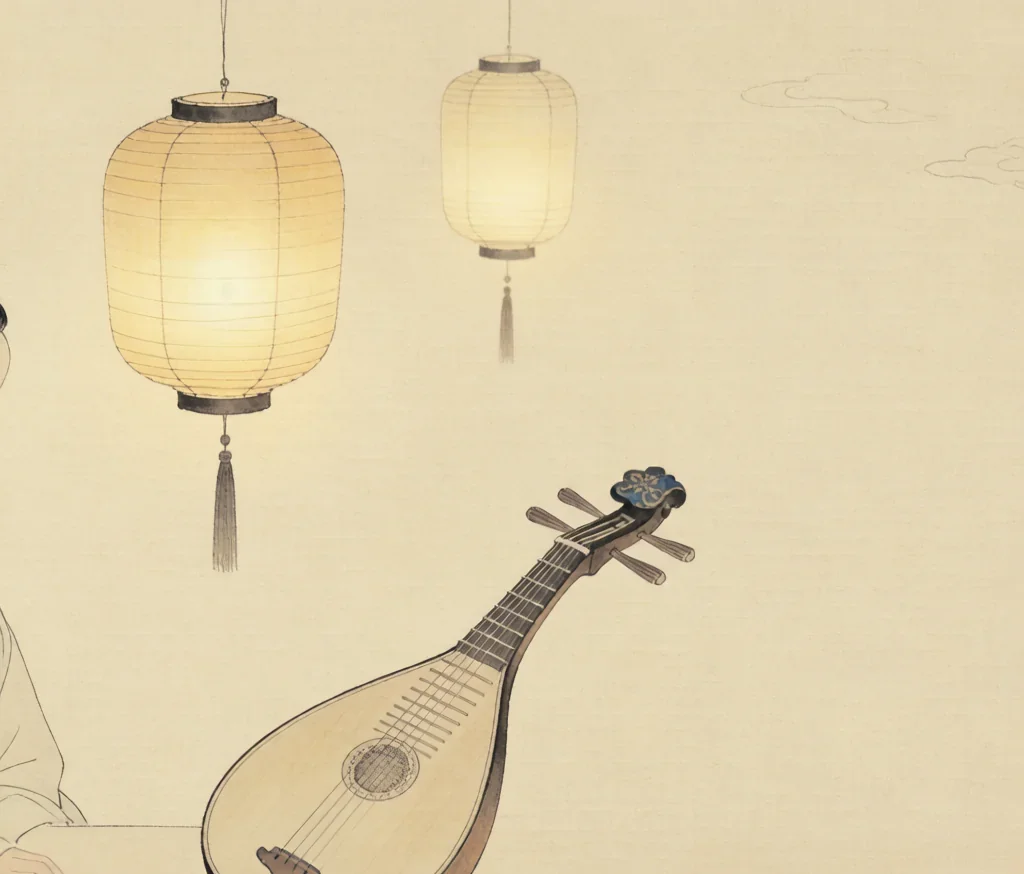
The 柳琴 (), literally the "willow lute," is the small, bright soprano of the Chinese lute family. With a tiny pear-shaped body, a short neck, and three or four strings plucked with a hard plectrum, it sings in the highest register of the plucked strings, cutting cleanly through an ensemble with a crisp, almost mandolin-like sparkle. Though long a humble regional instrument of the north and east, the liuqin was redesigned in the twentieth century into a concert soloist and now often plays the role of the piccolo or the soprano voice in the modern Chinese orchestra. This article examines its history, its construction, its brilliant sound, its technique, and its rise from local accompaniment to the spotlight.
From Local Accompaniment to Concert Stage
The liuqin began life not as a solo star but as a working instrument of regional music, especially in the storytelling and opera traditions of Jiangsu, Shandong, and Anhui. There it accompanied singers in a high, clear voice that matched the bright timbre of local vocal styles, and its small size made it easy to carry to teahouses and village stages. For a long time it was considered a folk instrument, less polished and less famous than the great pipa that sat beside it in the lute family.
The transformation came in the mid twentieth century, when instrument makers enlarged the liuqin's body slightly, added a fourth string, extended its range with more frets, and gave it a proper concert tuning. These changes turned a modest companion instrument into a true soprano soloist capable of fast, brilliant passages and high melodic lines. The reformed liuqin then entered the national orchestra, where its piercing clarity filled the top of the plucked-string section and earned it the nickname of the soprano of the lute family.
Construction of the Willow Lute
True to its name, the liuqin has a body shaped like a small pear or willow leaf, traditionally carved from a single piece of wood with a thin soundboard on top and a sound hole or rosette at the center. Its neck is short and carries frets, now usually of metal, set to the Chinese scale. The earliest instruments had only two or three strings and a very small body scarcely larger than a hand, but the modern concert liuqin is somewhat larger and carries three or four strings tuned for a wide, bright range.
The strings are plucked with a hard plectrum, often of plastic or tortoise-shell substitute, which gives the liuqin its characteristic crisp attack. Because the body is small, it does not produce much volume on its own, but the hard pick and the high tuning make each note ping with clarity, and amplification or a naturally bright hall lets it project. The whole instrument is light and compact, which suits the rapid, flicking right-hand technique that its music demands.
The Sound and Its Brilliant Role
The liuqin's voice is high, bright, and incisive, with a quick decay that makes rapid note sequences sparkle rather than blur. Listeners often compare it to the mandolin or the soprano of a choir, and in an ensemble it naturally rises above the warmer ruan and the heavier pipa. Its clarity is a virtue: where a fuller lute might melt into the texture, the liuqin states the melody in a clean, ringing line that the ear can follow without effort.
This brightness does come with a need for control. Played too hard, the liuqin can turn shrill, so good players balance attack and restraint, using slower pieces to show its singing side and faster pieces to display its dazzle. Composers exploit the contrast, writing high ostinatos and flying runs that shimmer above the orchestra, then pulling the instrument into a sudden soft, lyrical phrase. The liuqin thus wears two faces: the brilliant and the tender.
Technique and the Hard Plectrum
The right hand drives the liuqin with a hard plectrum, using fast alternate strokes, arpeggios, and tremolo to create its signature brilliance. The left hand handles the frets, executing the slides, vibrato, and portamentos that give Chinese melody its vocal quality, and reaches across the short neck to shift position for the high notes. Because the instrument is small, the hands work close together, and speed is a natural outcome of the compact layout.
A distinctive challenge is evenness at speed. The liuqin's quick decay means that a run of notes can sound uneven unless the player's strokes are perfectly balanced, so students drill scales and tremolo until the sound is glassy and uniform. Damping with the left hand shapes rhythms and prevents unwanted ringing, and skilled players add subtle dynamic shading so that a fast passage still feels musical rather than mechanical. The technique looks simple but is exacting in execution.
The Liuqin in the Modern Orchestra
In the Chinese orchestra the liuqin anchors the top of the plucked-string section. Beneath it sit the ruan family and the yangqin; beside it the pipa takes the middle; above all of them the liuqin flashes the highest lines. This分层 lets the section sound like a full plucked choir, from deep bass through singing middle to bright soprano, and the liuqin's job is to crown that texture with light. It also takes solo and feature passages where its brilliance can be enjoyed on its own.
Concerto and chamber composers have embraced the instrument, writing works that show off its speed and its unexpected lyricism. A liuqin concerto might open with a cascade of notes like falling water and then settle into a slow, singing theme, proving that the little willow lute is more than decoration. Its journey from teahouse accompanist to concerto soloist is one of the clearer success stories of twentieth-century Chinese instrument reform.
Learning and Enjoying the Liuqin
For a beginner the liuqin is friendly in size if demanding in precision. Its short neck makes notes easy to locate, and a small instrument is comfortable for younger players, yet the hard plectrum and fast technique require patient drilling to sound clean. Starting slowly with single strokes and simple tunes builds the right-hand control that everything else depends on, and only later should a student attempt the flying runs that make the instrument famous.
To enjoy the liuqin, listen to a full ensemble and pick out the high, clear line that seems to dance above the rest; then hear a solo piece where the same instrument slows down and sings. Its story is a neat lesson in how Chinese music modernized: take a humble regional lute, refine its design, and give it a defined role in a balanced orchestra. The willow lute, once a quiet companion to local singers, now leads the plucked strings into the light, and its bright voice is a good place for any newcomer to start hearing the logic of the Chinese orchestra.
❓ Frequently Asked Questions
📝 Chinese Vocabulary
柳琴 — : the willow lute, or liuqin.
拨片 — : the hard plectrum used to pluck it.
品 — : the fret on the short neck.
高音 — : high pitch, the liuqin's register.
柳叶 — : willow leaf, the shape echoed in the instrument's small body
梨形 — : pear shape, describing the liuqin's body form
拨弦 — : plucked string, the family of instruments the liuqin belongs to
柳琴戏 — : Liuqin opera, a regional opera tradition of Jiangsu, Shandong, and Anhui that features the instrument
🎉 Fun Facts
- The liuqin's name means "willow lute" after its small leaf-shaped body.
- It is nicknamed the soprano of the Chinese lute family because of its high, bright register.
- Until the twentieth century it was mainly a folk accompaniment instrument, not a concert soloist.
- The liuqin's notes decay quickly, so fast playing demands unusually even right-hand strokes to sound clean.
- The liuqin is light enough that younger students can hold and play it comfortably, which has made it a popular introductory plucked instrument in music schools.
- Its quick decay means a sustained note cannot be held the way a bowed string can, so players create the impression of a long line through fast repeated or rolled notes.