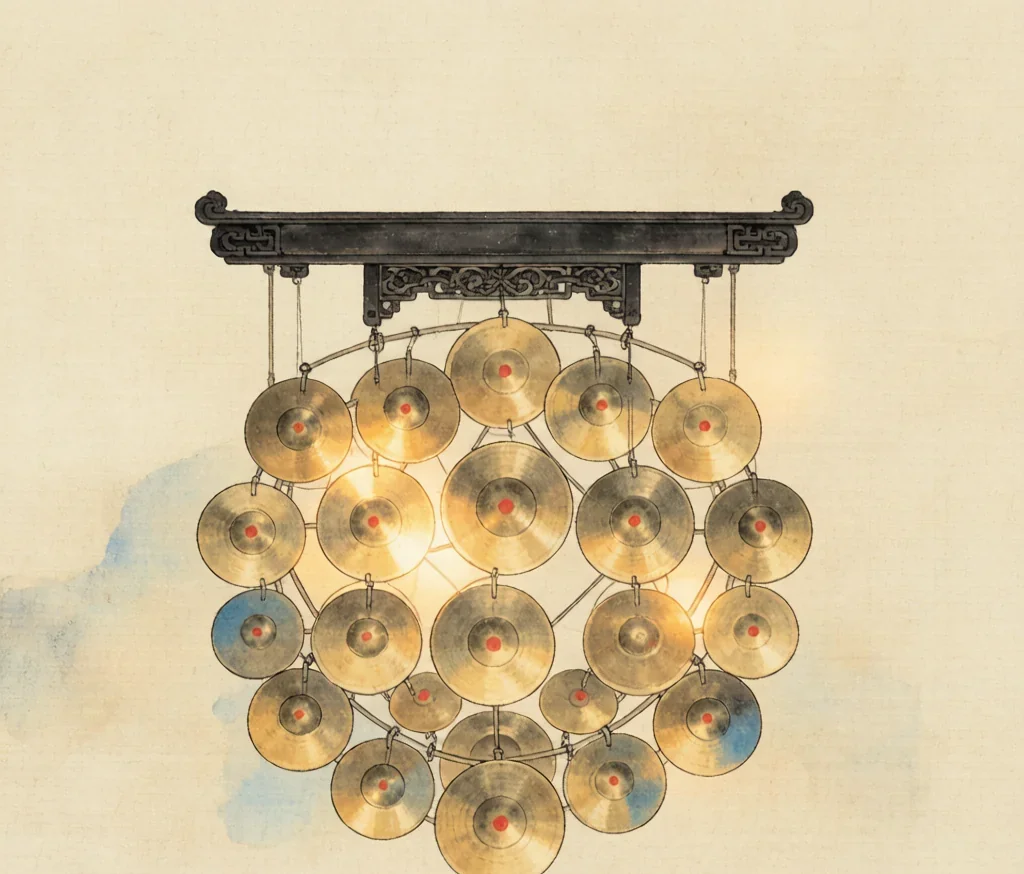
Hang a row of small, shining gongs in a frame and strike them one by one, and you begin to understand the yunluo (云锣, yún luó), the "cloud of gongs." Unlike the great concert gongs that boom with no fixed pitch, each gong of the yunluo is tuned, so the instrument can actually play melodies. The name captures its appearance as much as its sound: a set of rounded, bossed gongs arranged in a frame like little clouds floating in rows. For centuries the yunluo has added a shimmering, bell-like voice to Chinese ensembles, from court and temple music to the modern national orchestra. It is proof that the gong, often thought of only as a noise of alarm or celebration, can also be coaxed into song.
What Makes a Gong Musical
Most people know the gong as a large, flat disc that produces a swelling crash with no definite pitch. The gongs of the yunluo are different. Each is a small, thick disc of bronze with a raised central boss, the little dome in the middle, and that boss is what gives the gong a clear, tunable pitch. By varying the size, thickness, and curvature of each disc, makers tune the set across a scale, so a player can run melodic lines across the frame just as a glockenspiel player runs across bars. The tone is bright and metallic, with a quick, singing ring that decays into a soft shimmer.
The traditional yunluo held a set of ten gongs, arranged in a wooden frame and often divided into two rows. Each gong was tuned to a step of the Chinese scale, and the whole instrument could be held or stood on a rack. Modern versions used in the national orchestra have expanded the idea enormously, mounting two or three dozen gongs in a larger frame and widening the range so the instrument can take part in complex orchestral writing. The principle, however, has never changed: many small tuned gongs, struck to make music rather than mere noise.
A Cloud in the Ensemble
The yunluo earns its poetic name when seen in performance. The round gongs, set into a lacquered wooden frame, look like a constellation of small moons or a bank of clouds, and as the player's mallets move across them the visual and the sound seem to drift together. In ensemble music the instrument typically supplies a bright, decorative voice, outlining melodies, adding sparkling fills, or marking important beats with a clear metallic chime. Its sound cuts through a texture of strings and winds without the weight of a drum, giving music a sense of light.
Historically the yunluo appeared in the ceremonial and ensemble music of north China, including the wind-and-percussion ensembles that performed at festivals and processions. It also found a place in the music of the imperial court and in certain religious repertoires, where its clean, bell-like tone suited solemn or festive occasions alike. Wherever a touch of brilliance was needed, the cloud of gongs could provide it.
How the Cloud of Gongs Is Played
The player holds a mallet, often of wood or bamboo tipped with a softer material, in each hand, and strikes the bossed centers of the gongs to sound them. Because the gongs are fixed in a frame, playing is a matter of precise, quick movement between positions, much like playing a small keyboard laid out in the air. The two mallets allow rolls, rapid alternation, and the kind of flowing passage work that makes the instrument feel melodic rather than percussive.
Technique also involves controlling the decay. A gong left to ring will shimmer for a moment and fade; a player can let tones overlap into a cloud of sound or strike with restraint for a cleaner line. Skilled performers use the instrument's natural ring to create sustained, glowing harmonies, so the yunluo can function almost like a choir of small bells. This blend of percussion and melody is what makes it special among Chinese instruments.
From Court and Temple to the Concert Hall
The yunluo's history reaches back several centuries, with descriptions of tuned gong sets appearing in later imperial China. It was a refined instrument, associated with ensemble and ceremonial music rather than solo showpieces, and its relatively quiet, bright voice suited indoor and processional settings. Over time, as Chinese instrumental music was reorganized into larger modern ensembles, the yunluo was expanded and standardized, much as the Western orchestra's percussion section grew more colorful in the same period.
Today the enlarged yunluo is a regular member of the Chinese national orchestra's percussion section, where composers write for it as both a rhythmic and a melodic voice. New works exploit its range and its bell-like shimmer, and solo and chamber pieces have also appeared. The instrument thus bridges old and new: a traditional set of tuned gongs reborn as a versatile modern voice, still called by its old poetic name.
Sound, Symbol, and Survival
There is a reason the yunluo is called a cloud. Its gongs hang in a frame like gathered vapor, and its sound seems to float and disperse rather than land. In a musical culture that values resonance, space, and the lingering decay of a tone, the yunluo fits perfectly. It teaches the ear to enjoy not only the attack of a note but its disappearance, the way a struck gong fades into the air it disturbed.
Preserving the craft of making tuned gongs is itself an art. Each disc must be shaped and tuned by hand, and the bronze alloy, the boss size, and the frame all affect the result. As interest in Chinese orchestral music grows, makers and players continue to refine the yunluo, ensuring that this cloud of gongs keeps raining bright notes on audiences old and new.
A Closing Reflection
The yunluo reminds us that even the noisiest of instruments can be taught to sing. A gong, usually a symbol of alarm or joy in a single great crash, becomes in this frame a whole scale of small voices, each tuned and tender. To watch a player move two mallets across that cloud of gongs is to see music made visible, sound turned into a drifting, glittering weather. In its quiet brilliance, the yunluo is one of Chinese music's most poetic inventions.
❓ Frequently Asked Questions
📝 Chinese Vocabulary
云锣 — : The cloud of gongs; the instrument's name.
锣 — : A gong, the basic disc from which the instrument is built.
钟 — : A bell, whose clear pitched tone the yunluo resembles.
锣鼓 — : Gongs and drums, the core of many Chinese percussion ensembles.
民族管弦乐 — : The Chinese national orchestra that includes the yunluo.
编锣 — : A rack of tuned gongs, the larger family to which the yunluo belongs.
青铜 — : Bronze, the alloy from which the tuned gongs are cast.
锣槌 — : The mallet used to strike the gongs.
🎉 Fun Facts
- Unlike a typical large gong, each yunluo disc has a raised central boss that gives it a definite, tunable pitch.
- The traditional yunluo had around ten gongs, but modern orchestral versions can mount several dozen to extend the range.
- Its name, "cloud of gongs," comes from both the instrument's floating appearance and its shimmering, drifting tone.
- The yunluo can function as both percussion and melody, a rare double role that makes it a favorite for adding brilliance to ensembles.
- In the traditional eight-material classification, the yunluo belongs to the 'metal' (金, jīn) group because its gongs are cast of bronze.
- The yunluo is sometimes described as a 'glockenspiel of gongs,' since each tuned disc sounds like a small bell struck with a mallet.