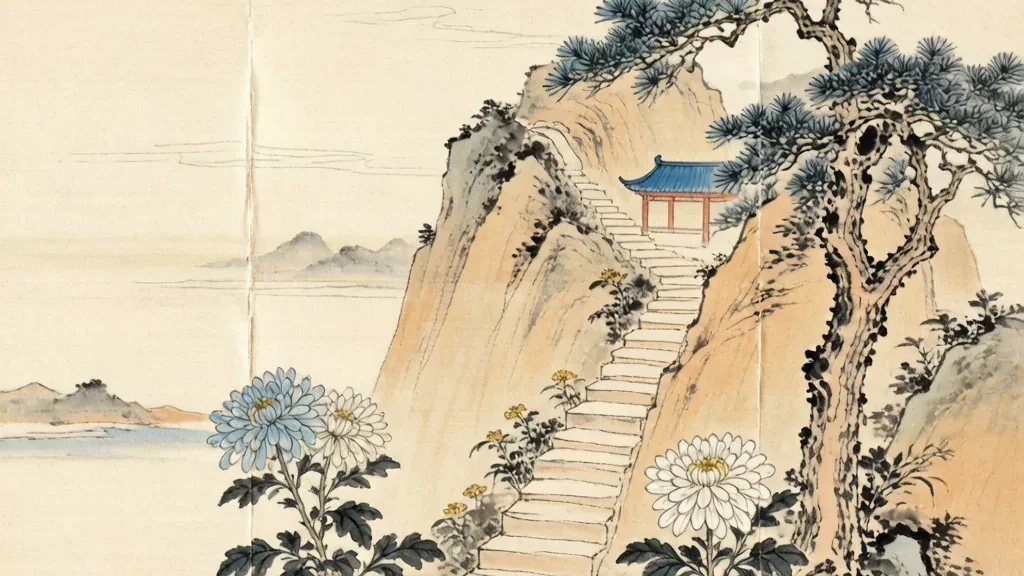
On the ninth day of the ninth lunar month, when autumn is at its clearest and the air turns crisp, Chinese families climb hills, drink chrysanthemum wine, and look out from high places. This is 重阳 (Chongyang), the Double Ninth Festival, a day built around a wish for long life. The number nine was considered yang, bright and masculine, in the old system of yin and yang, and a doubled nine was doubly charged. Far from being a somber occasion, the festival sends people upward, toward mountains and pagodas, to borrow the height and the clean air as medicine against time.
The Double Yang and the Pestilence
The festival's origin is often traced to a Han-era tale of a man named Huan Jing, who was warned by a sage that disaster would strike his family on the ninth day of the ninth month. The advice was to take his household to a high hill, wear a sachet of dogwood, and drink chrysanthemum wine. They did so, and when they returned they found their animals dead but their people safe. The height had lifted them above the pestilence that walked the low ground.
Whether or not the story is history, it encodes real wisdom. Autumn was a time when illness spread, and climbing into fresh, breezy air, with bitter herbs to cleanse the body, was sound precaution dressed as ritual. The doubled nine became a date to rise above danger, literally and figuratively, and to wish one another the years to keep climbing.
Climbing High
The signature custom of the day is climbing high. Families make for the nearest hill, mountain, or even a tall tower or city wall, and spend the day walking upward. The exercise itself, in cool dry air, was thought to strengthen the body against the coming winter. From the summit, one looks out over the harvest land and feels, briefly, above the small troubles of the year.
In cities without mountains, people climb stairs, pagodas, or hillside parks, and the spirit is the same. The act is both physical and symbolic: to go up is to seek longevity, to put distance between oneself and the ills of the earth. The view from the top becomes a kind of blessing, a wide calm purchased by the effort of the climb.
Chrysanthemum and Dogwood
Two plants define the festival. The chrysanthemum blooms in late autumn and was prized for its ability to withstand the first frosts; drinking wine infused with its petals was believed to aid health and long life. Dogwood was worn in sachets or pinned to clothing for its sharp scent, thought to drive away evil and disease.
Together they make the day fragrant and purposeful. Poets through the ages wrote of chrysanthemums with reverence, seeing in the flower a model of quiet endurance. To offer a cup of chrysanthemum wine to an elder on the ninth of the ninth was to offer, in liquid form, the wish that they bloom as long and as bravely as the flower itself.
A Day for the Elders
In modern China, the Double Ninth has been reframed as Senior Citizens' Day, a public occasion to honor the aged. Families visit parents and grandparents, and communities hold events for older people: performances, free health checks, and gatherings in parks. The ancient wish for longevity has become a civic virtue of respect, fitting neatly with the deep value of Confucianism (儒家).
This shift is natural. A festival whose whole meaning is "may you live long" was bound, in an aging society, to become a day of tending the old. The climb, the wine, and the flower are now offered less as magic and more as straightforward devotion, the kind that needs no legend to explain it.
Poems on the Ninth Day
The Double Ninth inspired some of the most loved lines in Chinese poetry. The Tang poet Wang Wei, far from home, wrote of missing his brothers on the day they would be climbing with dogwood, regretting that one sprig-bearer was absent. Such poems fixed the festival in feeling: it is a day of height and of homesickness, of looking out and looking back at once. The autumn clarity that makes the view possible also makes absence visible.
To read these poems on the ninth day is to join a long line of climbers who paused at the summit and thought of someone below or far away. The festival, then, is not only about personal longevity but about the threads that hold a family across distance and time, threads as real as the dogwood on the lapel.
Why We Still Climb
The Double Ninth survives because its message is simple and inexhaustible: go up, breathe, and wish the people you love many more years. In a culture that honors age rather than hides it, a day devoted to longevity is no quaint custom but a statement of what matters. The mountains are still there, the chrysanthemums still open, and the climb still rewards those who make it.
Foods of the Ninth Day
The Double Ninth expresses its meaning through a few modest foods. The Chongyang cake leads them: a steamed rice-flour sponge, often nine layers thick and topped with two little sheep figures, because 'sheep' sounds like the bright 'yang' of the doubled ninth. Dates, chestnuts, and raisins pressed into the top add sweetness and color. Chrysanthemum gives the day its drink, wine for the traditional toast to long life, tea for a lighter modern table, and the flower's late bloom makes it a natural emblem of endurance. Some households serve lamb or longevity noodles, warming dishes suited to the cooling weather. None of these foods is elaborate, yet each one is chosen to say the same thing: may you climb high, stay well, and see many more autumns. On the ninth of the ninth, even a simple cake becomes a quiet wish spoken in sugar and flour.
A Festival of Height in Modern Life
The old call to 'climb high' still sounds in modern cities, even where real mountains are far. Office workers take the stairs of a tower, families ride up a pagoda or hilltop park, and schools organize autumn outings that borrow the festival's spirit of aspiration. The day's public side has grown: as Senior Citizens' Day, it is marked by community concerts, free health screenings, and bus trips for the elderly to scenic spots. Media remind young people to call their grandparents, and shops sell chrysanthemum and cake gift sets. What survives from the legend is the upward gesture, the belief that rising above the low ground, literally or in life, keeps trouble at a distance. The Double Ninth thus keeps its shape across centuries: a holiday that tells a busy, urban society to pause, look up, and honor the long-lived.
❓ Frequently Asked Questions
📝 Chinese Vocabulary
重阳 — : The Double Ninth Festival.
登高 — : Climbing high, the day's signature act.
菊花 — : Chrysanthemum, drunk as wine for longevity.
茱萸 — : Dogwood, worn in sachets to ward off illness.
敬老 — : Respecting the aged, the modern theme of the day.
桓景 — : The young man who, warned by a sage, led his family up the mountain to escape the plague.
重阳糕 — : The steamed Chongyang cake, a festival sweet.
老年节 — : Senior Citizens' Day, the festival's modern public name.
🎉 Fun Facts
- The Double Ninth is now officially Senior Citizens' Day in China, focused on honoring the elderly.
- The chrysanthemum is so tied to the festival that "ninth-day wine" means chrysanthemum wine.
- The legend of Huan Jing says climbing saved his family while their livestock, left below, perished.
- Climbing on the ninth of the ninth is said to "avoid disaster" as much as to seek a long life.
- The Double Ninth is considered the finest day of autumn for 'ascending to view the chrysanthemums,' and large flower shows open in cities like Beijing and Shanghai.
- In parts of southern China the day was also a time to fly kites, since the high autumn winds were thought to carry misfortune away with them.