On the fifteenth day of the seventh lunar month, Chinese tradition says the boundary between the living and the dead grows thin. This is 中元 (Zhongyuan), the Ghost Festival, when the gates of the underworld open and ancestors and wandering spirits are believed to walk the world of the living. Far from a horror story, the festival is an act of mercy: the homeless dead, with no family to tend them, are fed and guided, and the honored ancestors are welcomed with offerings. It is the most solemn of the year's rituals of remembrance, a time when compassion is extended even to those no one remembers.
The Open Gates of the Seventh Month
The seventh lunar month is known broadly as the "ghost month," and its fifteenth day is its peak. In the cosmology behind the festival, the realm of the dead opens and spirits stream out to visit the living, particularly those without descendants to care for them. The Zhongyuan name places the day as the "middle prime," one of three "yuan" festivals of the year alongside the upper and lower primes.
The mood is not terror but duty. The spirits are mostly kin, or neglected strangers deserving pity. Households set out food and burn paper for them, and temples hold rites to feed the hungry ghosts and light their way. To ignore the open gates was to risk unrest; to honor them was to keep the world in balance, a concern shared with Daoism (道家) and Buddhist teaching alike.
Feeding the Hungry Ghosts
The central rite is the food offering to the hungry ghosts. Families and temples place out meals, sometimes in the open or at roadside altars, so that spirits with no one else to feed them may eat. Large public ceremonies feature elaborate "ghost tables" laid with empty seats, welcoming the unseen guests as one would honored, if invisible, visitors.
Alongside food, people burn paper money and paper goods, the same offerings made at Qingming, so the dead may have means in their world. The belief is practical kindness stretched across the veil: what you give here is received there, and the lonely dead are, for one night, not lonely. The rite reflects a deep ethic that no spirit, however forgotten, should go hungry.
The Buddhist Story of Mu Lian
A powerful layer of the festival comes from a Buddhist tale of Mu Lian, a monk who used his powers to find his mother suffering in the realm of hungry ghosts, her throat too thin to swallow and her body starving. He sought the Buddha's help, and was told to make offerings on the fifteenth of the seventh month to feed the assembled spirits. His mother was released, and the day became one of universal feeding of the dead.
This story gave the Ghost Festival its strong current of filial rescue, the child saving the parent across the boundary of death. It joined neatly with the older Chinese custom of ancestor care, so that Buddhist monasteries and Daoist temples and family hearths all observed the fifteenth in their own keys, yet with one shared melody of relief for the suffering dead.
Lanterns to Guide the Way
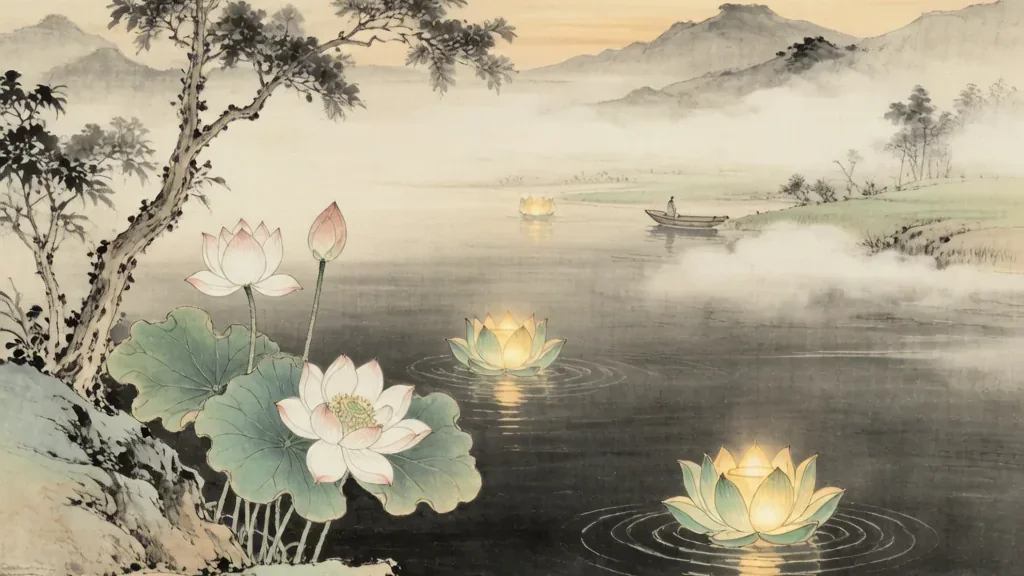
Light plays a special role. On the water and in the sky, people set or float small lanterns to show the spirits the way home and, after the night, the way back. Water lanterns, made of paper on a reed frame, are released on rivers and ponds, their little flames drifting like a procession of stars upon the dark surface. The glow is both welcome and guidance, a kindness made visible.
In some places, lanterns are also lit to honor the dead by name, carried in evening processions through the streets. The effect is serene rather than eerie: a town of small lights moving in the dark, each one a sentence of care spoken to someone who cannot answer, but is, the tradition insists, listening.
Taboos and Caution
Because the month is thought to host wandering spirits, folk caution grows. People may avoid late-night swimming, moving house, or starting big ventures during the seventh month, and children are kept close after dark. These taboos are less about fear than about respect, a way of saying the world is crowded now and one should move gently through it.
Such customs reveal the festival's true tone. It is not a warning against evil but an instruction in humility: that the living share the earth with the remembered and the forgotten, and that a little care, a floating lamp, a plate of food, keeps the whole company at peace. The caution is courtesy extended to the unseen.
A Festival of Compassion
At its heart the Ghost Festival is the most generous of China's observances, because it feeds not only one's own ancestors but the stranger dead, those with no one else. In a culture that measures virtue by how widely one extends care, the holiday asks a striking question: will you feed the ghost no one claims? To answer yes is to practice a compassion that crosses even death.
The Daoist Rite of Universal Salvation
The Daoist layer of the festival is built around the idea of universal salvation. On the fifteenth of the seventh month, temples and households perform rites of pu du, offering food, scripture, and prayer not just to kin but to every wandering and hungry spirit with no one to tend it. The belief is that the boundary between worlds is thin then, so kindness shown to the forgotten dead earns merit for the living. Processions carry placards for the orphaned souls, and priests chant through the night to settle restless ghosts. This spirit of mercy toward strangers is what sets the Ghost Festival apart from the family-centered rites of Qingming, making it the most generous of the year's ceremonies of remembrance.
Ghost Festivals Across Asia
The Ghost Festival is not confined to China. In Japan it became Obon, when families welcome the spirits of ancestors home, clean graves, and dance the bon odori to send them off again. Korea observes a similar mid-summer remembrance, while Vietnam holds the lunar seventh-month ceremony of offering to the hungry ghosts, especially in Buddhist temples. Across the Chinese diaspora in Singapore, Malaysia, and beyond, the seventh month is still marked with street operas, community feasts, and the release of floating lamps. Though the names and small customs differ, the shared impulse is the same everywhere: a season to feed, honor, and gently guide the dead, and to remember that no spirit should be left alone. In recent decades the seventh month has even reached museum halls and university campuses in Europe and North America, where Obon dances and lantern ceremonies are offered as cultural events, carrying the custom to new shores. The theme of feeding and guiding the unseen, it turns out, needs little translation between peoples.
❓ Frequently Asked Questions
📝 Chinese Vocabulary
中元 — : The Ghost Festival, the middle prime.
鬼月 — : The ghost month, the seventh lunar month.
施食 — : Offering food to hungry ghosts.
目连 — : The monk whose tale shaped the festival.
孤魂 — : Lonely or orphaned souls with no family.
盂兰盆 — : Ullambana, the Buddhist rite of offering to the departed, closely linked to the Ghost Festival.
普度 — : Universal deliverance, the Daoist and folk rite of saving and feeding all hungry ghosts, not only one's own ancestors.
城隍 — : The city god, a local deity who governed the underworld of a town and was honored during ghost-month rites.
🎉 Fun Facts
- The Ghost Festival is one of three "yuan" prime festivals of the year, the middle prime among them.
- Water lanterns are released to guide spirits both to the feast and back to their realm afterward.
- The Buddhist tale of Mu Lian parallels the theme of filial rescue found at Qingming.
- The day feeds not only one's own ancestors but the "hungry ghosts" with no family to tend them.
- In many places an open-air opera or play is staged with the stage facing away from the audience, performed for the spirits of the dead rather than for the living to watch.
- The fifteenth of the seventh lunar month is also the Daoist Zhongyuan festival, when temples hold great rites of universal salvation for every restless or hungry ghost, not only for family ancestors.