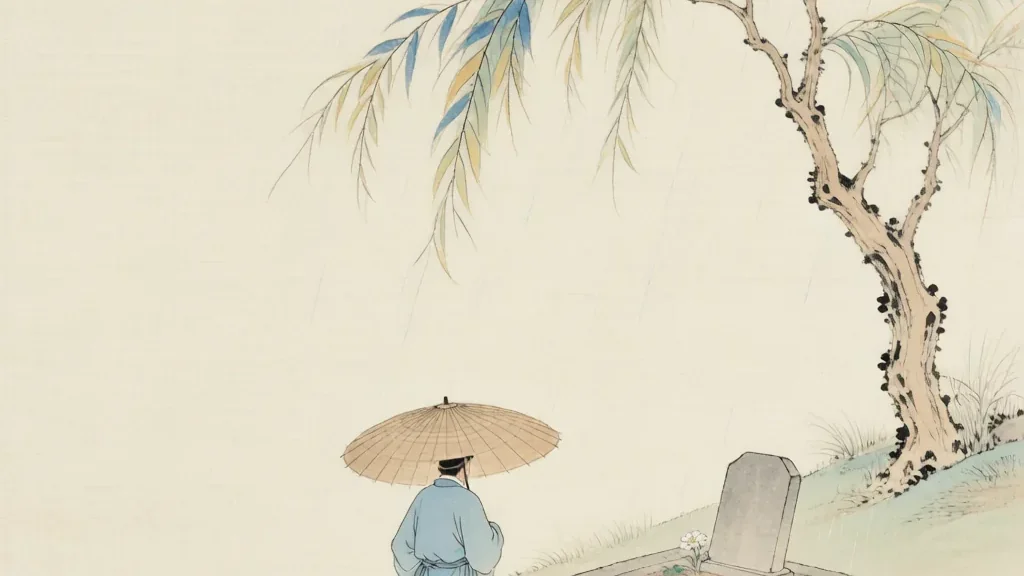
Between early April and the heart of spring, when the rain comes soft and the willows turn green, Chinese families step out of their homes to the graves of those they have lost. This is 清明 (Qingming), the Pure Brightness Festival, a day of tomb-sweeping, quiet remembrance, and the first taste of the warm season. Unlike the loud cheer of the Spring Festival or the racing drums of Duanwu, Qingming is hushed and tender. It is the one day of the year when the living and the dead are formally, gently remembered together, and when the turning of spring is honored as a time both to mourn and to walk outside again.
The Meaning of Pure Brightness
The name Qingming means "clear and bright," pointing to the weather of the season more than to any single event. It is one of the twenty-four solar terms, the ancient Chinese way of marking the year by the sun's position and the rhythm of farming. Around this time the frost is gone, the soil softens, and the fields call for planting. The festival usually falls on April 4th or 5th of the Gregorian calendar, a fixed point even though it is rooted in the older solar system.
To the agricultural mind, this was a natural moment to tend both the living land and the resting dead. The grave, after all, sits in the earth that spring is waking. Sweeping it clean was a way of acknowledging that the family's roots, above and below ground, shared the same season of renewal.
Sweeping the Graves
The central act of Qingming is sweeping the tomb. Families travel to the burial hills, clear weeds from the grave, repair the mound, and wipe the stone. They lay flowers, burn offerings of paper money, and set out the favorite foods of the person who has died. The gesture is practical and spiritual at once: the grave is a house for the ancestor, and a clean house is a sign of respect.
Burning paper replicas, of money, houses, or even phones, sends comfort to the other world, in the belief that what is offered here is received there. The smoke rising from these small fires is, for many, the most visible sign of the day, a thin gray thread connecting the two sides of life. The mood is not grim but attentive, the way one tends a garden one loves.
A Spring Outing
Qingming is also a day to go outside and enjoy the season, an custom called treading the green. After the solemnity of the grave, families stroll through the countryside, fly kites, and picnic under the new leaves. The willow branch is especially loved: people weave it into hats or hang it at the door, for the willow is among the first trees to green and is thought to keep away unwelcome spirits.
This mixture of mourning and merriment is not a contradiction but a balance. The festival acknowledges loss without denying life. To walk in the spring after visiting the grave is to say that the dead are part of the living world's continuity, that remembering them is compatible with the simple joy of warm sun and green grass.
The Cold Food Connection
Qingming sits right after the old Cold Food Festival, when fire was forbidden and only prepared, cold dishes were eaten. The Cold Food custom is linked to a loyal subject of antiquity who was burned to death in a forest fire and honored thereafter by extinguishing all flames for a day. Over the centuries the two observances merged, and some Qingming foods, like cold snacks and sweet wheat cakes, carry the memory of that fireless day.
Though few people today keep a full cold-food fast, the echo remains in the calm, restrained tone of the meals and in the quiet respect that marks the festival. It is a reminder that restraint, too, can be a form of honor, and that the lightest gestures, a cold cake, a swept stone, can carry the heaviest feeling.
Poetry in the Spring Rain
No description of Qingming is complete without its most famous poem, written by the Tang poet Du Mu, in which a traveler on the road asks where the tavern is, as rain falls on the graves and the shepherd points to a village of apricot blossoms. The image, of drizzle, mourners, and distant wine, has fixed Qingming in the Chinese imagination as the festival of spring rain and gentle sorrow. It is taught to children and recited without thinking at the first gray April sky.
The poem captures what the day is for: a pause in the year's rush to remember, to feel the rain, and to find, among the graves, a kind of peace. For a culture that values continuity between generations, Qingming is the yearly reaffirmation that no one is forgotten, and that the green of spring covers everyone at last.
Qingming Today
Modern China observes Qingming as a public holiday, and the roads fill with families returning to hometowns, much as at the Spring Festival though on a smaller scale. Cities have built large memorial parks, and many people now choose to offer flowers instead of burning paper, for the sake of air and fire safety. Online tomb-sweeping has appeared too, letting the distant light a virtual candle.
Yet the essence holds. Whether by hillside or by screen, Qingming remains the day Chinese families turn toward their ancestors and say, we have not let go. In a rapidly changing country, that steady gesture of remembrance may be the festival's deepest gift, a continuity older than any skyline.
The Taste of Qingming
Qingming has its own quiet cuisine. The green rice ball leads it: sticky rice tinted by mugwort or wheat juice into a soft jade, wrapped around red bean or sesame sweetness, its color a small echo of spring fields. For families keeping the Cold Food memory, the meal stays simple and unprepared by fire, cold noodles and vegetable dishes that contrast with the rich feasts of other festivals. Wild greens and tender shoots appear on the table as the earth warms. To eat this way on the tomb-sweeping day is to taste the balance the festival teaches, grief and freshness on the same plate, remembrance seasoned with the first green of the year. Some households also steam a plain round cake marked with the date, shared among those who tend the same grave, so the meal itself becomes a quiet contract of kinship across generations.
Kites, Swings, and the Joy of Spring
Qingming is not only solemn. After the graves are swept, the same outing becomes play. Kites of every shape fill the spring wind, and in an old custom the flyer cuts the string so the kite escapes, carrying illness and bad luck away with it. Some regions set up swings, and children and adults alike take a turn as a way to 'shake off' the stagnation of winter. These pleasures are not a contradiction of mourning but its companion: the festival trusts that to walk, laugh, and look up under a clear sky is itself a fitting tribute to those who came before and to the life they handed down. In the countryside families spread a picnic on the grass after the sweeping, turning the visit into a day outdoors, where the living and the remembered share the same warm afternoon.
❓ Frequently Asked Questions
📝 Chinese Vocabulary
清明 — : Pure Brightness, the tomb-sweeping festival.
扫墓 — : Sweeping the tomb, the central act of the day.
踏青 — : Treading the green, a spring outing.
寒食 — : The Cold Food Festival that merged with Qingming.
柳 — : The willow, a symbol of spring and protection.
青团 — : Green rice balls, glutinous dumplings colored with mugwort or wheat juice, a seasonal Qingming treat.
祭祖 — : Honoring ancestors, the act of offering food, incense, and paper to the departed family.
纸钱 — : Paper money, spirit money burned at the grave as a gift to the ancestors in the afterlife.
🎉 Fun Facts
- Qingming is one of the twenty-four traditional solar terms that guided Chinese farming for millennia.
- The most famous Qingming poem, by Tang poet Du Mu, mentions spring rain, graves, and a tavern among apricot blossoms.
- Willow branches are hung at doors during Qingming because the tree greens earliest and was thought to ward off spirits.
- Qingming is a rare festival that blends ancestor worship with the simple pleasure of a spring picnic.
- The green rice balls, colored with mugwort or wheat juice, are a seasonal treat made specially for Qingming and rarely eaten at other times of year.
- During Qingming kite flying, some people cut the string so the kite drifts away freely, a custom believed to carry off illness and bad luck with it.