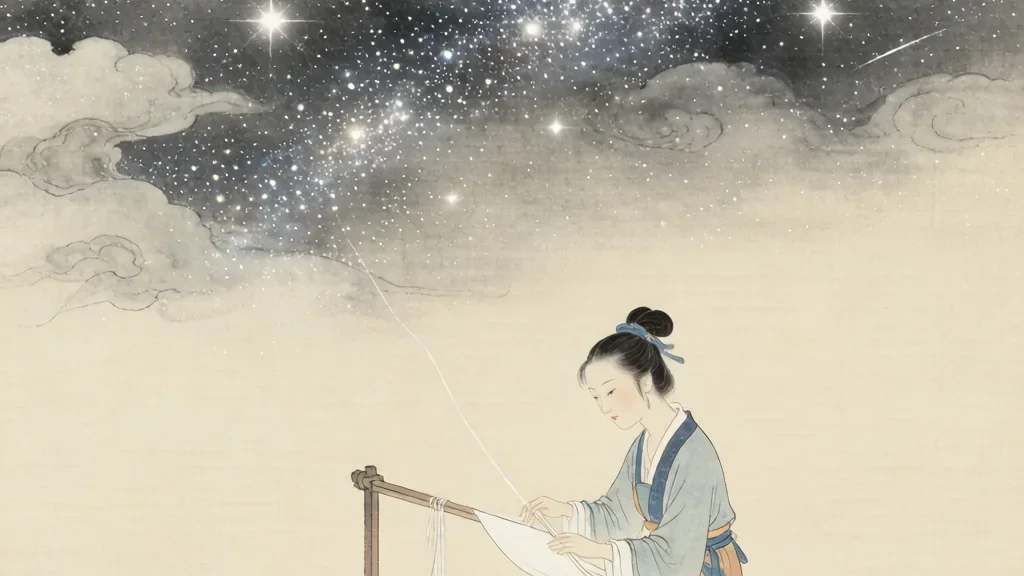
On the seventh night of the seventh lunar month, Chinese tradition turns its eyes to the summer sky. This is 七夕 (Qixi), the Double Seventh Festival, often called China's Valentine's Day. It tells the love story of a weaver girl who lived in heaven and a cowherd who lived on earth, parted by a celestial river and allowed to meet only once a year, when a flock of magpies forms a bridge across the stars. Long before greeting cards and red roses, Chinese lovers looked up at the Milky Way and found there a tale of separation and reunion that still moves people today.
The Weaver Girl and the Cowherd
The legend, told for more than two thousand years, begins with the Weaver Girl, the daughter of the Queen Mother of the West, who wove the clouds and robes of the heavens. A mortal named Niulang, a humble cowherd, fell in love with her, and with the help of his faithful ox they married and had children. But the heavenly court disapproved of the match across the worlds, and the Queen Mother drew a silver river, the Milky Way, to separate them forever.
Moved by their grief, the gods allowed the couple to meet on the seventh day of the seventh month, when magpies of the world fly up and lay their bodies side by side to make a bridge. On that one night, the weaver and the cowherd cross to hold each other, before the river of stars opens again. The two bright stars Vega and Altair, on either side of the Milky Way, are said to be them. The story belongs to the same family of loves as the Weaver Girl and the Cowherd, the star and the mortal of Chinese legend.
A Night for Girls to Pray
In older times, Qixi was less a lovers' holiday than a girls' festival. Young women, who were expected to be skilled at weaving, sewing, and needlework, would set up small altars on the evening of the seventh and pray to Zhinu for dexterity and, hopefully, a good marriage. They offered fruit, flowers, and tiny shoes or embroidery as tribute to the weaver who was mistress of the craft.
A favorite game was "begging for skills," in which girls threaded a needle by moonlight or floated needles on water to read the shadow they cast, judging whose hand was steadiest. The festival was thus a moment when women's work, so often unseen, was honored and made visible, a rare public celebration of the domestic arts that shaped a household's fortune.
Foods and Small Rituals
Like every Chinese festival, Qixi has its foods. In some regions people eat qiaoguo, thin fried pastries sometimes called "skill fruits," shaped with presses into flowers and figures. Eating them was a way to borrow the weaver's cleverness. Other areas serve melon and seasonal fruit, laid out on the courtyard table beside the offering to the stars.
Families also point children toward the two stars and tell the tale, so the story passes from grandmother to granddaughter as surely as the needle passes through cloth. In parts of China, girls would hide under a gourd vine on this night, hoping to overhear the whispered meeting of the lovers, a charming belief that the truth of love could be eavesdropped if one listened in the right green silence.
Qixi as Chinese Valentine's Day
In recent decades, Qixi has been rediscovered as a romantic holiday for couples, encouraged by shops and media eager for an answer to February's Valentine's Day. Lovers exchange gifts, share meals, and in the evening look for the two stars. The old prayers for needlework have given way, for many, to prayers simply to be together, or to find the one who is still across the river.
This modern revival is not fake nostalgia but a return to the festival's emotional core. The story was always about longing and reunion, about the pain of distance and the sweetness of meeting. A society on the move, where lovers are often separated by cities and careers, finds in Qixi a perfect mirror of its own hopes.
The Stars Above, the Heart Below
What keeps Qixi alive is its honesty about love. It does not promise that love is easy or that distance is small. It admits the river, the parting, the single night. And yet it insists that the meeting is worth everything, that the magpies will come, that the two will cross. In a culture that values endurance as much as passion, this may be the truest love story it tells.
To watch the summer sky on the seventh night is to join countless generations who looked up and ached and hoped. The weaver and the cowherd are still there, two lights across a silver stream, reminding anyone who loves and waits that they are not the first, and will not be the last.
Reading the Stars: Vega and Altair
The Qixi legend is written in the summer sky. The two lovers are real stars: Vega, one of the brightest stars overhead, is the Weaver Girl, while Altair, set on the other side of the hazy band of the Milky Way, is the Cowherd. Between them runs the 'silver river,' the Galaxy itself, the water that keeps them apart for most of the year. On the seventh night of the seventh month, Chinese tradition says, the two stand closest in the evening sky, and a bridge of magpies lets them cross. Sky-watchers have known these stars for millennia; farmers used them as a calendar mark for the late summer. To look up on Qixi is to read a love story in plain sight, with the dark river between the lights standing for every distance that love must cross to reach the one it misses.
Qixi in Poetry and Painting
Few Chinese festivals inspired as much art as Qixi. Poets from the Han onward returned to the meeting of the weaver and the cowherd, using the single night of reunion to speak of parting, patience, and the pain of distance, themes that resonated with scholars sent far from home by exams or posts. Painters pictured the two stars as a lady at her loom and a youth with an ox, often with a flock of magpies arcing across the sky. Famous works show the moonlit meeting with delicate, wistful lines. The story also entered opera and folk song, so a child might learn it from a grandmother's singing as easily as from a book. This long artistic life is why Qixi feels less like a fixed event than a repeated confession: across dynasties, writers have used the same two stars to say what they could not say in person.
Regional Ways of Keeping Qixi
Although the core legend is shared, Qixi is kept differently across China. In Guangdong and parts of the south, women once built elaborate 'Qixi altars' with tiny furniture and handicrafts, competing to show the finest skill. In some areas girls floated needles on water under the moon, reading the shadow to judge whose hand was steadiest, while in others they hid beneath gourd vines hoping to overhear the lovers' whispered meeting. Northern families might simply point children to the two stars and tell the tale over fruit. Among overseas Chinese the night often blends with local customs, yet the wish for cleverness and a good match remains. These variations show that Qixi was never one rigid rite but a loose frame of love, craft, and longing, filled in by local habit, which is precisely why it could later become a country-wide Valentine's day without losing its old, quiet heart.
❓ Frequently Asked Questions
📝 Chinese Vocabulary
七夕 — : The Double Seventh Festival.
织女 — : The Weaver Girl, a star goddess.
牛郎 — : The Cowherd, the mortal lover.
巧果 — : "Skill fruits," fried pastries eaten on the day.
鹊桥 — : The magpie bridge that joins the lovers.
银河 — : The Milky Way, the 'silver river' that separates the lovers.
乞巧 — : Begging for skills, the girls' rite of praying for needlework talent.
牵牛 — : An alternate classical name for the Cowherd star, Altair.
🎉 Fun Facts
- The two stars in the legend are Vega and Altair, among the brightest in the summer sky.
- The "magpie bridge" myth says the birds of the world sacrifice one night of rest each year to reunite the lovers.
- In ancient times Qixi was mainly a girls' festival for praying to become skilled at needlework.
- The festival appears in poetry dating back over two thousand years, including lines from the Han era.
- On Qixi some families still set out a small 'beauty tray' of seasonal fruit at dusk and offer it to the Weaver Girl, a quiet household rite kept in rural areas.
- In modern cities the night is marked with light shows and couple photographs under the stars, blending the old legend with new ways of celebrating love.