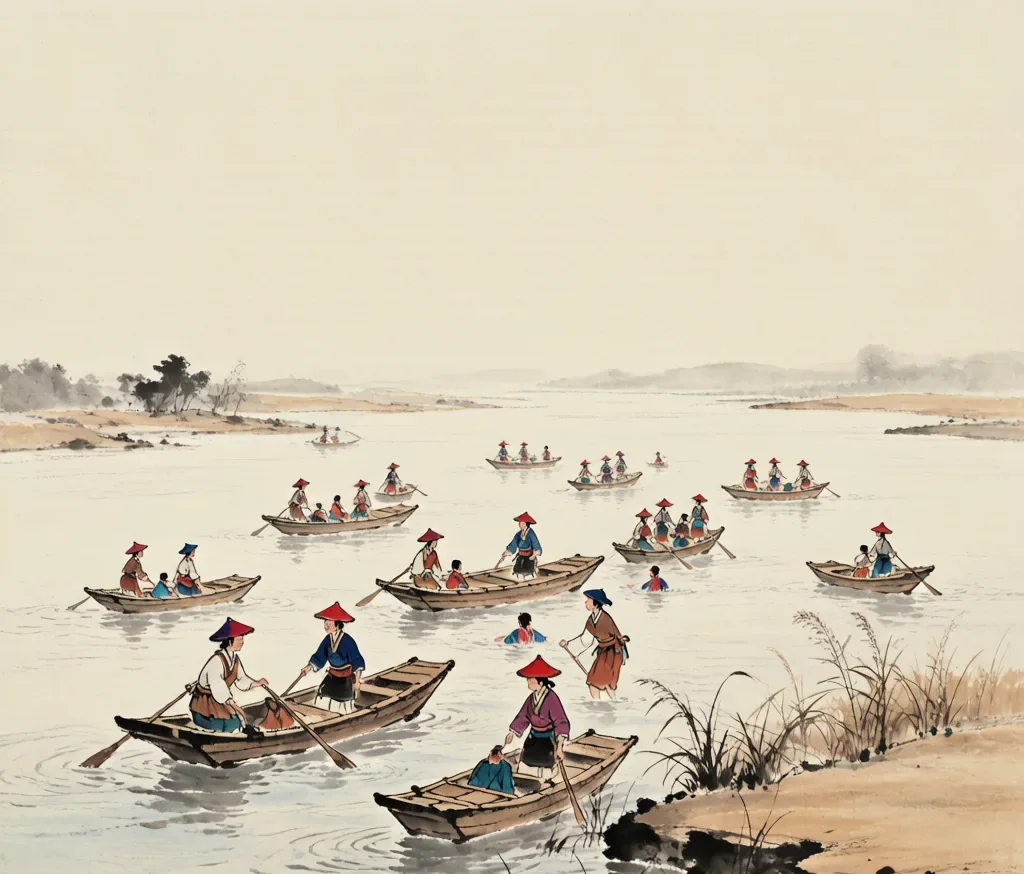
On the broad green waters of the Qingshui River in Guizhou, a long wooden dragon cuts through the current. It is not one boat but three — a great central "mother boat" flanked by two slender "child boats," together forming a Miao single-log dragon boat. For more than a thousand years, Miao villages along the Qingshui and Bala rivers have gathered each lunar May to race these massive craft, standing upright as they paddle, in one of China's most dramatic river festivals: the Miao Dragon Boat Festival.
What Is the Miao Dragon Boat Festival?
The Miao Dragon Boat Festival, called 掐仰勇 () in the Miao language, is a traditional festival of Miao communities in southeastern Guizhou. Unlike the Han Dragon Boat Festival on the fifth day of the fifth lunar month, which commemorates the poet Qu Yuan, the Miao festival takes place from the 24th to the 27th day of the fifth lunar month — roughly twenty days after Duanwu. It is at heart a rain-prayer and harvest festival, rooted in agriculture, ancestry, and the river itself.
The festival centers on 施洞 () Township in Taijiang County and surrounding villages along the middle reaches of the Qingshui River, stretching about 100 kilometers from Shilong in Huangping upstream to Gedong in Jianhe downstream. This area is known as the "Miao Single-Log Dragon Boat Cultural Circle" and was listed as part of China's national intangible cultural heritage in 2008.
The Legend Behind the Boats
The origin of the festival is preserved in a Miao legend. Long ago, an evil dragon living in the Qingshui River devoured the only son of an old fisherman. Grief-stricken and furious, the fisherman organized the villagers to hunt and kill the dragon. After the dragon died, it appeared in a dream to the people: although it had done great wrong, the river could not be without a dragon. Each year after the rice seedlings were transplanted, the Miao should carve a dragon from a single log, race it on the water, and offer sacrifices. In return, the dragon spirit would grant timely rain and abundant harvests. The people agreed, and the tradition has continued ever since.
The story explains why the festival is held after planting rather than at the Han Duanwu, and why the boats are carved from whole trees rather than built from planks. The dragon is both honored and managed — a powerful spirit that must be remembered and appeased so that the community and the land may prosper.
A Boat Carved from One Tree
The most striking feature of the festival is the boat itself. Each Miao dragon boat is made from three enormous fir logs: a thick central "mother boat" (母舟, ) and two thinner "child boats" (子舟, ) lashed alongside. The whole craft can reach 24 to 27 meters in length and weigh 3 to 4 tons. A carved dragon head with curved horns is fixed to the bow, and a long tail rises at the stern. Historical records from the Qing dynasty's Zhenyuan Gazetteer already described these strange, tree-trunk vessels carrying thirty to forty men.
Building a boat is a communal act. Villagers select and fell a great tree, hollow it over weeks, shape the gunwales, and paint the wood. The finished boat is stored in a "dragon boat shed" near the river until festival time, when it is carried to the water, blessed, and assembled. Because each boat belongs to a village or a clan, its upkeep and decoration are matters of collective pride.
Standing to Row
Where most dragon-boat racers sit, Miao paddlers stand. About 38 men in matching traditional dress stand on the two child boats, each holding a two-meter paddle. At the bow sits the 鼓头 (), the drum head — an honored elder or respected figure who beats the drum and calls the rhythm. At the stern a helmsman steers with a long oar, while a pole-man at the front helps launch and guide the boat through shallow water.
The paddlers move as one, leaning into each stroke to the beat of the drum and the roar of the crowd. Standing gives them leverage and a commanding view of the river, but it also demands extraordinary balance and coordination. The result is a spectacle unlike any other Chinese boat race: a long, low dragon gliding fast, its crew rising and falling together like a single body.
Four Days on the River
The festival unfolds over four days. On the 24th day of the fifth lunar month, villages perform the "rising dragon" ceremony, bringing the boats out of their sheds, offering sacrifices of chickens and wine to the protective deity Gaha, and launching them into the river. The 25th is "gathering dragons," when boats from different villages assemble at the race ground near Shidong's Tangba Village. The 26th and 27th are "dividing dragons" — the races themselves, with boats competing in sprints and displays of strength.
Between races, families host visiting relatives. Married daughters return to their parents' villages with gifts of ducks, geese, glutinous rice, and wine. Villagers share "dragon boat rice" and 粽粑 (), rice dumplings wrapped in bamboo leaves. On the banks, horse racing, bird fighting, singing, and embroidery markets turn the festival into a broad celebration of Miao culture.
From Rain Prayer to Living Heritage
Originally the festival was a rain-prayer ritual. Miao farmers along the Qingshui River watched for the "dragon boat rain" that traditionally arrived with the races, signaling the right moment to plant late rice. In drought years, the arrival of the festival was awaited with real anxiety; without it, the fields might be too dry to transplant.
Over time, the competitive and social aspects grew, and today the festival is both a sacred tradition and a vibrant public event that draws tens of thousands of spectators, researchers, and tourists. In 2008, the Miao Single-Log Dragon Boat Festival was added to China's national intangible cultural heritage list. Master craftsmen such as Zhang Tianrong of Balhe Village in Shidong have spent more than fifty years building and repairing the boats, training apprentices so the skill survives into the future.
Why the Miao Dragon Boat Festival Matters
The festival is more than sport. It is a calendar marker that binds river villages together, a ritual that negotiates the relationship between people and water, and a stage on which Miao language, dress, music, and craft are renewed each year. In a world of modern entertainment, the sight of a 27-meter log boat, carved by hand and driven by standing paddlers, remains a powerful image of continuity — a dragon still crossing the river, just as it did a thousand years ago.
❓ Frequently Asked Questions
📝 Chinese Vocabulary
苗族龙舟节 — : Miao Dragon Boat Festival.
独木龙舟 — : single-log dragon boat.
母舟 — : mother boat (central hull).
子舟 — : child boat (side hull).
鼓头 — : drum head; the boat's leader and rhythm keeper.
清水江 — : Qingshui River.
施洞 — : Shidong Township, center of the festival.
掐仰勇 — : the festival's name in the Miao language.
🎉 Fun Facts
- Miao dragon boats can reach 27 meters in length and weigh 3-4 tons, among the largest racing craft in the world.
- Paddlers stand rather than sit, a rare style of dragon-boat racing.
- The festival is held after, not on, the Han Dragon Boat Festival.
- It was listed as national intangible cultural heritage in 2008.
- A Qing dynasty gazetteer described the strange tree-trunk boats carrying 30-40 men.