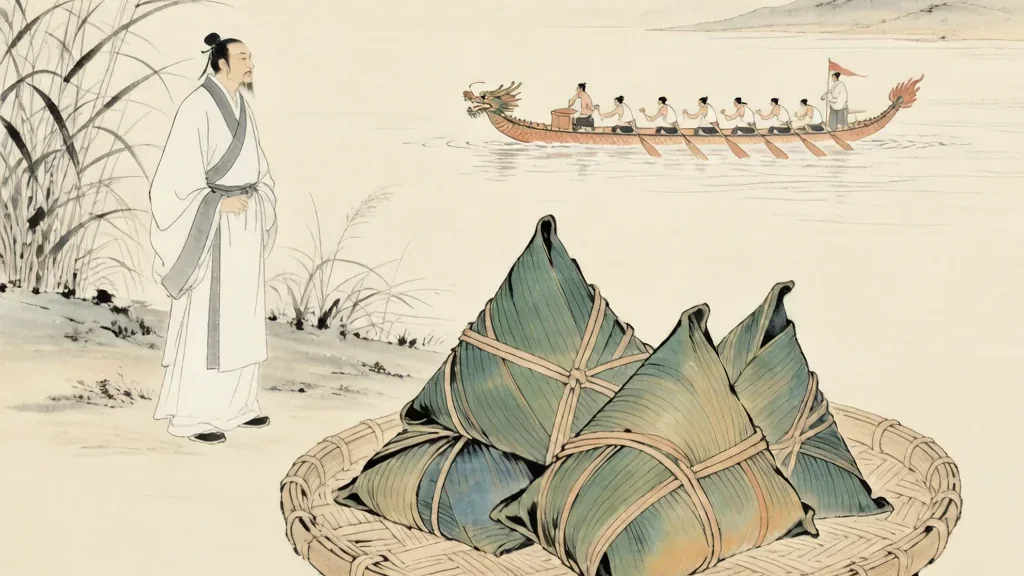
On the fifth day of the fifth lunar month, the rivers and lakes of China come alive with the beat of drums and the flash of paddles. This is 端午 (Duanwu), the Dragon Boat Festival, a day of racing boats, eating fragrant rice parcels, and remembering a poet who drowned more than two thousand years ago. Among China's traditional festivals, Duanwu is unusual in how sharply it mixes joy and sorrow: a spectacle of color and speed on the water, rooted in a story of loyalty, exile, and grief. It is celebrated not only across China but wherever Chinese communities have settled, from Southeast Asia to North America.
A Poet and a Kingdom Lost
The festival's most famous origin story centers on Qu Yuan, a poet and minister of the state of Chu during the Warring States period. He served his king with devotion but fell victim to slander and was exiled. As rival states encroached and Chu's capital fell, Qu Yuan despaired. In the year 278 BCE, according to tradition, he waded into the Miluo River and ended his life rather than witness his homeland's ruin. Local fishermen rushed out in their boats to save him, beating drums and splashing paddles to keep fish and water spirits away from his body.
Though historians note that dragon-boat racing likely predates Qu Yuan as a rain-making and river ritual, the poet's story became the festival's heart. His lament, the Li Sao or "Encountering Sorrow," remains one of the triumphs of classical Chinese literature, and his death gave the fifth day of the fifth month a weight of mourning that no mere harvest rite could carry.
The Rice Packets That Save a Poet
During the festival, nearly every household eats zongzi, glutinous rice wrapped in bamboo or reed leaves and tied with string. Fillings vary by region: in the south, red bean paste, salted egg yolk, or chunks of pork; in the north, sweet red dates or plain sugar. The leaf wrapping gives the rice a green, almost grassy fragrance, and the parcels are boiled or steamed until tender.
The custom is tied directly to Qu Yuan. The legend says that after his death, people threw rice into the river to feed his spirit and to distract the fish from his body. Later a dream warned that the rice was being eaten by a river dragon, so the people began wrapping it in leaves and binding it, making the offering harder for the beast to steal. Whether or not the tale is literal, zongzi turned an act of grief into a comfort shared at every table.
The Races Themselves
A dragon boat is a long, narrow vessel, often painted with a dragon's head at the bow and a tail at the stern, and fitted with a drum at the center. Crews range from a dozen paddlers to several dozen, all stroking in time to the drummer, who sets the rhythm that can mean the difference between victory and collapse. A steersperson at the rear and a flag-catcher at the front complete the team. The boats skim the water in lanes, and crowds line the banks cheering.
Races are held on rivers, lakes, and even coastal bays. In modern times the sport has organized internationally, with clubs training year-round and competing in world championships. Yet the village spirit remains: the race is less about the trophy than about the drum, the unity of the crew, and the roar of the crowd that echoes the fishermen who first raced to save a poet.
Building and Blessing the Dragon Boat
A dragon boat is more than a racing shell; it is a crafted object with its own rituals. Builders shape a long, narrow hull and fix a carved dragon head at the bow and a curling tail at the stern, often painting the body in red, green, and gold. Before racing, many communities hold a launching ceremony: the boat is carried to the water, blessed, and sometimes given offerings of fruit or incense so the river dragon will favor the crew. Eyes may be painted onto the dragon head in a separate rite, a moment said to 'open' the boat's spirit. The care given to the vessel shows why the race feels sacred as well as sporting, the boat is treated as a living dragon awakened for the day. Only after these rites is the hull allowed to meet the current and the drums to begin.
Keeping the Five Poisons Away
The fifth month was historically called the "poison month," when summer heat, insects, and disease arrived together. Many festival customs are really protections against illness. People hang bundles of mugwort and calamus, a reedlike plant, on their doors, believing the sharp scent drives off pests and evil. Children are tied with colored silk threads, and sometimes dressed in brightly colored, herb-filled sachets meant to repel pests.
Families also drink a mild wine of realgar, a mineral said to clear toxins, and paint the character for "king" on children's foreheads in realgar powder, borrowing the tiger's authority to frighten harm away. These practices belong to a older layer of the festival, the seasonal ritual of surviving the turning of the year into heat and sickness.
Duanwu Foods Beyond Zongzi
Zongzi dominate the Dragon Boat Festival table, but they are not the only seasonal food. Realgar wine, faintly yellow and faintly bitter, was the traditional drink, taken in tiny amounts to 'clear toxins' of the hot month. In some regions people eat eel, eggs boiled with herbs, or dishes flavored with mugwort, all chosen as warming or protective foods for early summer. Children might receive a boiled egg painted red, a small charm against the season's ills. The fifth month's reputation as a time of disease gave every dish a double job: to nourish and to guard. Even the act of hanging calamus and mugwort by the door had a culinary cousin, since both herbs were also used in cooking. So while the leaf-wrapped rice gets the fame, the fuller Duanwu table is a quiet pharmacy of tastes meant to carry a household safely into summer.
A Festival Recognized by the World
In 2009, UNESCO inscribed the Dragon Boat Festival on its list of intangible cultural heritage, recognizing it as a living tradition carried by communities rather than a frozen relic. Across China, the day is now a public holiday, and the rice parcels appear in shops weeks ahead. In Hong Kong, the Tai O and other races draw international crews; in Hunan, near Qu Yuan's homeland, the observances carry special local pride.
The festival's spread beyond China shows its universal appeal. In Canada, Germany, and Australia, dragon-boat racing has become a beloved community sport, often tied to charity and teamwork. What began as an act of mourning on a river in ancient Chu has become a global celebration of solidarity, rhythm, and the simple pleasure of pulling together toward a finish line.
Why the Day Still Matters
The festival endures because it holds two truths at once: that a society should honor those who loved it faithfully, and that survival through hard seasons requires care, vigilance, and shared ritual. The poet in the river and the racers on the water are the same story told in two keys, one of loss, one of life. To eat a zongzi and hear a drum on the fifth day of the fifth month is to join a chain of memory stretching back more than two millennia.
❓ Frequently Asked Questions
📝 Chinese Vocabulary
🎉 Fun Facts
- The UNESCO list of intangible cultural heritage added the Dragon Boat Festival in 2009.
- Some dragon boats are more than thirty meters long and carry crews of fifty paddlers or more.
- The drummer, not the helmsman, is often considered the most important member of a racing crew.
- Realgar wine, once drunk on the day, glows faintly and was thought to purge summer poisons.
- The fifth day of the fifth month was once thought so inauspicious that parents tied 'longevity threads' of five colored silks on children to shield them from the day's harmful influences.
- In some southern villages, people scoop the river water after the races, believing the stirred 'dragon boat water' carries the boat's good fortune for the year.