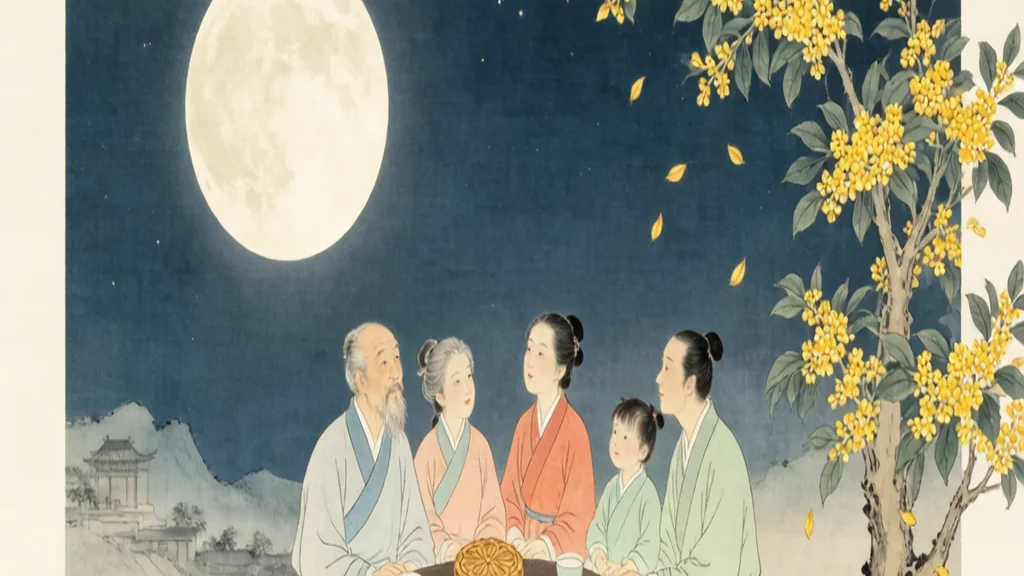
When the eighth lunar month reaches its middle and the moon hangs at its roundest and brightest, hundreds of millions of people turn their faces skyward. This is 中秋 (Zhōngqiū), the Mid-Autumn Festival — China's second most important holiday after the Spring Festival, and its tenderest. Where the New Year is about movement and noise, Zhongqiu is about stillness and closeness: a reunion dinner, a table of round fruits, and a long quiet look at the full moon. It is celebrated not only across China but throughout the Sinophone world, from Vietnam to Singapore to Chinatowns on every continent.
A Festival of the Full Moon
The festival is fixed to the fifteenth day of the eighth month of the traditional Chinese calendar — the night of the month's fullest moon, and the midpoint of autumn. The very name points to this: zhong means "middle" and qiu means "autumn." The full moon is no accident of timing but the heart of the holiday. In Chinese symbolism the round moon (yuanyue) stands for wholeness and togetherness, the visual rhyme of tuanyuan (团圆), family reunion. On this one night, people who have traveled far make their way home, because to miss the moon together is to feel the distance twice.
Unlike the solar holidays of the West, Zhongqiu moves on the Gregorian calendar, arriving somewhere between early September and early October. In 2026 it falls on Friday, September 25, gifting mainland China a three-day public holiday from the 25th to the 27th. The date's shift is a quiet yearly reminder that the festival follows the rhythm of heaven and earth, not the wall clock.
The Legend of Chang'e and the Elixir
No Mid-Autumn is complete without the story of Chang'e, the lady who flew to the moon. The archer Hou Yi shot down nine scorching suns to save the earth and was given the elixir of immortality as a reward. Fearing the potion would fall into the hands of a tyrant — or, in some tellings, to protect her husband from a selfish choice — Chang'e drank it and rose into the sky, coming to rest on the moon. There she lives still, beside the Jade Rabbit who pounds the elixir of life in a mortar of jade. When families point at the silver disc and say "look, there is Chang'e," they are repeating a gesture thousands of years old. The full myth, with Hou Yi and the ten suns, has its own page in our collection.
Mooncakes: The Taste of Reunion
If the moon is the festival's face, the mooncake is its flavor. These dense, palm-sized pastries are pressed in carved wooden molds that stamp them with flowers, characters, and the characters for "longevity" or "reunion." They are round for the same reason the moon is honored — the circle is completeness, the shape of a family made whole. Traditions differ by region: the south favors lotus seed paste wrapped around a salty egg yolk like a little sun, while the north leans sweet with red bean or date paste. A "five kernels" (wuxiren) filling of walnuts, sesame, melon seed, and almonds speaks to old ideas of health and balance.
Modern bakeries have exploded the form — snow-skin wrappers, custard lava, even ice-cream and truffle versions — but the meaning has not changed. Mooncakes are rarely eaten alone; they are presented in lacquered boxes, exchanged between relatives, colleagues, and clients, and opened only after the family has sat down to admire the moon. To give a mooncake is to send a wish for the receiver's circle to stay unbroken.
Moon-Viewing and the Reunion Table
The evening's central ritual is shangyue (赏月), "viewing the moon." After dinner, households carry a low table into the courtyard or onto the balcony and lay it with round things: a pomelo scored into petals, a cluster of grapes, pears, and a pot of tea. The mooncake box is opened last. Elders tell the children which shadows on the moon are Chang'e and which is the rabbit, and the conversation drifts to those absent — a daughter abroad, a grandfather remembered. The round table and the round moon together make a single image of belonging. In cities without courtyards, rooftops and riverside parks fill instead, everyone tilted toward the same light.
Lanterns, Riddles, and the Fire Dragon
Light is the festival's second language. Children carry paper lanterns — rabbits, stars, fish, and cartoon figures glowing on sticks — through lanes and parks, a custom said to guide the moon's light down to earth and to please the spirits. In the evenings, lantern riddles (caidengmi, 猜灯谜) are pinned to strings of lanterns in temples and squares: passersby call out answers, and a correct one wins a small prize, turning the night into a gentle public game. Southern China keeps a more spectacular rite: the fire-dragon dance of Hong Kong's Tai Hang, in which a coiled dragon of straw and incense is whirled through the streets amid sparks and drums to drive off plague and invite luck. The same impulse — light against the dark, community against isolation — runs through all of it.
Osmanthus, Wine, and Other Customs
Early autumn is also the season of guihua (桂花), fragrant osmanthus, and the festival borrows its scent. Families steep osmanthus in tea or ferment it into a sweet wine, raising a cup to the moon as an offering and a toast. In some regions people float small river lanterns or set a chair and a plate of cakes toward the moon to "welcome her down." The date sits near the harvest, so the holiday also carries a older thankfulness for a full granary before winter — a moment when the food on the table and the light in the sky both feel like gifts. None of these acts is required; together they make the night feel intentional, a pause carved out of the year.
Mid-Autumn Around the World
The fifteenth of the eighth month belongs to more than China. In Vietnam it is Tết Trung Thu, a children's festival of lion dances and star-shaped lanterns. Korea's great harvest rite is Chuseok, held on its own lunar date but sharing the spirit of homecoming and food. Across Singapore and Malaysia, where ethnic Chinese are numerous, the nights glow with lantern displays and mooncake fairs. Even far from Asia, the diaspora keeps the custom alive on balconies and in community centers, a way of carrying the old country's moon to a new one. The festival's power is precisely this portability: wherever a family looks up together, Zhongqiu is happening.
Why the Night Still Matters
The Mid-Autumn Festival endures because it answers a need older than any calendar: to stop, look up, and know you are not alone. In a culture that measures time by the moon and teaches that harmony begins at home, one full circle of light asks the simplest question — are you gathered, are you whole? To eat a mooncake under the brightest moon of the year is to join a chain of reunions stretching back two thousand years, and to promise the next one. It is, finally, less a holiday than a yearly act of attention: to the sky, to the season, and to the people beside you.
❓ Frequently Asked Questions
📝 Chinese Vocabulary
🎉 Fun Facts
- The Mid-Autumn Festival is sometimes called the "Mooncake Festival" or simply the "Moon Festival" in English.
- Legend says mooncakes once carried secret messages: rebels reportedly hid notes inside them to coordinate an uprising against the Yuan dynasty.
- The Jade Rabbit is said to pound the elixir of immortality with a mortar and pestle — look for it in the moon's shadows.
- Mid-Autumn is also a harvest festival, a moment of thanks for the grain before winter sets in.
- Vietnam's Tet Trung Thu turns the same date into a children's festival of lanterns and lion dances.
- In Hong Kong's Tai Hang district, a fire-dragon dance of straw and incense winds through the streets for three nights running.