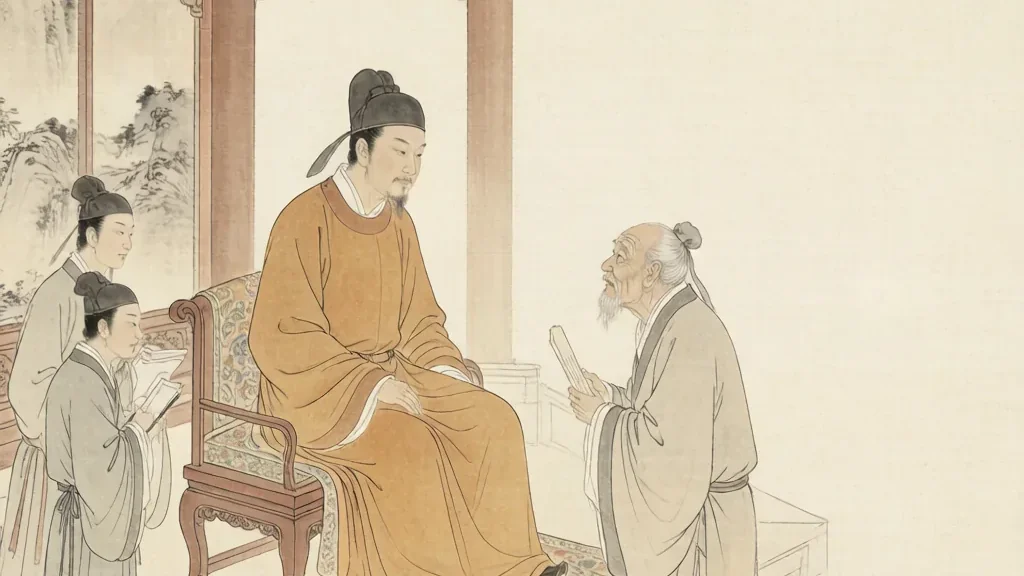
Of all the emperors who sat on China's dragon throne, none became a more studied model of good rule than Emperor Taizong of Tang (唐太宗, Táng Tàizōng). Born Li Shimin, he seized power in a bloody palace coup, then governed for twenty-three years with such wisdom, openness to criticism, and military success that his reign — the Zhenguan era (627–649) — became the gold standard against which later emperors measured themselves. He expanded the Tang to its greatest early extent, welcomed foreigners to his capital, and famously kept a wall of remonstrating officials who could tell him he was wrong. Taizong proved that a usurper could become a sage-king, and his example shaped Chinese political thought for a thousand years.
Taizong ruled at the dawn of the Tang dynasty, China's most cosmopolitan and confident age. This article follows his rise as a young general, the coup that won him the throne, his principles of government, his wars and diplomacy, and the legacy of a ruler whose greatness was purchased at the cost of his own brothers' blood.
The Young General Who Built the Dynasty
Li Shimin was born in 598, the second son of Li Yuan, a Tang-dynasty founder-to-be. As a young man he was a gifted cavalry commander during the wars that toppled the Sui dynasty and founded the Tang in 618. While his father hesitated, it was Li Shimin who pressed the family to rise, and it was he who won the decisive battles against rival warlords, earning a reputation for personal bravery and tactical brilliance.
His military genius was wedded to political sense. He cultivated able advisers and attracted talents who would later staff his government. By the time the Tang was secure, he was the empire's most powerful and popular prince — and also the rival of his elder brother, the heir apparent Li Jiancheng. The tension between the brothers was not merely personal; it was a struggle over the direction of the new state.
This phase of his life shows Taizong as he truly was: ambitious, capable, and willing to act decisively when caution might lose everything. Those same traits would soon produce both his greatest crime and his greatest opportunity.
The Xuanwu Gate Coup
In 626, fearing for his position, Li Shimin struck first. At the Xuanwu Gate, the northern entrance to the palace, he and his men ambushed and killed his brothers Li Jiancheng and Li Yuanji. He then forced his father to abdicate and took the throne as Emperor Taizong. The act was fratricide, a violation of Confucian filial and fraternal norms that his later propagandists labored to justify.
Yet the coup is also remembered because of what followed. Rather than rule through terror, Taizong used his bloody ascent as a warning to himself. He is said to have reflected that a ruler who kills his brothers to win power must govern so well that history forgives the means. Whether or not the story is exact, the reign that followed was strikingly moderate and law-bound.
The Xuanwu Gate episode became a permanent reference point in Chinese political debate: can a throne won by violence be legitimized by virtue? Taizong's answer — govern so the people prosper — became the pragmatic Confucian reply, and it let later usurpers cite him as precedent.
The Zhenguan Model of Government
Taizong's greatness lay less in conquest than in administration. He kept the capable ministers he inherited, including the blunt statesman Wei Zheng, who remonstrated with him hundreds of times and whom Taizong praised even when the criticism stung. The emperor cultivated a court where honest advice was rewarded, not punished — a rarity in absolute monarchy.
He governed lightly: low taxes, restrained corvée, careful law, and merit-based appointment. He reformed the legal code (the Tang Code, which became the basis for law across East Asia), standardized weights and texts, and promoted agriculture. His famous saying was that the people are the root of the state, and the ruler is a boat that the water (the people) can also overturn.
This "government by remonstrance" ideal — a ruler who listens — is Taizong's signature contribution. Later emperors were measured by whether they, like him, tolerated critics. The Zhenguan era came to symbolize the possibility that an enlightened monarchy could serve the common good.
Empire and the World
Militarily, Taizong was formidable. He crushed the Eastern Turks and brought the steppe under Tang suzerainty, earned the title "Heavenly Khagan" from nomadic peoples, and extended influence into Central Asia and the Tarim Basin. His campaigns restored the security the Sui had lost and projected Tang power farther west than before.
Diplomatically, his court at Chang'an was the most cosmopolitan city on earth. Merchants, monks, and envoys from Persia, India, Arabia, Japan, and Korea walked its streets; Buddhism, Nestorian Christianity, and Zoroastrianism all had communities there. Taizong welcomed this diversity, seeing the Tang as the center of a world order. The era's openness is a large part of why the Tang remains a byword for cultural glory.
His reign also strengthened the civil service and the examination system, laying the groundwork for the Tang's golden age in poetry and arts that followed under his successors. A stable, confident state let culture flourish, and Taizong's peace was its precondition.
Historical Context: The Early Tang
Taizong ruled just after the Tang replaced the short-lived, harsh Sui dynasty, whose overexpansion and forced labor had provoked revolt. The new rulers learned from the Sui's collapse, and Taizong made restraint a deliberate policy. He kept the Sui's useful institutions — the centralized bureaucracy, the canal system — while dropping its tyranny.
The early Tang also inherited a divided, war-worn realm and a multi-ethnic frontier. Taizong's success in unifying and securing it, then governing with moderation, explains why his reign became the template. Later dynasties, from the Song to the Qing, invoked "Zhenguan" as the name for good order, and manuals of statecraft quoted his words to advise living emperors.
Legacy of the Sage-King
Emperor Taizong died in 649 after a reign that defined the Tang at its best. His later years were clouded by a poorly chosen heir and a disastrous war in Korea, and he reportedly sought Daoist elixirs — a humanizing end to a disciplined life. Yet his reputation as the model ruler endured unchallenged for centuries.
His story carries a durable lesson: that institutions and character matter more than the circumstances of a ruler's rise. Taizong showed that a throne won in blood could be redeemed by service, and that listening to critics is a strength, not a weakness. For anyone studying how China imagined ideal power, the Sage-King of Zhenguan is the figure who answers the question of what a good emperor should be.
Taizong and the Tang Legal Code
Taizong understood that lasting power rests on law as much as on arms. He oversaw the revision of the Tang Code, a clear, comparatively humane body of statutes that fixed punishments, protected against arbitrary torture, and organized crime by category. Where the harsh Sui laws had bred revolt, his code sought moderation and predictability, yet it lost none of its authority. The Tang Code proved so durable and respected that later dynasties in China, and courts in Japan, Korea, and Vietnam, borrowed its structure for centuries. By coupling lenient taxation with a trustworthy legal order, Taizong gave his subjects reason to obey willingly. The code stands as one of his least visible but most far-reaching achievements, the quiet architecture beneath the Zhenguan era's celebrated glory.
The Wounds of Succession and His Final Years
Taizong's last years were shadowed by the very problem he had created at the Xuanwu Gate: who should rule next. He named his eldest son heir, yet the chosen successor proved weak and became entangled in a plot that ended in his death, a grim echo of the founder's own fratricide. A later campaign against Koguryo in Korea drained resources and ended in failure, chastening the aging emperor. Searching for longevity, he turned to Daoist elixirs, a poignant close for a ruler who had governed by reason. He died in 649 having secured the dynasty but not a clean transfer of power. The contrast between his peerless public order and his troubled private succession is part of why he remains so human: the sage-king, too, could not command everything, not even his own family's peace.
❓ Frequently Asked Questions
📝 Chinese Vocabulary
唐太宗 — : The Tang emperor and model sage-king (r. 626–649).
贞观 — : The Zhenguan reign era, byword for good government.
玄武门 — : Xuanwu Gate, site of the coup that won him the throne.
魏徵 — : Wei Zheng, his famously candid remonstrating minister.
唐朝 — : The Tang dynasty, China's cosmopolitan golden age.
天可汗 — : Heavenly Khagan, the title nomadic steppe peoples bestowed on Taizong after his victories over the Turks.
凌烟阁 — : The Pavilion of Lingyan, where Taizong had portraits of twenty-four meritorious officials hung to honor them.
唐律 — : The Tang Code, the legal compilation Taizong reformed and that became the model for law across East Asia.
🎉 Fun Facts
- Taizong won the throne by killing his two brothers at the Xuanwu Gate in 626.
- He kept Wei Zheng, who criticized him to his face hundreds of times, and praised him after his death.
- He was called "Heavenly Khagan" by the nomadic peoples he subdued.
- His capital Chang'an was the most cosmopolitan city in the world of its day.
- Taizong honored his six favorite warhorses with stone reliefs at his tomb, the Zhao Mausoleum, a celebrated set of Tang carvings.
- A capable poet and patron of letters himself, he personally wrote essays on statecraft and encouraged literary culture at court.