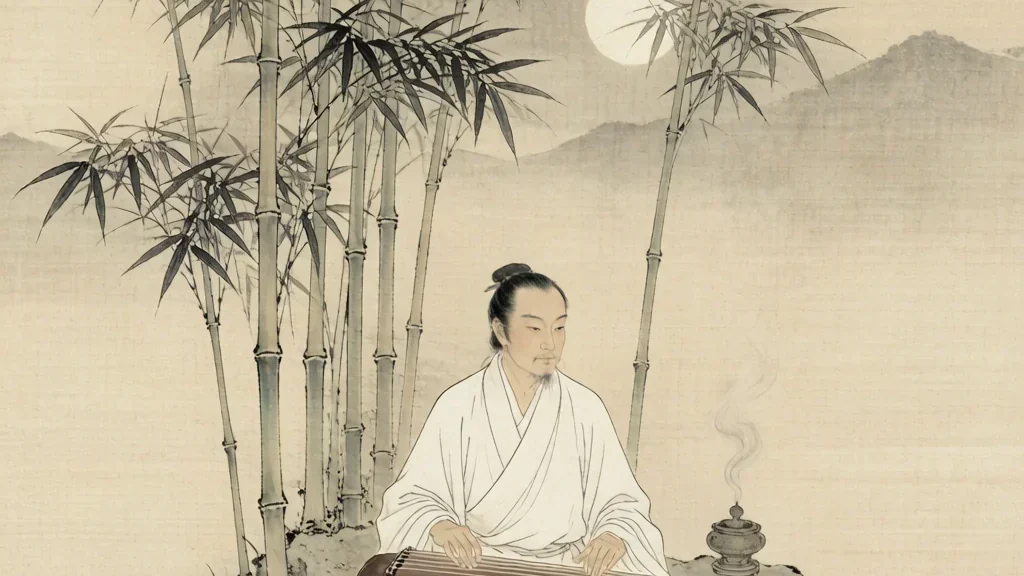
If one Tang poet could be said to have painted with words and written with a brush, it was Wang Wei (王维, Wáng Wéi). A courtier, a devout Buddhist, a master of both poetry and painting, Wang Wei lived in the eighth century at the height of the Tang dynasty's cultural brilliance and through its most shattering catastrophe, the An Lushan Rebellion. His short landscape poems — quiet, visual, almost weightless — have been cherished for more than a thousand years as the purest expression of China's meditative spirit. The painter Su Shi later said of him that "in his poetry there is painting; in his painting there is poetry."
Wang Wei was not a public moralist like some of his contemporaries. He was a private sensibility, a man who loved mountains, monasteries, and the silences between sounds. Yet his life was far from secluded: he served the empire, suffered captivity, and navigated the dangerous politics of the capital. This article explores how a gentle artist survived a violent age and left behind verses so still they seem to hum with the breath of the universe.
Birth, Talent, and Early Success
Wang Wei was born around 701 in Qizhou, in present-day Shanxi, to a family of scholarly officials. He showed prodigious talent in music, painting, and poetry from childhood. By his late teens he had already passed the imperial examination and was appointed to a court post connected with music — a fitting start for a man whose art would always be attuned to harmony and tone. His early poems, often on courtly or romantic themes, displayed a refinement that marked him as a rising star.
Unlike many poets who struggled for decades to gain office, Wang Wei moved easily in elite circles and was admired for his cultivation. He was also strikingly handsome and accomplished, reputed to play the qin (zither) with great feeling. A famous early poem, "The Song of Peach Blossom Spring" echoing Tao Yuanming's idyll, already showed his lifelong longing for a world untouched by worldly noise.
Personal loss shaped him early. The death of his wife when he was still young devastated him; he never remarried and turned increasingly toward Buddhism and solitude. From then on, a thread of detachment ran through his life, even as he continued to hold official positions and live in the capital.
The Buddhist Hermit at Court
Wang Wei's Buddhism was no mere fashion. He studied Chan (Zen) meditation, befriended monks, and built a retirement estate at Wangchuan, south of the capital, where he lived part of each year among streams, bamboo, and gardens. There he composed the celebrated "Wangchuan Collection," a sequence of poems each paired with a painting of the same scene — an early and perfect fusion of his two arts.
What makes Wang Wei distinctive is the way his faith informed his eye. A typical Wang Wei poem does not argue or exclaim; it simply places the reader inside a moment — a deer park at dusk, a mountain empty after rain, a woodcutter's fire vanishing into blue mist. The Buddhist idea of perceiving reality without grasping it finds exact expression in his restraint. He shows, and then withdraws, leaving the silence to do the work.
Yet he was no hermit in the woods. He kept his court rank, entertained literati, and fulfilled his duties. This dual life — engaged official by day, mountain mystic by spirit — was a balance many Tang gentlemen sought, but few achieved with Wang Wei's grace. His example helped define the ideal of the "literatus" who serves the world without being owned by it.
The An Lushan Rebellion and Captivity
In 755 the general An Lushan rebelled, seized the capital Chang'an, and declared his own dynasty. The emperor fled, and Wang Wei, caught in the city, was captured and forced to serve the usurper's regime. This collaboration, however unwilling, was a mortal danger: after the Tang restored order, any official who had served the rebels faced execution or exile.
Legend says Wang Wei tried to resist by taking medicine to feign illness and silence, and that while captive he sent a poem expressing his loyal grief to the fleeing emperor. When the Tang returned, that poem and the protection of his brother, a high official, helped save his life. He was demoted but allowed to remain in service, and in his later years he was even promoted. The episode reveals both the peril of his times and the quiet courage beneath his mild exterior.
The rebellion's trauma deepened his withdrawal. Increasingly he divided his time between the capital and Wangchuan, writing poems of deeper stillness. The catastrophe that broke the Tang's golden age also, paradoxically, purified Wang Wei's art into its most characteristic, hushed mode.
Poetic Style: Poetry as Painting
Wang Wei's landscape poems are among the shortest in Chinese literature, often just twenty characters in a four-line form, yet they evoke vast space. He favors muted colors — blue, white, gray — and sounds that emphasize quiet: a distant bell, a bird's cry, a stream's murmur. A single poem might place a lone figure in a misted mountain and let the emptiness speak.
Critics note his use of what might be called "negative space," borrowed from painting: what is left out matters as much as what is shown. A poem may mention only a wood, a sunset, and a closing gate, yet the reader feels an entire mood. This economy, combined with his painter's sense of composition, is why Su Shi's dictum about poetry and painting in his work has been repeated for a millennium.
His influence extended to landscape painting itself. Later painters studied his verses as much as his surviving scrolls, and the scholarly "Southern School" of Chinese painting traced its spirit to Wang Wei. He thus shaped not one art but two, becoming a foundational figure for the whole literati tradition of poetry, painting, and calligraphy as intertwined pursuits.
Major Works and Themes
Among his best-loved poems are "Deer Park," "Bird-Singing Brook," "Mount Zhongnan," and the longer "My Retreat at Wangchuan." Recurring themes include the changing of the seasons, the companionship of monks, the pleasure of solitude, and the gentle melancholy of parting from friends. Nature in Wang Wei is rarely dramatic; it is a calm presence that absorbs human feeling rather than reflecting it back.
He also wrote occasional poems, farewell poems, and some early romantic and courtly pieces, showing range beneath the calm. But it is the landscape lyrics — precise, cool, and luminous — that secured his fame. They became staples of anthologies and were among the first Chinese poems translated into Western languages, where they helped form the modern image of "Oriental" serenity.
Legacy: The Poet-Painter Ideal
Wang Wei's reputation grew steadily after his death. By the Song dynasty he was ranked among the very greatest Tang poets, and his fusion of arts became the model for the scholar-gentleman. In Japan his restrained, nature-loving sensibility resonated deeply with Zen aesthetics and influenced garden design and ink painting for centuries.
Today Wang Wei is studied as a bridge between literature and visual art and as a poet of mindfulness centuries before the term existed. In a noisy world, his small poems offer what they always offered: a pause, a view, a breath of mountain air. For readers seeking calm, Wang Wei remains inexhaustibly generous — an artist who proved that the quietest voice can echo the longest.
Official Between Art and State
Despite his reputation as a recluse, Wang Wei spent much of his life in office. He held posts in the capital's music bureau in youth, later served in provincial administration, and after the An Lushan Rebellion was even promoted, ending his career as a respected official. This double existence, engaged by day and meditative by spirit, was the balance many Tang gentlemen sought. He entertained literati, fulfilled duties, and navigated factional politics, yet his true home was the quiet of Wangchuan. The arrangement let him support himself and his family without surrendering his inner life. His example helped define the ideal of the literatus who serves the world without being owned by it, a figure who could be both a competent courtier and a mountain mystic, and who proved the two need not conflict.
The Wangchuan Collection and the Union of Arts
At his riverside estate of Wangchuan, Wang Wei created the work that best shows his fused genius: a sequence of short poems, each paired with a painting of the same spot, a stream, a pavilion, a grove. The poems and pictures were not illustrations of one another but parallel meditations, the verbal and the visual breathing the same stillness. This pairing anticipated how later scholar-artists would inscribe verse onto their paintings, making poetry, calligraphy, and image a single act. The collection also fixed his method, placing the reader inside a moment and letting emptiness carry the mood. Because it joined his two gifts so completely, the Wangchuan set became the touchstone for the claim that his poetry contains painting and his painting contains poetry, a standard repeated for a thousand years.
❓ Frequently Asked Questions
📝 Chinese Vocabulary
王维 — : The Tang poet-painter and Chan Buddhist.
唐朝 — : The Tang dynasty (618–907), his golden-age milieu.
辋川 — : Wangchuan, his riverside retirement estate.
禅 — : Chan (Zen) Buddhism, central to his outlook.
诗中有画 — : "In his poetry there is painting" (Su Shi's praise).
山水 — : Landscape, the painting and poetry genre in which Wang Wei became a defining master.
南宗 — : The Southern School of Chinese painting, whose meditative spirit later critics traced to Wang Wei.
辋川集 — : The Wangchuan Collection, his sequence of poems each paired with a painting of the same riverside scene.
🎉 Fun Facts
- Wang Wei was a musical prodigy who held a court post in the imperial music bureau as a young man.
- He never remarried after his wife died young, turning instead to Buddhism and solitude.
- He is considered the spiritual founder of the "Southern School" of Chinese landscape painting.
- A poem he secretly sent while captive helped prove his loyalty and save his life after the rebellion.
- Wang Wei's calm, imagistic manner became a model for Japanese Zen ink painting and garden design for many centuries.
- He was admired by the later poet Su Shi, who coined the famous line that in Wang Wei's poetry there is painting and in his painting there is poetry.