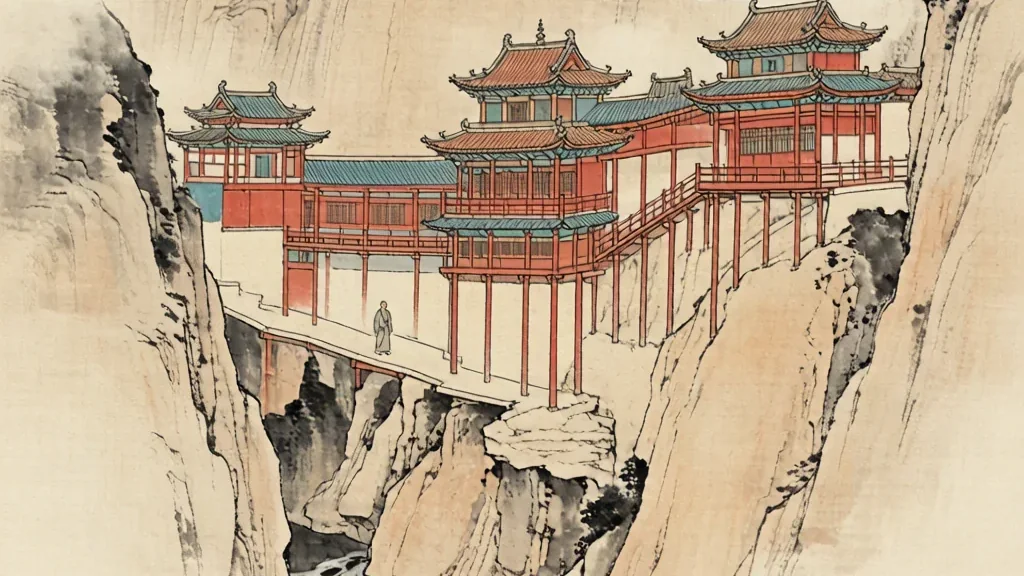
On the face of a sheer cliff in Shanxi province, a wooden temple clings to the rock as though it had grown there. Known in Chinese as 悬空寺 (Xuánkōng Sì), the Hanging Temple is one of the most astonishing structures in all of China — a monastery built into the side of a mountain, supported on beams driven into the cliff and seeming, from below, to defy gravity entirely. More than fifteen hundred years old, it is also a rare monument to religious harmony, for within its narrow galleries sit statues of the Buddha, the Confucian sages, and the Daoist immortals side by side. To stand on its swaying planks, with a river far below and the wind moving through the pines, is to understand why travelers have called it a miracle of engineering and a poem written in timber.
A Temple Between Three Faiths
The Hanging Temple was first constructed during the Northern Wei dynasty, around the year 491, in a region where Buddhism, Daoism, and the Confucian tradition all competed for patronage. Rather than choosing one, the founders built a sanctuary that honored all three. The main halls are arranged so that Buddhist, Daoist, and Confucian deities each have their place, and a visitor walking the circuit passes from one tradition's iconography to the next without ever leaving the cliff.
This tri-faith character is exceptional. Most Chinese religious sites are dedicated to a single dominant tradition, even if folk practice blends them in daily life. The Hanging Temple makes the blend architectural and explicit. Scholars see in it a reflection of the Northern Wei court's syncretic spirit, when rulers sponsored Buddhism while drawing on Daoist and Confucian ideas to govern a vast, newly unified north. The result is a building that is, in effect, a theological statement carved into stone and wood.
How It Stays Up: The Engineering
The temple's apparent impossibility is its greatest fame. From the valley floor it looks as though the entire structure floats, held by nothing but a few thin poles. In reality, the secret lies in a method that Chinese builders had refined over centuries. Horizontal beams of seasoned elm were driven deep into holes chiseled into the cliff face, and these beams carry the weight of the halls. The visible poles beneath the walkways are largely decorative supports added later, not the true load-bearers.
The cliff itself was chosen with great care. The temple sits in a recess where an overhanging ledge of rock shields it from rain and, crucially, from the worst of the sun and frost that would rot timber. The narrow gorge funnels wind in a way that, paradoxically, helps keep the structure dry, and the site was selected partly to avoid the flash floods of the river below. For more than a millennium this combination of clever carpentry and smart siting has kept the temple standing through earthquakes that leveled buildings on the plain.
The Halls, Statues, and Hidden Passages
Despite its dramatic setting, the Hanging Temple is compact. It houses roughly forty halls and pavilions, connected by narrow corridors and steep staircases that climb the rock in a zigzag. The largest hall holds a central Buddhist triad, while side niches preserve Daoist immortals and Confucian figures. One celebrated chamber displays a group of statues including the founders of the three traditions arranged in conversation, a visual sermon on coexistence.
What strikes most visitors is the intimacy. Unlike the vast stone temples of the plains, everything here is close, wooden, and human-scaled. The plank walkways are only a board or two wide, and the railings are low. The temple was never meant to hold crowds; it was a place of retreat for a small community of monks and the occasional pious traveler. That intimate scale, pressed against an immensity of cliff, is precisely what gives the place its uncanny beauty.
The Setting: Hengshan and the River
The temple hangs below the slopes of Hengshan, one of the sacred 五岳 (Wǔyuè), the Five Great Mountains of China, and it sits near the meeting point of two mountain streams. The chose location is said to have been picked to keep the building out of the path of the elements and to give the monks a place of quiet above the noise of the world. The surrounding canyon is green and narrow, and in autumn the cliff is draped with changing leaves.
Hengshan itself is a destination for pilgrims, and the Hanging Temple serves as its most famous gateway. The mountain has long been associated with Daoism, which makes the temple's inclusion of Daoist halls especially fitting, while the Buddhist presence speaks to the region's role on the northern Buddhist routes. Together the mountain and the temple form a single sacred landscape, where geology and devotion are inseparable.
Survival, Restoration, and Fame
Over fifteen centuries the temple has been repaired many times. Wooden components rot and must be replaced; the beams are renewed using the same methods as the originals. Remarkably, the basic plan has survived intact, so that a visitor today sees essentially the same arrangement that medieval travelers described. Modern conservation has reinforced the cliff anchors and limited visitor numbers to reduce strain on the walkways.
In recent decades the Hanging Temple has become one of Shanxi's best-known attractions, celebrated in photographs and travel writing around the world. It was even listed by some architectural surveys among the most precarious yet enduring buildings on earth. Yet for all its fame, the experience of the place remains private and vertiginous — a few minutes of careful walking on a board that trembles, with the whole of Chinese religious history compressed into a cliffside the size of a small house.
Why the Hanging Temple Matters
The Hanging Temple matters because it refuses the easy categories we use to sort Chinese culture. It is Buddhist and Daoist and Confucian at once; it is an engineering feat and a work of devotion; it is fragile and yet has outlasted empires. In a country rich with monumental sites, few speak so directly to the Chinese genius for placing human make in conversation with overwhelming nature.
To visit is to be reminded that faith in China has rarely been a matter of exclusive creeds. The temple's three traditions share a single cliff, a single roofline, a single breath of mountain air. That quiet lesson, delivered from a plank walk high above a northern river, may be the most enduring thing the Hanging Temple has to teach.
The Northern Wei World That Built It
The Hanging Temple was born in a particular moment of Chinese history. The Northern Wei dynasty, founded by the Tuoba, a people of steppe origin, ruled northern China from the late fourth century and became one of Buddhism's greatest patrons, carving caves at Yungang and sponsoring monasteries across the north. Yet the court also drew on Daoist and Confucian ideas to govern a vast, mixed population. It was in this syncretic atmosphere, around 491, that a sanctuary was conceived to honor all three traditions at once. Understanding that background explains the temple's unusual tri-faith plan: it was not an accident of tolerance but a deliberate statement of how a frontier empire imagined unity among China's great teachings.
Visiting the Hanging Temple Today
The temple lies in Shanxi province below Hengshan, one of China's sacred mountains, and is usually reached from the city of Datong to the north. Visitors climb short flights to reach the plank walkways, where the passages narrow to a board or two and the railings sit low; numbers are limited and the boards can tremble underfoot. The experience is intimate and vertiginous rather than grand, best attempted on a clear morning before crowds arrive. Photographers favor the view from across the gorge, where the wooden galleries appear to float against the cliff. Modest dress and a calm step suit a working religious site, and combining the visit with nearby Yungang makes a natural northern-Shanxi heritage route.
❓ Frequently Asked Questions
📝 Chinese Vocabulary
悬空寺 — : The Hanging Temple, the cliffside monastery in Shanxi.
五岳 — : The Five Great Mountains of China, of which Hengshan is one.
恒山 — : Hengshan, the northern sacred mountain beneath which the temple hangs.
北魏 — : The Northern Wei dynasty that founded the temple in the late fifth century.
三教 — : The Three Teachings — Buddhism, Daoism, and Confucianism.
释迦牟尼 — : Shakyamuni, the historical Buddha, enshrined among the temple's statues.
老子 — : Laozi, the revered founder of Daoism, honored in the temple's Daoist halls.
孔子 — : Confucius, the teacher whose image sits alongside the Buddhist and Daoist figures.
🎉 Fun Facts
- The Hanging Temple was built around 491, making it older than most of Europe's great cathedrals.
- The cliff overhang was deliberately chosen to shield the wooden structure from rain, sun, and frost.
- The temple enshrines statues of Buddha, Laozi, and Confucius together under one roof.
- The temple holds around forty halls and pavilions linked by narrow corridors and steep staircases climbing the rock.
- Though it looks impossibly fragile, it has outlasted earthquakes that flattened buildings on the open plain, thanks to its sheltered siting.
- Architectural surveys have listed it among the most precarious yet enduring buildings on earth, a cliffside the size of a small house that still stands.