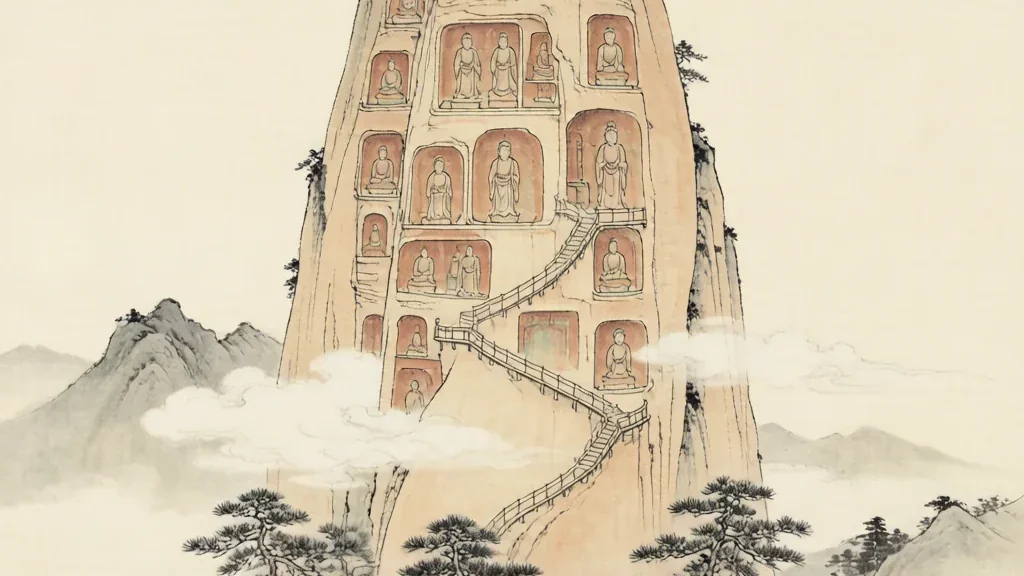
Rising from the foothills of the Qinling mountains in Gansu province is a conical hill that looks, from a distance, like a giant stack of wheat. This is 麦积山 (Màijī Shān), the Maiji Mountain, and cut into its vertical faces are nearly two hundred cave niches filled with some of the most graceful Buddhist sculpture in China. The Maijishan Grottoes were hollowed out over more than a thousand years, from the fourth century into the Ming, by artisans who clambered up scaffolding to carve and paint on a cliff that seems almost unwilling to hold them. The result is a vertiginous gallery of faith, suspended above a green valley, where the gentle faces of bodhisattvas have watched over travelers on the Silk Road for sixteen centuries.
The Wheat-Stack Mountain
The name Maijishan means "Wheat Stack Mountain," a nickname earned by the hill's rounded, terraced silhouette, which does indeed resemble a pile of harvested grain. The mountain is made of soft conglomerate rock — a crumbly mixture of sand and gravel — which is easy to excavate but prone to erosion. This geology dictated the site's character: rather than deep caves, Maijishan's artisans cut shallow niches and arched recesses into the cliff, then filled them with clay sculptures and murals.
The setting is dramatic. The hill stands alone, a solitary cone surrounded by forested ridges and mist, and the grottoes trace a ladder up its southern and western faces. From the valley the niches appear as dark windows punched into the rock, linked by walkways that cling to the cliff like the galleries of a fantastical pagoda. Few Buddhist sites feel so intimately tied to the drama of their own geography.
A Thousand Years of Carving
Work at Maijishan began in the fourth and fifth centuries, during the tumultuous period of the Sixteen Kingdoms and the Northern Wei dynasty, when Central Asian Buddhism was flowering in the northwest. The site grew through the Western Wei, Northern Zhou, Sui, Tang, Song, and Yuan periods, with later dynasties adding niches, refacing statues, and repainting walls. Unlike a single-phase monument, Maijishan is layered history — each century leaving its handprint on the cliff.
This long span makes the grottoes a textbook of changing style. The earliest figures are slender and austere, with the angular dignity of early Buddhist art from the north. Tang-dynasty sculptures swell with the relaxed naturalism of that golden age. Song and later works introduce an almost domestic warmth, with smiling, approachable bodhisattvas. Walking the cliff is therefore a walk through a millennium of Chinese aesthetic evolution, all preserved on one mountainside.
The Sculptures and Their Famous Faces
Maijishan is celebrated above all for its clay sculptures, of which there are said to be over seven thousand individual figures. The soft local rock could not easily hold freestanding stone carving, so artisans modeled figures in clay over wooden armatures and painted them in bright mineral pigments. The effect, where preservation allows, is startlingly lifelike — rounded cheeks, flowing scarves, and the famous gentle smiles that have made Maijishan's bodhisattvas icons of Chinese Buddhist art.
Among the most admired are the so-called "flying apsaras" and the serene images of Maitreya and Guanyin that seem to lean out of their niches in greeting. The Tang-dynasty "smiling Maitreya" is often singled out for its warmth and humanity. Because the clay was painted, many figures retain traces of their original color, giving visitors a rare sense of how vivid these cliff temples once appeared to the pilgrims who climbed to them.
The Cliff Walkways and Engineering
To reach the upper grottoes, visitors today use walkways and platforms bolted to the rock, a modern echo of the wooden galleries that have been attached to Maijishan for centuries. Historical records describe multiple tiers of wooden corridors that once wrapped the entire mountain in a lattice of timber, so that the hill looked like a multi-storied pavilion built into stone. These structures were as much feat of carpentry as the carvings were of sculpture.
The challenge was extraordinary. Working on a crumbling cone, artisans had to stabilize the rock, erect scaffolding, carve niches, model clay, and paint — all while suspended high above the valley floor. Earthquakes and weathering have repeatedly damaged both cliff and galleries, and restoration has been a continuous enterprise. The present walkways let visitors ascend safely, but they also preserve the vertiginous thrill that has always been part of the Maijishan experience: faith approached, quite literally, on the edge of a precipice.
Murals, Devotion, and the Silk Road
Beyond the sculpture, Maijishan preserves extensive murals that once covered the niche walls and ceilings. These paintings depict Buddhist paradises, processions of donors, and decorative patterns drawn from the broad visual culture of the Silk Road. They connect the site to the wider world of Central Asian and Indian art while showing how those influences were localized into a Chinese idiom of line and color.
The grottoes were never an isolated hermitage. They sat near routes that linked the Chang'an region with the northwest, and they attracted patronage from rulers, monks, and ordinary believers who funded niches as acts of merit. Inscriptions left by donors record names, dates, and wishes, turning the cliff into a kind of community ledger of devotion. Reading them, one hears the voices of people who, a thousand years ago, hoped for health, harvest, and rebirth and left their prayers in clay and pigment.
World Heritage and Lasting Wonder
In 2014 the Maijishan Grottoes were inscribed as part of the UNESCO World Heritage listing of the "Silk Roads: the Routes Network of Chang'an-Tianshan Corridor," recognizing their role in the transmission of Buddhism and art across Eurasia. The designation brought new resources for conservation, crucial given the fragility of the soft rock and the clay figures that adorn it.
Maijishan endures as a monument to human daring and tenderness. It is a place where engineering meets devotion, where a crumbling hill was transformed into a ladder of light, and where the gentle faces of bodhisattvas still smile down on those who make the climb. For anyone seeking to understand how Buddhism traveled, took root, and was made beautiful in China, the Wheat Stack Mountain is an essential, unforgettable stop.
Maijishan Among the Great Grottoes
Maijishan is counted among the Four Great Grottoes of China, together with Mogao at Dunhuang, Yungang at Datong, and Longmen at Luoyang, yet it is the odd one out. The others were carved from durable sandstone or limestone; Maijishan's soft conglomerate forced a different art, with clay figures modeled over wooden frames rather than cut from stone. That difference gives the site its signature warmth, the rounded, smiling faces that feel closer to people than to doctrine. Its position on the Silk Road also set it apart, a meeting point where Central Asian and Indian forms were absorbed into a Chinese idiom of line and color. To compare the four is to see one faith expressed in four materials and temperaments, and Maijishan is the gentle, human-scaled member of the family.
Saving a Mountain of Clay
The same softness that made Maijishan's art possible makes its preservation hard. The conglomerate erodes, the painted clay flakes, and earthquakes have repeatedly damaged both cliff and galleries. After centuries of weather and a turbulent twentieth century, many niches arrived at the modern era cracked and faded. Today conservators stabilize the rock, rebuild lost clay with traditional recipes, and shelter the most fragile faces from rain, while digital scanning records the site in three dimensions before more weathering occurs. Visitor numbers are managed so that foot traffic and vibration do not accelerate decay. The work is never finished; it is a continuous pact between caregivers and a crumbling hill, undertaken so that the bodhisattvas' smiles survive another thousand years.
❓ Frequently Asked Questions
📝 Chinese Vocabulary
麦积山 — : Maiji Mountain, the "Wheat Stack Mountain" of Gansu.
石窟 — : Rock grotto or cave chapel, the form of the Maijishan carvings.
飞天 — : The flying apsaras, celestial figures commonly depicted in the grottoes' art.
菩萨 — : Bodhisattva, the compassionate enlightened beings whose images fill the niches.
弥勒 — : Maitreya, the future Buddha, honored by several celebrated Maijishan statues.
泥塑 — : Clay sculpture, the modeled figures that define Maijishan's art because the local rock is too soft to carve.
栈道 — : The plank walkways bolted to the cliff that let visitors and artisans reach the high niches.
西魏 — : The Western Wei dynasty, one of the early periods that enriched the grottoes' style.
🎉 Fun Facts
- Maijishan contains nearly two hundred cave niches and is said to hold over seven thousand clay figures.
- The soft conglomerate rock forced artisans to model in clay rather than carve freestanding stone.
- Historical galleries of timber once wrapped the entire mountain, making it look like a pagoda built into a cliff.
- Maijishan lies near the routes linking Chang'an with the northwest, so its art shows Central Asian and Indian influences localized into Chinese forms.
- The site was inscribed in 2014 as part of the UNESCO Silk Roads World Heritage listing, recognizing its role in transmitting Buddhist art.
- Donor inscriptions on the cliff record names, dates, and wishes, turning the mountain into a community ledger of devotion.