In the city of Luoyang, in Henan province, stands a temple that calls itself the cradle of Chinese Buddhism. Known in Chinese as 白马寺 (Báimǎ Sì), the White Horse Temple was, by tradition, the first Buddhist monastery established on Chinese soil. Founded in the first century of the Common Era under the Eastern Han dynasty, it marks the moment when the teachings of the Buddha, traveling along the Silk Road from India and Central Asia, found their first permanent home in the Middle Kingdom. For nearly two thousand years it has been a living center of worship, scholarship, and pilgrimage. To walk its courtyards is to walk the starting line of one of the great religious and cultural transmissions in human history.
The Legend of the White Horse
The temple's origin story is among the most beloved in Chinese Buddhism. According to tradition, the Emperor Ming of the Han dreamt of a golden figure flying near his palace, and he sent envoys west to discover its meaning. The envoys returned from Central Asia with Buddhist scriptures and images, carried on the backs of two white horses. In gratitude, the emperor founded a monastery at the capital and named it for the animals that had borne the holy texts — the White Horse Temple.
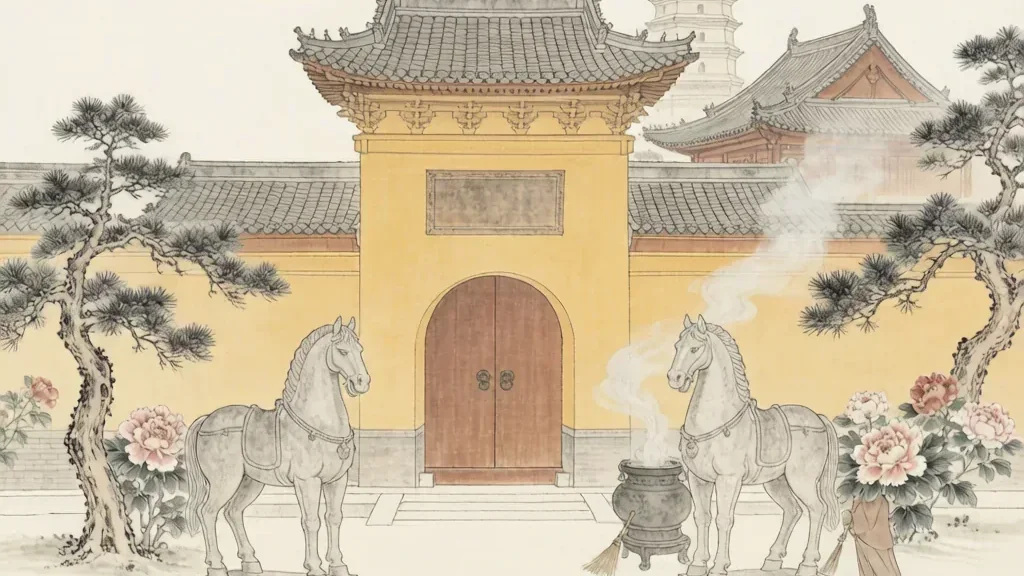
Like many origin legends, this tale blends history and symbolism. The dream, the envoys, and the horses may be partly narrative invention, but they encode a real process: the arrival of Buddhist monks and texts in the Han capital and the imperial decision to sponsor their translation. The white horse became a lasting symbol, and images of the two horses still guard the temple's entrance today, a quiet reminder of the long journey that began the religion's Chinese life.
Foundation Under the Eastern Han
Most scholars place the temple's founding around the year 68 CE, during the reign of Emperor Ming of the Eastern Han. Luoyang was then the imperial capital, a cosmopolitan city at the eastern end of the Silk Road. The new monastery was built in the style of a Han official's residence, with a pagoda-style hall for storing scriptures — an architectural borrowing that would shape Chinese temple design for centuries.
The first resident monks were the envoys-turned-monks who had journeyed west, along with Indian and Central Asian teachers who came to translate the sutras. Working in the temple's early halls, they produced some of the first Chinese-language Buddhist texts, rendering Sanskrit concepts into Chinese characters and, in doing so, inventing much of the religious vocabulary that Chinese Buddhism would use forever after. The White Horse Temple was thus not only a house of worship but the birthplace of Chinese Buddhist literature.
The Temple Through the Dynasties
Because Luoyang lay on the main currents of Chinese history, the temple was destroyed and rebuilt many times. It burned in the upheavals that ended the Han, was revived under later dynasties, and was repeatedly expanded by rulers who saw patronage of Buddhism as a source of legitimacy and merit. The Tang dynasty, a golden age of Chinese Buddhism, lavished attention on the site, and the Ming and Qing dynasties restored its halls in the forms we see in outline today.
What is striking is the continuity of the name and the place. Even when buildings fell, the monastery was re-founded on the same ground, so that the White Horse Temple of today occupies, in a real sense, the same sacred plot as the original first-century foundation. Few religious sites on earth can claim an unbroken identity across nineteen hundred years. Pilgrims who come now step where the very first Chinese Buddhist community once chanted.
Architecture and the Sacred Compound
The temple follows the standard axis of a Chinese monastic compound: a south-facing entrance, a series of courtyards separated by halls, and a tower or pagoda marking the sacred center. The Hall of the Heavenly Kings guards the approach, followed by the Main Hall enshrining the Buddha, and a rear hall dedicated to the temple's founders. Stone steles record the donations and restorations of successive ages, and ancient ginkgo and cypress trees shade the paths.
Near the entrance stand the famous pair of stone horses, replicas of the legendary carriers of the scriptures. Behind the traditional compound, more recent additions include gardens and memorial structures donated by Buddhist communities from countries such as India, Thailand, and Myanmar, making the temple a small museum of pan-Asian Buddhist architecture. These international halls testify that the White Horse Temple is honored not only in China but across the Buddhist world as a shared ancestral site.
A Living Center of Pilgrimage
Unlike many heritage sites that are preserved mainly as museums, the White Horse Temple remains an active monastery. Monks live, chant, and perform rites within its walls, and visitors may join in the rhythms of devotion. Important Buddhist festivals draw crowds from across Henan and beyond, and the temple's role as a training and translation center, begun in the first century, finds echoes in its continued scholarly life.
For Chinese Buddhists, a pilgrimage to Luoyang carries a meaning akin to a visit to a founding shrine. The temple is spoken of as the 祖庭 (Zǔtíng), the ancestral court, of Chinese Buddhism — the place where the faith took root. This living devotional function keeps the site from being merely a relic; it is a working root system for a religion that now counts hundreds of millions of adherents.
Why the White Horse Temple Matters
The significance of the White Horse Temple extends far beyond its modest size. It marks the point of contact between two of the world's great civilizations — the Indian and the Chinese — and the beginning of a transformation that would reshape Chinese art, philosophy, language, and daily life. Buddhism would go on to inspire the cave temples of Dunhuang and Yungang, the poetry of the Tang, and the devotional life of a continent.
All of that, the legend says, arrived on the back of a white horse. Whether or not the horses were real, the temple they named endures as a symbol of open-mindedness — a reminder that China's greatness has often lain in its willingness to receive and remake the gifts of the wider world. In the quiet of its oldest courtyard, you can still feel the moment when a foreign teaching became, slowly and profoundly, Chinese.
The Silk Road and the Arrival of the Dharma
The White Horse Temple owes its existence to the Silk Road, the web of trade routes that linked China to Central Asia and India. Along those roads traveled not only silk and spices but ideas, and in the first century of the Common Era Buddhist monks and texts began to reach the Han capital at Luoyang. The emperor's envoys, sent west after a dream of a golden figure, returned with scriptures and images carried on white horses, and the monastery they founded became the first permanent home of the Buddha's teaching in China. In this sense the temple marks a moment of contact between two great civilizations, when a foreign faith arrived not by conquest but by translation, patience, and the slow work of rendering Sanskrit thought into Chinese words.
The White Horse Temple in the Buddhist World Today
More than nineteen centuries after its founding, the White Horse Temple is still honored far beyond China's borders as the ancestral court of Chinese Buddhism. Within its grounds stand halls donated by Buddhist communities from India, Thailand, and Myanmar, each built in its own national style, so that a single courtyard displays the architecture of several Buddhist cultures side by side. The temple remains an active monastery, with monks chanting and teaching where the first Chinese Buddhist community once lived. For pilgrims it is a founding shrine, a place to touch the origin of a tradition that now numbers hundreds of millions of adherents. Its survival across dynasties, wars, and rebuildings makes it a rare unbroken link between the ancient Silk Road and the living faith of the present day.
❓ Frequently Asked Questions
📝 Chinese Vocabulary
白马寺 — : The White Horse Temple, traditionally the first Buddhist monastery in China.
洛阳 — : The ancient capital city in Henan where the temple stands.
祖庭 — : The ancestral court or founding shrine of a tradition.
汉明帝 — : Emperor Ming of Han, who is said to have sent envoys west and founded the temple.
东汉 — : The Eastern Han dynasty under which the temple was established.
译经 — : Sutra translation, the work of rendering Buddhist scriptures into Chinese.
伽蓝 — : A monastery or sangharama, the community dwelling of monks.
浮屠 — : An early Chinese transliteration for the Buddha or for a stupa.
🎉 Fun Facts
- The White Horse Temple is traditionally dated to 68 CE, within the lifetime of the Eastern Han dynasty.
- Stone replicas of the two scripture-carrying white horses still stand at the temple entrance.
- Recent halls at the temple were donated by Buddhist communities from India, Thailand, and Myanmar.
- The White Horse Temple's earliest halls were modeled on a Han official's residence with a pagoda-style scripture store, a layout that shaped Chinese monastery design for centuries.
- The first resident monks were the envoys who had traveled west, joined by Indian and Central Asian teachers who taught the art of translation.
- The site has been destroyed and rebuilt many times, yet always re-founded on the same sacred ground, giving it an unbroken identity of some 1,900 years.