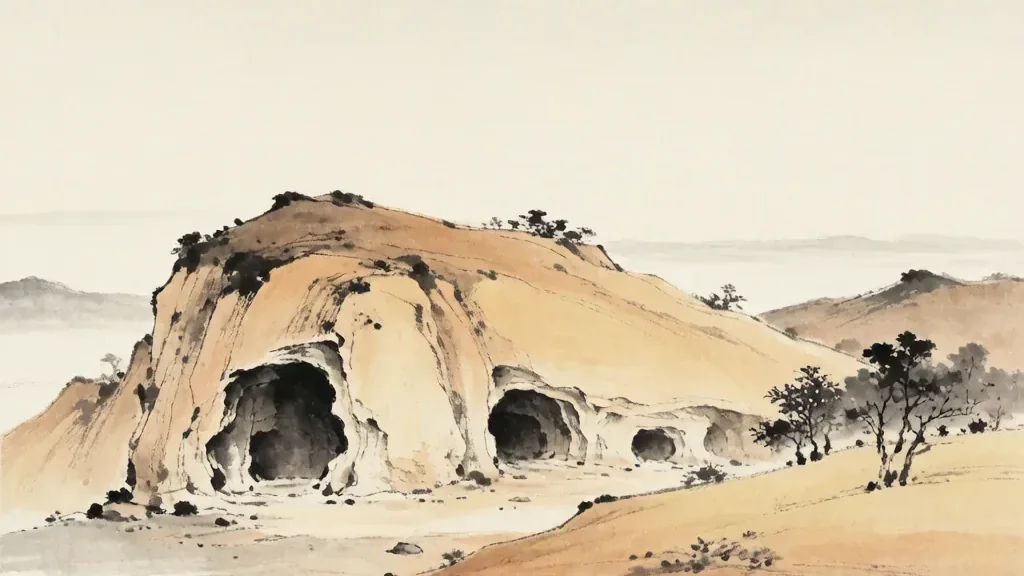
In the limestone hills southwest of Beijing lies a cluster of caves and gullies that rewrote the human story in East Asia. This is 周口店 (), Zhoukoudian, the site where excavations early in the twentieth century uncovered the fossils of "Peking Man," an ancient human ancestor who lived in these caves hundreds of thousands of years ago. More than a dig, Zhoukoudian is a window into the deep past, evidence that humans inhabited northern China far earlier than anyone had imagined. Today it is a UNESCO World Heritage site and one of the most important paleoanthropological locations on Earth.
The Discovery That Changed History
The story of Zhoukoudian begins in the early nineteen hundreds, when a Swedish geologist surveying the area noticed fossil-rich deposits in the local limestone. Systematic excavation soon followed, led by a team of Chinese and international scientists. In 1929, a young Chinese paleontologist named Pei Wenzhong made the breakthrough that made the site famous: he unearthed a complete skullcap of an ancient hominin in a cave later called Locality 1. The fossil was assigned to a species named Homo erectus, and the popular press christened it "Peking Man," or in Chinese 北京人 (). The find pushed the known presence of humans in China back hundreds of thousands of years and showed that East Asia had its own chapter in the human evolutionary story.
Subsequent seasons recovered more skull bones, jaw fragments, teeth, and stone tools, along with evidence of fire and the remains of animals the inhabitants had eaten. The cave had clearly been occupied on and off for a very long time, and the accumulation of ash suggested that its dwellers controlled fire, a milestone in human development. For scientists of the era, Zhoukoudian was nothing less than the Asian counterpart to the famous Neanderthal and early human finds of Europe and Africa, and it placed China firmly on the map of human origins.
Who Was Peking Man?
Peking Man belonged to the species Homo erectus, an ancestor that walked upright and had a brain significantly larger than that of earlier apes but smaller than a modern human's. The Zhoukoudian individuals lived roughly between seven hundred thousand and two hundred thousand years ago, though exact dates are debated as methods improve. They made simple stone tools by chipping flakes from cobbles, hunted or scavenged deer and other animals, and likely gathered plants. The evidence of burned bones and ash layers indicates they used fire for warmth, cooking, and protection, a capability that would have transformed daily life in the cold northern climate.
What Zhoukoudian does not show is a simple, straight line from Peking Man to living Chinese people. Human prehistory in the region was complex, with migrations, replacements, and mixtures over immense spans of time. Scientists are careful to say that the site demonstrates deep antiquity of human presence in China rather than proving direct descent from these particular individuals. That honesty is part of the site's value: it is a chapter, not the whole book, of how humans came to inhabit the region.
The Lost Skulls
One of the most poignant threads in the Zhoukoudian story is the disappearance of the original fossils. In the closing years of the Second World War, as Japan's defeat approached and unrest spread, the precious Peking Man specimens were packed for shipment to safety in the United States. They vanished in transit and have never been recovered. To this day, the fate of the skulls remains one of archaeology's great mysteries, the subject of competing theories and occasional hopeful searches.
Fortunately, detailed plaster casts and descriptions had been made before the loss, so the scientific record survived even though the originals did not. Later excavations and the study of remaining animal fossils and stone tools kept the research alive. The episode is a sobering reminder of how fragile heritage can be in times of war, and why copies, records, and international cooperation matter for the survival of human knowledge.
More Than One Ancient Human
Zhoukoudian is not only about Peking Man. The same hills yielded fossils of "Upper Cave Man," a later group of modern humans, Homo sapiens, who lived tens of thousands of years ago and were buried with ornaments of shell and stone. The presence of both ancient Homo erectus layers and later modern human remains in one locality makes Zhoukoudian a layered record of changing human life across an extraordinary span of time. It shows continuity of occupation in the landscape even as the people themselves changed.
Researchers have also studied the pollen, animal bones, and sediments from the caves to reconstruct the ancient environment, a cool and wooded landscape quite different from the suburban Beijing of today. This ecological context helps explain how early humans survived, what they ate, and how climate shaped their lives. The site is therefore a repository not only of bones but of an entire lost world, preserved in thin bands of sediment.
Becoming a World Heritage Site
In 1987, UNESCO inscribed Zhoukoudian on the World Heritage List, recognizing it as an exceptional record of human evolution and one of the most important paleoanthropological sites anywhere. The designation helped protect the remaining deposits from the quarrying and urban growth that had long threatened them. A museum and a reconstructed cave entrance now help visitors understand the science without damaging the fragile stratigraphy that holds the real evidence.
The site's global importance lies in what it represents: a place where the deep human past is literally layered into the earth, accessible to patient investigation. For China, Zhoukoudian is a source of pride as evidence that the region has been home to humans for hundreds of millennia. For all humanity, it is a shared origin story, a reminder that our species' story in Asia is as old and as rich as anywhere on the planet.
Visiting Zhoukoudian Today
The Zhoukoudian site lies about fifty kilometers southwest of central Beijing and can be reached by bus or car in about an hour and a half. The visitor center presents casts, models, and the story of the excavations, while the hillside itself shows the caves and gullies where the work took place. A climb to the excavated localities gives a sense of the landscape that early humans chose for shelter and stone.
Visitors should come with curiosity rather than the expectation of seeing original skulls, most of which are lost or held in research collections. The experience is less about objects than about standing where, layer by layer, the ground gives up the memory of people who lived long before writing, cities, or nations, and who were, nonetheless, undeniably human. That perspective alone is worth the trip.
Reading the Ancient Climate
Zhoukoudian is more than a bone repository; it is a climate archive. Researchers have studied the pollen, animal remains, and fine sediment layers trapped in the caves to reconstruct the landscape Peking Man knew. The picture is of a cooler, wooded environment quite different from the suburban Beijing of today, with forests and open grassland that supported herds of large mammals. Seasonal temperature swings would have tested the inhabitants' survival skills and made controlled fire essential for warmth and cooking. By comparing these layers across the long occupation sequence, scientists can trace how the local environment shifted over hundreds of millennia. This ecological context explains not only what early humans ate but how climate shaped their tools, their movement, and their eventual success in northern China.
Zhoukoudian Among the World's Fossils
In the global story of human origins, Zhoukoudian holds a special place as the Asian counterpart to famous European and African finds. When the first skullcap appeared in 1929, it proved that humans had inhabited East Asia for hundreds of thousands of years and gave the region its own chapter in evolutionary history. Yet scientists are careful: the site shows deep antiquity of human presence in China, not a straight line from Peking Man to living Chinese people, because later migrations and population shifts complicate the picture. What Zhoukoudian does demonstrate is that human prehistory was a worldwide phenomenon with parallel developments on several continents. For visitors and scholars alike, the caves are a reminder that our species' story in Asia is as old and as rich as anywhere else on Earth.
❓ Frequently Asked Questions
📝 Chinese Vocabulary
周口店 — : Zhoukoudian, the site of the Peking Man caves near Beijing.
北京人 — : Peking Man, the popular name for the Homo erectus fossils found there.
化石 — : Fossil, the preserved remains of ancient life.
石器 — : Stone tool, the chipped implements made by early humans.
火种 — : Fire, control of which was a milestone at the site.
山顶洞人 — : Upper Cave Man, the modern human group found in a later layer at Zhoukoudian.
裴文中 — : Pei Wenzhong, the Chinese paleontologist who unearthed the first Peking Man skullcap in 1929.
直立人 — : Homo erectus, the extinct human species to which Peking Man belonged.
🎉 Fun Facts
- The original Peking Man skulls vanished during the chaos at the end of the Second World War and have never been found.
- Zhoukoudian also yielded "Upper Cave Man," a later group of modern humans buried with shell and stone ornaments.
- The site preserves evidence of human occupation across an enormous span of time, from Homo erectus layers to later modern humans.
- Detailed plaster casts made before the fossils were lost allowed science to keep the record intact.
- The first Peking Man skullcap was found on December 2, 1929, after years of digging, and Pei Wenzhong is said to have carried it cradled in his own hands back to the field station.
- The ash layers at Zhoukoudian are so deep and widespread that they suggest the cave's inhabitants kept fires burning for long stretches, a rare sign of sustained fire use in the ancient world.