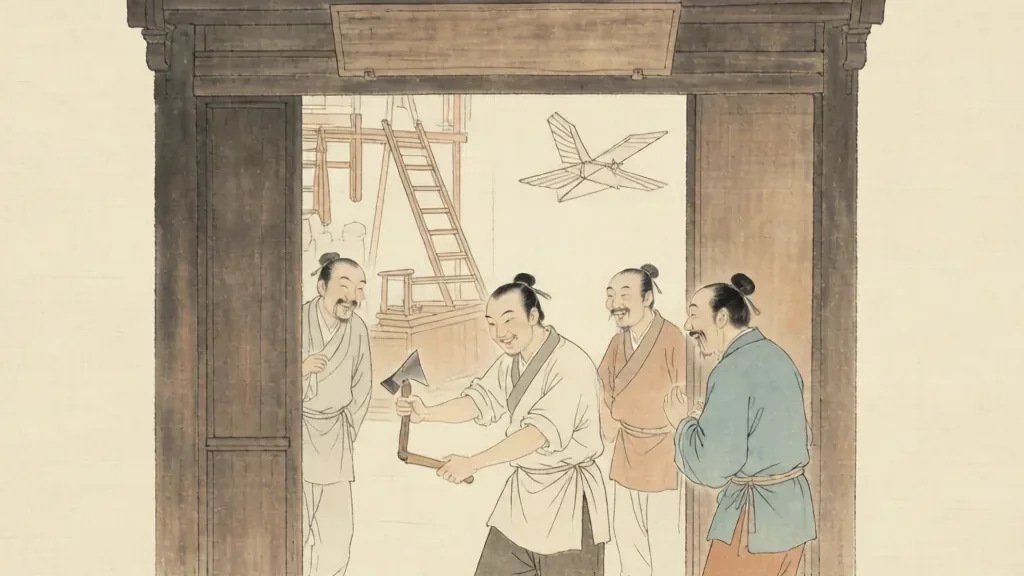
The idiom 班门弄斧 means to wield an axe at the door of Lu Ban, the ancient master carpenter, and it describes showing off a small skill before an expert who far surpasses you. Lu Ban, also known as Gongshu Ban, was a legendary craftsman of the Spring and Autumn period credited with inventing tools and building techniques, so his doorway is the last place one should demonstrate beginner carpentry. The phrase is a gentle, often self-deprecating joke about awkward display, used when someone offers amateur advice to a professional or performs clumsily in front of masters. It reminds speakers to know their audience and to respect true expertise, while also poking fun at the universal human urge to show what little we know where it is least needed.
Who Was Lu Ban
Lu Ban, whose personal name was Gongshu Ban and who lived in the state of Lu during the Spring and Autumn period, became the patron saint of Chinese carpenters and builders. Legend credits him with improving the saw, the plane, and various lifting and surveying devices, and with constructing bridges, pavilions, and ingenious mechanical contrivances. His name gathered so much craftsman lore that he stands for mastery itself.
Because Lu Ban represented the peak of the builder's art, his gateway became the symbolic home of expertise. To appear there with an axe, the carpenter's tool, was to claim a competence the master had already perfected beyond reach. The historical Lu Ban thus supplied the idiom with a fixed reference point for supreme skill, allowing later speakers to invoke "his door" whenever true professionals were present and amateur show was risible.
The Literal Scene of the Axe
The image is comic: a visitor arrives at the famous carpenter's threshold and begins to swing an axe, as though demonstrating technique to the man who invented the tools. The mismatch between the claimant's modest ability and the audience's greatness is the whole joke. The axe, a basic carpenter's implement, underscores that the show-off is not even using something advanced.
By setting the act at a door rather than a workshop, the idiom also implies intrusion, an uninvited performance in a space that belongs to the expert. The doorway is where the amateur is noticed and judged, and where the contrast becomes unavoidable. The simple scene thus packs humiliation, humor, and a lesson about place, all in four characters that any listener can picture without explanation or pity.
Self-Deprecating Use by Authors
Chinese writers frequently use the idiom about themselves when presenting work to established masters, calling their own effort a mere axe-wielding at Lu Ban's door to show modesty and respect. This polite convention lets an author acknowledge giants in the field while still contributing, turning potential embarrassment into gracious humility. The phrase became a standard preface gesture.
Such self-deprecation also disarms criticism, since admitting one's smallness before experts preempts the charge of presumption. Scholars used it to situate their work within a lineage rather than above it, a move valued in a culture that prized humility and continuity. The idiom therefore functioned as social lubricant, allowing junior voices to speak near senior ones without seeming to challenge the order of mastery.
Lessons on Knowing Your Audience
The deeper lesson is rhetorical and social: tailor what you show to who is watching, and do not perform where you will only be exposed. A person who understands the room will stay silent before experts or offer only what is warranted, saving display for settings where it helps. The idiom encodes practical wisdom about status and context in communication.
It also warns against the vanity of visibility, the desire to be seen exercising a skill regardless of fit. By laughing at the axe at the door, the culture trains people to gauge their own level honestly and to yield the floor to those who know more. The phrase thus supports a modest, audience-aware style of conduct that values learning from masters over performing before them.
Use in Humor and Criticism
In casual speech the idiom is lightly teasing, used when a friend offers cooking tips to a chef or grammar corrections to a novelist. The tone is usually fond rather than harsh, marking the moment as funny rather than offensive. Its humor comes from shared recognition that everyone sometimes waves an axe where they should not.
Critics also use it more sharply to deflate pretension, suggesting that a loud amateur should step back and learn. The idiom's flexibility between joke and rebuke is part of its usefulness, letting a speaker choose severity by tone. Whether gentle or cutting, it always points to the gap between claimed and actual skill, and to the wisdom of not demonstrating that gap at the wrong threshold.
Contrast With Confidence Idioms
Some idioms praise boldness and self-assurance, but banmen-nongfu belongs to the cautionary set that values knowing one's place. It does not condemn skill or effort; it condemns misplaced display, the performance that reveals ignorance instead of concealing it. The ideal it implies is competent work shown to the right eyes at the right time.
This contrasts with idioms that celebrate challenging masters or surpassing teachers, reminding us that Chinese culture holds both impulses in tension: respect for expertise and ambition to excel. The axe at the door is funny precisely because the culture also honors those who learn at a master's feet, so the fool is the one who confuses learning with showing. The idiom thus safeguards the seriousness of true apprenticeship.
Modern Applications in Expertise
Today the phrase is used in academic, technical, and artistic circles when a newcomer lectures veterans, or when an amateur reviews a professional's work with misplaced confidence. It circulates in online spaces where everyone comments on fields they barely know, making the old carpenter's door newly relevant in the age of public expertise. The idiom's bite has if anything sharpened.
It also serves as a personal check, a whispered reminder before one speaks: am I at Lu Ban's door right now? Used this way, it promotes humility and better listening in meetings, classrooms, and forums. Few idioms so neatly capture the perennial gap between confidence and competence, or offer such a portable, good-natured way to name it and suggest, politely, that the axe be lowered.
Lu Ban in Craft Guilds and Folk Worship
Beyond the idiom, Lu Ban himself became a genuine figure of worship among Chinese craftsmen, revered as the patron deity of carpenters, masons, stonemasons, and builders for well over a thousand years. Craft guilds maintained small shrines in their workshops where they offered incense and prayed for skill, safety, and steady work, treating the old master less as a historical person than as a living guardian of their trade. This religious dimension gave the idiom's reference point a real social weight: to wave an axe at Lu Ban's door was to show off before a god of the craft.
The veneration produced annual observances, often called the Lu Ban Festival, held around the date believed to be his birthday, when workers rested, feasted, and displayed their finest tools and products. Such rituals kept his name present in everyday working life long after the historical Lu Ban had faded into legend, and they explain why the phrase still feels immediately intelligible: almost every traditional builder knew a Lu Ban altar. The idiom thus draws on a deep layer of occupational piety as much as on a comic image.
❓ Frequently Asked Questions
What does banmen-nongfu mean?
It means to wield an axe at Lu Ban's door, describing someone who shows off a minor skill before an expert who far surpasses them.
Who was Lu Ban?
He was a legendary craftsman of the Spring and Autumn period, credited with inventing tools and building methods, and revered as the patron of carpentry.
Why is the door significant?
The doorway is the master's home ground, so performing there turns a small display into an awkward, intrusive claim of equality with expertise.
How do writers use it?
Authors often apply it to themselves to show modesty before masters, gracefully acknowledging giants while still contributing their own work.
Is it an insult?
Usually it is gently teasing, though it can rebuke pretension; tone decides whether it is a fond joke or a sharper correction of misplaced confidence.
What lesson does it teach?
It teaches knowing your audience, respecting true expertise, and not performing where the gap between claimed and actual skill is exposed.