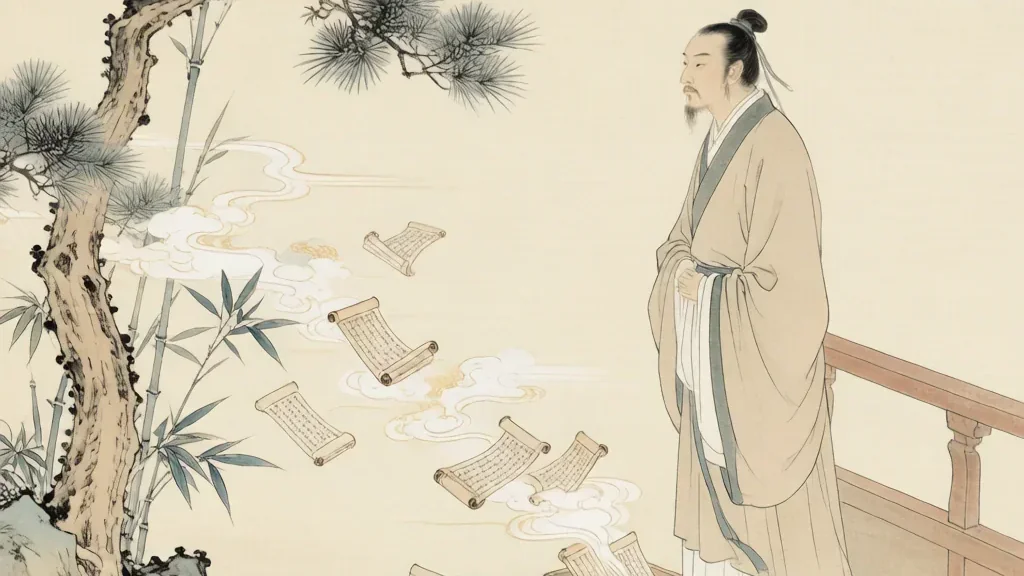
Some praise is so extravagant it becomes arithmetic, and the Chinese idiom cái gāo bā dǒu does just that for literary gift. Written 才高八斗 and pronounced , it means "eight dou of talent" — a tribute to a writer so gifted that, of all the talent in the world, he alone holds eight parts of a ten-part measure. English says "a genius" or "a poet of the first rank," but Chinese reaches for the grain scoop. For readers discovering Chinese culture, the phrase is a charming key to how a civilization measured the invisible wealth of the mind. In this article we meet the boastful poet Xie Lingyun, trace the math of the idiom, and see why "eight dou" became the highest compliment a writer could earn.
Xie Lingyun's Bold Claim
The idiom is credited to Xie Lingyun (谢灵运, 385–433), a Southern Dynasties poet famous for landscape verse of luminous clarity. Xie was a man of immense self-regard, and he is said to have announced a remarkable division of the world's literary talent. "Among all the talent under heaven," he declared, "there is one (a measure of ten dou). Cao Zhi alone takes eight dou; I take one; and the remaining one dou is shared by everyone else, ancient and modern." The remark was outrageous, but it fixed the scale forever.
By placing himself second only to the brilliant Cao Zhi (曹植), Xie paid the highest compliment to a predecessor while claiming the next highest seat for himself. The idiom we use — "eight dou of talent" — is shorthand for Cao Zhi's share, and by extension for any writer of near-supernatural gift. The boast, repeated for fifteen hundred years, turned into a standard of praise far removed from Xie's original ego.
Literal Meaning and the Measure
The characters are a tiny sum. (才) is talent; (高) is high; (八) is eight; and (斗) is a dou, an old grain measure roughly equal to a gallon. Read as "talent-high-eight-dou." The key is the unit: a was a scoop for rice and millet, so the idiom literally weighs talent like grain. A learner meets here a charming Chinese habit — measuring the mind by the tools of the farmhouse.
The full background assumes a (石) of ten dou. Cao Zhi gets eight, Xie gets one, the world gets one. The number eight thus means "almost all of it" — not a literal census but a poetic way of saying a genius held talent in overwhelming proportion. The idiom keeps that superlative force: to call someone "eight dou" is to say their gift dwarfs the field.
Cao Zhi, the Boy Genius
The true hero of the idiom is Cao Zhi, a prince of the Three Kingdoms era and one of China's most beloved poets. Legend says that, at the command of his jealous brother Cao Pi, he composed a poem in seven steps that pleaded for his life — the "Seven Steps Poem" (七步诗) about boiling beans with their own stalk. His fluency, emotion, and speed became the very model of effortless genius, which is why Xie singled him out for eight dou.
Cao Zhi's reputation rests on real achievement: his rhapsodies and lyric poems set a standard for elegance and feeling that later poets measured themselves against. To invoke "eight dou of talent" is therefore to invoke not just cleverness but a particular kind of literary grace — spontaneous, musical, and deeply felt. The idiom carries his aura whenever it is spoken.
How the Idiom Is Used Today
Modern Chinese uses to praise writers, scholars, and artists of obvious brilliance. It appears in book forewords, award citations, and warm introductions. The tone is admiring and formal; it is the sort of phrase you use when you want to signal real respect, not casual liking. A newspaper might call a novelist "eight dou of talent" to mark a masterpiece.
The idiom also plays a role in humble speech. A writer might say, with a smile, that they are far from "eight dou," placing themselves among the ordinary one dou shared by everyone. In this self-deprecating use, the phrase sets a peak that almost no one claims, which is exactly why it works socially — it gives people a lofty standard to either honor in others or disclaim in themselves.
Companions in the Measuring of Minds
The phrase stands beside 学富五车 (xué fù wǔ chē, "learned enough to fill five carts"), which measures learning by cartloads, while this one measures talent by the dou. 出口成章 (chū kǒu chéng zhāng, "words become prose as they leave the mouth") praises spontaneous eloquence; 江郎才尽 (jiāng láng cái jìn) marks its loss. Together they let a speaker move from praise to pity across the career of a writer.
For learners, this cluster is a delight because it shows Chinese quantifying the invisible. Talent comes in dou, learning in carts, and a person's worth as a writer can be weighed like harvest grain. Knowing these phrases lets you praise a poet with the exact, slightly archaic grandeur a native would choose — and to do so with a smile at the arithmetic.
A Closing Reflection
There is something disarming about : it treats genius as a measurable crop, scooped and counted like rice. The image humanizes the intimidating idea of "a genius," putting even Cao Zhi's gift into a farmer's measure. It also reminds us that praise, in Chinese, loves a little math — a way of saying "this much" when words alone feel too thin. To call someone eight dou of talent is to lay a full scoop of admiration at their feet, and to join, however playfully, a fifteen-hundred-year-old conversation about who deserves it.
Xie Lingyun the Landscape Poet
Behind the boastful idiom stands a real and influential poet. Xie Lingyun served at the Southern Dynasties court and is remembered as a pioneer of landscape poetry, verses that linger on the shapes of mountains, the sound of streams, and the mood of a lonely walk. His work shifted Chinese poetry away from public rhetoric toward personal observation of nature. The same man who divided the world's talent so arrogantly also wrote lines of genuine delicacy, and it is worth remembering that eight dou of talent honors not only a legend but a body of poems still read today. His personality, proud and restless, made the idiom possible, but his verse is why posterity kept his name. To know the man behind the boast is to see the idiom as biography as much as praise.
Measuring the Mind in Ancient China
Eight dou of talent belongs to a charming habit in Chinese culture: weighing the invisible wealth of the mind with the tools of the farmhouse. Talent comes in dou, learning in cartloads, and a person's worth as a writer can be scooped and counted like grain. This impulse reflects a practical, almost accountant's view of the intellect, where even genius is a quantity to be divided and compared. For learners it is a delight, because mastering one measuring phrase opens a cluster of others, from learned enough to fill five carts to the loss of talent. Together they show that Chinese praise loves a little arithmetic, a way of saying this much when plain words feel too thin. The habit turns the invisible into something a farmer could weigh, which is precisely why it stays memorable.
❓ Frequently Asked Questions
📝 Chinese Vocabulary
才高八斗 — : eight dou of talent; extraordinary literary gift.
才 — : talent.
斗 — : a dou, an old grain measure.
谢灵运 — : the poet who coined the division of talent.
曹植 — : the "eight dou" poet honored by the phrase.
石 — : A larger grain measure of ten dou, the unit against which Xie Lingyun weighed the world's talent as one dan.
七步诗 — : The Seven Steps Poem, the life-saving verse Cao Zhi is said to have composed in seven paces before his brother.
才子 — : A gifted scholar or talented man, the kind of person the phrase eight dou of talent is meant to honor.
🎉 Fun Facts
- Xie Lingyun gave himself only one dou, placing Cao Zhi far above him and everyone else in the remaining one.
- Cao Zhi was said to compose a life-saving poem in seven steps before his brother Cao Pi.
- A 斗 was a farmhouse grain scoop, showing how Chinese weighs the mind with kitchen measures.
- The idiom is the natural pair of "learned enough to fill five carts," China's two great measures of the intellect.
- The eight dou remark appears in the standard history Nan Shi, not only in anecdote, which shows how firmly it entered Chinese historiography.
- Because Xie Lingyun was also a celebrated landscape poet, later critics sometimes used eight dou of talent to praise nature poetry specifically, linking genius with a love of mountains and streams.