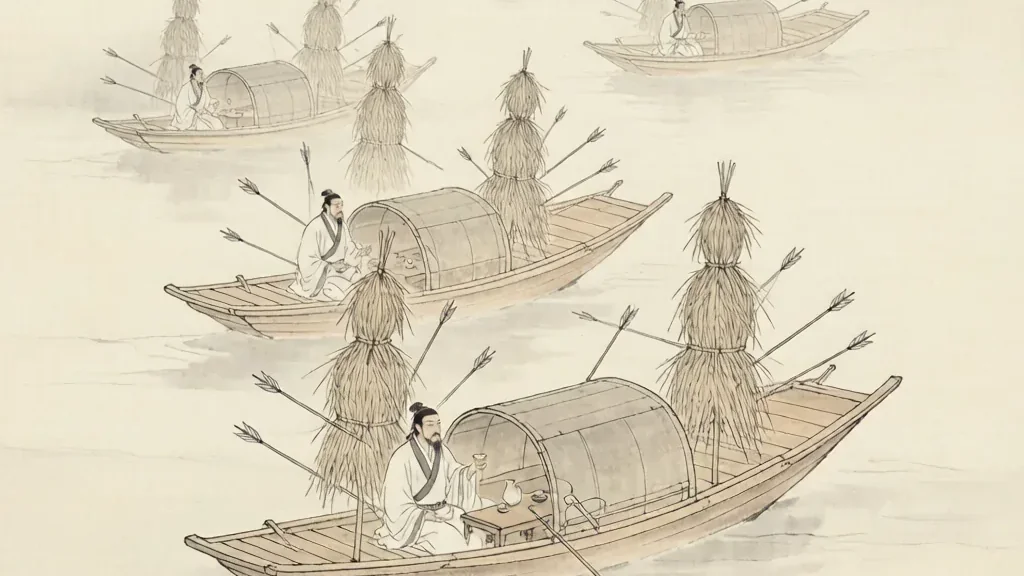
The idiom 草船借箭 means to borrow arrows by means of thatched boats, and it celebrates clever resourcefulness that turns an enemy's strength against him. The episode is set during the conflict between the northern warlord Cao Cao and the southern allied commanders Zhou Yu and Zhuge Liang, when Zhuge is said to have promised a vast number of arrows within a few days despite having no supplies to make them. Using fog, straw-stuffed boats, and the enemy's own archers, he collected thousands of arrows shot at his decoys and thus met his quota without forging a single shaft. The story has become the classic Chinese example of winning through wit and the intelligent use of circumstance rather than through brute force or materials one does not possess.
The Setting at the Red Cliffs
The stratagem belongs to the wider campaign later called the Battle of Red Cliffs, where the allied forces of the south faced Cao Cao's much larger army advancing from the north along the Yangtze. In this atmosphere of unequal numbers, clever tricks mattered as much as soldiers, and Zhuge Liang's reputation for foresight made him both an asset and a source of jealousy to the allied commander Zhou Yu. The arrow episode grew out of that rivalry.
According to the familiar telling, Zhou Yu assigned Zhuge Liang the impossible task of producing a huge quantity of arrows on a short deadline, expecting him to fail and be punished. Zhuge Liang accepted cheerfully and relied not on workshops but on weather and psychology. The fog of a winter morning on the river became his ally, hiding his boats while inviting the enemy to waste ammunition into the straw, a use of environment that defines the idiom's cleverness.
Zhuge Liang's Calculated Plan
Zhuge Liang is said to have prepared several dozen small boats bound together and lined with bundles of straw shaped like men, then sailed them toward the enemy camp under cover of dense river mist. He ordered his crews to beat drums and shout so the hidden foe would believe a night attack was underway and respond with volleys of arrows. The straw figures silently absorbed the shots.
When one side of the boats was thick with arrows, Zhuge turned the vessels around so the other side could be filled as well, maximizing the harvest from a single foggy excursion. At dawn he withdrew with his decks bristling with borrowed shafts and delivered them to Zhou Yu, fulfilling the quota with time to spare. The plan depended on knowing the enemy's predictable response and on reading the weather, a combination of insight and nerve.
The Role of Fog and Deception
Central to the trick is the use of natural fog to blind the opponent while revealing just enough noise to provoke a reaction. Cao Cao's troops, unable to see their target, relied on massed arrow fire to defend the camp, exactly as Zhuge anticipated. The idiom thus celebrates deception that costs the deceiver nothing and the deceived everything, a hallmark of strategic cunning admired in Chinese military lore.
The straw men are equally important: they are false targets that convert the enemy's aggression into one's own supply. By making himself appear as a threat, Zhuge Liang induced the enemy to arm him, a paradox that later readers found delicious. The episode shows that perception can be weaponized, and that a weaker side may prevail by shaping what the stronger side believes it sees in the murk of war.
Historical and Literary Sources
The arrow-borrowing tale appears most famously in the Romance of the Three Kingdoms, where it is one of Zhuge Liang's signature exploits. Earlier historical records mention Zhuge Liang's talents but not this specific incident in the same form, so scholars treat the episode as a later embellishment that captured his reputation for ingenuity. Its literary life outweighs its strict historicity.
What matters culturally is that the story distilled a real strategic principle, using terrain, weather, and enemy habit, into a single memorable scene. Generations learned from it that intelligence can substitute for resources, and that a commander's best weapon may be the opponent's own assumptions. The gap between history and romance does not diminish the idiom's usefulness as a compact lesson in adaptive thinking.
Use as a Model of Resourcefulness
Beyond warfare the idiom is applied to any situation where someone achieves a goal by borrowing the means from the very obstacle in the way. Business writers cite it for turning a competitor's move into one's own advantage, and students use it for solving problems with scarce materials through ingenuity. The thatched boats stand for making do with what is at hand and reshaping it.
The phrase also warns against forcing a direct approach when a clever indirect one will do. Zhuge Liang did not try to outbuild the enemy's arsenal; he outthought it, and the idiom encourages the same economy of effort. In a culture that prizes mental agility, the borrowed arrows became a symbol of winning gracefully, with fewer resources and more imagination than one's rival possessed.
Contrast With Open Confrontation
Chinese strategy literature often contrasts the direct and the indirect, and this idiom is a pure example of the indirect. Rather than meeting arrows with arrows, Zhuge Liang met them with straw and silence, converting attack into supply. The contrast highlights a preference for efficiency and psychological edge over sheer expenditure of strength.
This also distinguishes the idiom from tales of sheer valor, where heroes win by bravery in the open. Here the hero wins by absence, by hiding in fog and letting the enemy defeat himself. The lesson is that wisdom can be more decisive than courage, and that the best victory may be one in which the opponent unknowingly equips the very side he opposes. Such a frame appealed strongly to a civilization that prized the subtle over the obvious.
The Idiom in Drama, Art, and Popular Culture
The borrowing-arrows episode became one of the most staged scenes from the Three Kingdoms cycle, appearing in regional operas, storytelling, and later film and television as a set piece of cleverness rewarded. Painters and illustrators liked the visual contrast of misted boats bristling with arrows, and the image travels well to a single frame because the trick is so concrete. Folk performances often linger on the drumming and shouting that fooled the enemy, turning a military feint into theatrical suspense.
In modern popular culture the phrase survives as a shorthand for clever borrowing and has been attached to all manner of situational wit, from classroom pranks to competitive strategy games based on the Three Kingdoms. Its status as a household example of intelligence beating force means it is among the first stories children learn about Zhuge Liang. The durability of the scene in stage and screen confirms that the idiom's appeal is as much dramatic as moral, a small drama of mind over might that audiences never tire of watching unfold.
Modern Business and Life Applications
In modern speech the phrase describes leveraging an opponent's or a situation's own momentum to one's benefit, a kind of judo of circumstance. Negotiators recall it when they use a counterpart's pressure as leverage, and makers invoke it when they repurpose discarded materials into new products. The borrowed-arrow mindset is essentially circular: turn what pushes against you into what carries you forward.
The idiom also survives as encouragement not to despair when resources are lacking, since the lack itself may be solvable by imagination. It reframes scarcity as a design constraint that can breed invention, and it reassures the disadvantaged that cleverness can offset disadvantage. Few idioms so neatly capture the Chinese esteem for strategic wit as the equal of wealth or numbers, making it a perennial favorite in both boardroom and classroom.
❓ Frequently Asked Questions
What does caochuan-jiejian mean?
It means to borrow arrows using thatched boats, describing a clever trick that turns an enemy's own strength, his arrows, into one's own supply through wit rather than force.
Who is the story about?
The strategist Zhuge Liang, who is said to have met an impossible arrow quota for the allied commander Zhou Yu during the campaign against Cao Cao at the Red Cliffs.
How did he collect the arrows?
He sailed straw-stuffed boats into fog, drummed to feign attack, and let Cao Cao's archers waste arrows into the decoys, then turned the boats to fill both sides before dawn.
Is the episode historical?
It appears fully formed in the Romance of the Three Kingdoms; earlier histories praise Zhuge Liang's talent but lack this exact incident, so it is treated as a later embellishment.
What does the idiom teach?
It teaches that intelligence and circumstance can substitute for resources, and that the indirect, deceptive approach often beats direct confrontation of strength.
How is it used today?
It describes leveraging an opponent's or a situation's own momentum to one's benefit, from business negotiation to repurposing scarce materials through imagination.