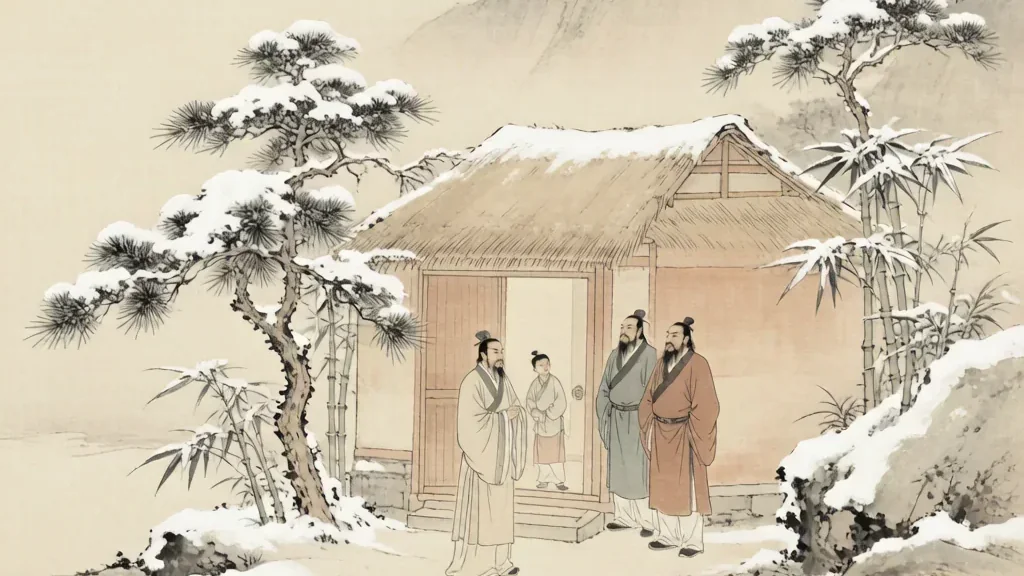
The idiom 三顾茅庐 means to visit the thatched cottage three times, and it honors the virtue of sincerely and repeatedly seeking out worthy talent. The story comes from the turbulent closing years of the Han dynasty, when the exiled imperial kinsman Liu Bei is said to have called on the hermit strategist Zhuge Liang three times before the young adviser agreed to leave his rustic retreat and serve him. Zhuge Liang then repaid that patience with the brilliant campaigns and administration that made him the model of the loyal minister. The phrase now describes any earnest, repeated effort to recruit or consult a valued expert, and it celebrates humility in a leader who is willing to lower himself before ability greater than his own.
The Historical Liu Bei and Zhuge Liang
Liu Bei was a descendant of the Han royal house who spent his early career as a wandering warlord with little land and many defeats, yet he was renowned for his kindness and his ability to win loyal followers. Zhuge Liang was a young man of scholarly reputation living in retirement in Longzhong, consulted by neighbors for his insight into the collapsing empire's affairs. The meeting of the two became one of the most celebrated recruitments in Chinese history.
According to the Records of the Three Kingdoms and later romance, Liu Bei heard of Zhuge Liang's ability and went to his simple dwelling, only to be turned away or find him absent on the first visits. He persisted, and on the third attempt the two men spoke at length, with Zhuge Liang laying out the famous Longzhong Plan that shaped Liu Bei's later kingdom of Shu. The patience of the seeker and the caution of the sought both became part of the idiom's meaning.
The Thatched Cottage Setting
The cottage, made of thatch and humble materials, symbolized Zhuge Liang's voluntary withdrawal from a corrupt and chaotic world. That a future prime minister lived among farmers underscored his purity and his freedom from office-seeking, qualities the idiom implicitly praises. Liu Bei's willingness to enter such a lowly door reversed the normal hierarchy of rank, since a claimant to kingship bowed to a common scholar.
The repeated journeys also mattered: the first two visits established sincerity, while the third delivered the conversation that changed history. Storytellers lingered on the weather and the seasons, sometimes placing the final visit in winter snow, to heighten the picture of a ruler enduring discomfort for the sake of wisdom. The cottage thus became a stage where humility and merit met, and the image of the snowy visit remains iconic in Chinese art.
The Longzhong Plan and Its Vision
When Zhuge Liang finally received Liu Bei, he is said to have presented a clear strategic picture of the realm, urging his visitor to take possession of the western provinces of Jing and Yi, forge an alliance with the eastern state of Wu, and wait for the moment to march north and restore the Han. This blueprint, known as the Longzhong Plan, showed exactly the kind of foresight the three visits were meant to obtain.
The plan's elegance is part of why the story endures: the reward for patience was not merely a loyal aide but a complete vision of statecraft. Later rulers measured their own advisers against Zhuge Liang, and the idiom came to imply that true talent arrives with a strategy, not just compliance. The Longzhong meeting thus linked the personal virtue of the seeker to the public good of sound policy, making the cottage visit a founding moment of the Shu kingdom.
Zhuge Liang as the Ideal Minister
After joining Liu Bei, Zhuge Liang became the indispensable administrator and strategist, managing the young state's laws, agriculture, and armies with famous diligence and fairness. After Liu Bei's death he served the heir Liu Shan with unwavering loyalty, undertaking the northern campaigns despite long odds. His reputation for devotion earned him the title of model minister for a thousand years of Chinese governance.
The idiom therefore carries a second lesson: the worth of the person sought justified the effort spent seeking. Zhuge Liang's life answered Liu Bei's patience with a lifetime of service, and the pair became the standard example of the good ruler-adviser relationship. Emperors and their counselors both invoked the story, the former to show they valued talent, the latter to hint that loyalty was owed only to those who honored ability.
Role in the Romance of the Three Kingdoms
The novel Romance of the Three Kingdoms, compiled in the Ming dynasty, dramatized the three visits with vivid scenes of snow, courtesy, and the young Zhuge Liang sleeping while the anxious Liu Bei waited respectfully. These episodes fixed the idiom in popular imagination and turned historical consultation into a moral set piece about reverence for wisdom. The novel's warmth toward Liu Bei amplified the story's appeal.
Through the romance the idiom reached audiences far beyond scholars, becoming common knowledge through opera, storytelling, and later film and television. The waiting scene in particular taught that a leader must suppress pride and accept delay when courting real ability. The novel's embellishments, while not strict history, are the version most people know, and they explain why the phrase feels both literary and folk at once.
Lessons on Leadership and Humility
The idiom offers a pointed contrast with rulers who demand service without earning loyalty, suggesting that great leaders descend to meet greatness wherever it hides. Liu Bei's rank did not excuse him from travel, weather, or rejection, and his example argues that position should amplify respect for talent rather than replace it. Humility here is not weakness but a practical method for finding the best advice.
In management writing the story is cited to show that recruitment is an active, courteous pursuit, not a passive posting of openings. The three visits model encourages patience with candidates who need convincing and respect for those who will not be bought cheaply. By framing the search as a moral act, the idiom elevates hiring from transaction to relationship, a lesson that travels well beyond the ancient court.
Modern Use in Recruitment and Courtship
Today the phrase is used whenever an organization repeatedly and respectfully approaches a prized expert, athlete, or scholar, signaling that the pursuit itself proves the value placed on the person. It can also describe a suitor's patient wooing, since the structure of earnest repeated visits fits romantic as well as professional contexts. The idiom's warmth makes it a compliment to both seeker and sought.
It survives because the underlying situation recurs in every era: ability often hides in modest corners, and only persistence combined with respect can draw it out. Employers who invoke the three visits acknowledge that talent may need wooing, and candidates who are so courted feel honored rather than merely hired. Few idioms capture the etiquette of recruitment so completely, from the first knock to the final willing yes.
Cultural Depictions in Art and Opera
Beyond literature, the three visits became a recurring subject for painters and stage performers, who favored the quiet moment of Liu Bei waiting outside the cottage while Zhuge Liang rested inside. Scrolls and operatic tableaux used the contrast between the anxious ruler and the calm scholar to stage a visual lesson about who truly held the power in that encounter. The snowy version of the scene, with its hushed white setting, proved especially popular because it let artists show patience as a kind of purity.
Local shrines and temples in places associated with Zhuge Liang kept the story alive as living ritual, and seasonal performances during folk festivals retold the visits to new generations. In this way the idiom moved from a historical anecdote into a shared cultural memory carried by image and song as much as by the written word. Its durability across media shows how a single act of courtesy could be magnified into a national ideal of how talent ought to be honored.
❓ Frequently Asked Questions
What does sangu-maolu mean?
It means to visit the thatched cottage three times, describing sincere and repeated efforts to recruit or consult a valued person.
Who visited whom?
Liu Bei, a Han imperial kinsman and warlord, visited the hermit strategist Zhuge Liang three times before Zhuge agreed to serve him.
What happened on the third visit?
Zhuge Liang outlined the Longzhong Plan, a strategy to secure western provinces, ally with Wu, and eventually restore the Han.
Is the story historical or legendary?
The core recruitment is recorded in early histories, while the Romance of the Three Kingdoms added vivid legendary detail such as snow and waiting.
What virtue does the idiom teach?
It teaches that a true leader shows humility and patience in seeking ability, and that worthy talent deserves earnest, respectful pursuit.
How is it used today?
It describes organizations or individuals who courteously and repeatedly approach a prized expert, and sometimes a suitor's patient wooing.