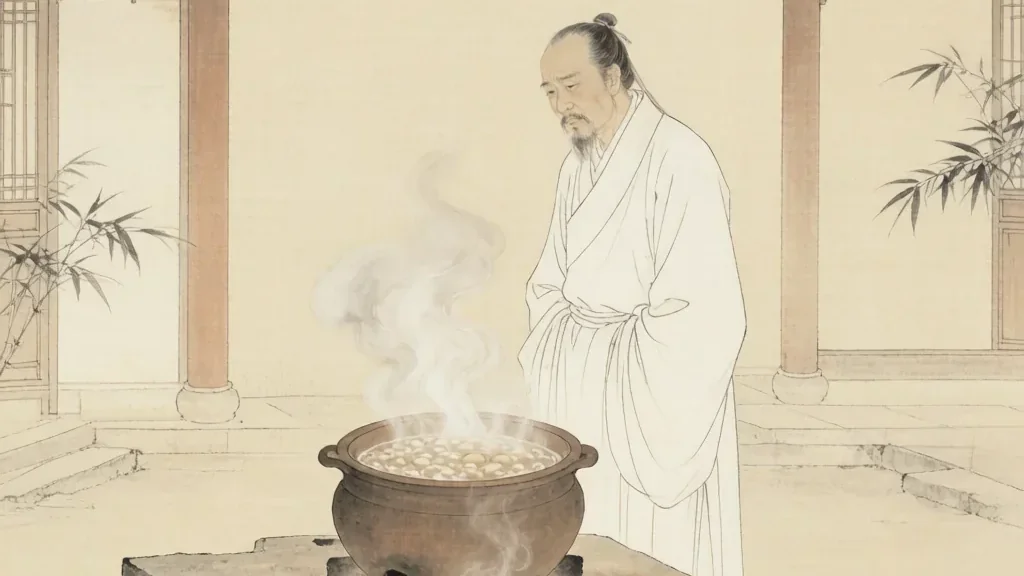
The idiom 煮豆燃萁 literally means to boil beans by burning the beanstalks, and it has come to symbolize the cruel persecution of one's own kin, especially brothers turning against each other in a struggle for power. Its origin lies in a famous episode from the early Three Kingdoms period, when Cao Zhi, a gifted poet of the Cao family, was forced by his suspicious elder brother, the future Emperor Cao Pi, to compose a poem within the span of seven paces or face execution. The verse Cao Zhi produced used the image of beans and their own stalks to plead against fratricide, and the story has resonated through Chinese literature for nearly eighteen hundred years as the definitive warning against destructive family rivalry.
Origins in the Jian'an Literary Circle
The phrase grew out of the vibrant Jian'an era of poetry, a period near the end of the Han dynasty and the opening of the Three Kingdoms age that produced some of the most emotionally charged verse in Chinese history. Cao Zhi stood among the most celebrated authors of this circle, admired for his natural talent, his flowing rhythm, and his ability to write polished compositions on the spot without revision. His father, the warlord Cao Cao, favored him for a time as a possible heir, which made him a threat in the eyes of his elder brother Cao Pi, who was ultimately chosen as successor and later founded the Wei state.
The tension between literary brilliance and political vulnerability lies at the heart of the idiom. Cao Zhi's misfortune was precisely his gift: a brother who felt insecure about his own abilities could not tolerate a sibling whose words won admiration across the realm. The boiling beans became a metaphor not merely for execution but for the waste of kindred talent consumed to fuel another's ambition, and the anecdote captured a theme that Chinese historians would return to whenever succession disputes turned bloody.
The Seven-Step Verse and the Test of Life
According to the most widely told version of the story, after Cao Pi took the throne he summoned Cao Zhi and commanded that the younger man compose a poem describing a certain relationship, with the condition that the lines be finished before Cao Zhi could complete seven paces of walking. If he failed, the punishment would be death. Cao Zhi is said to have begun walking and, within those few steps, recited the lines that compare beans boiling in a pot to the stalks burning beneath them.
In the poem the beans weep as they are cooked, asking the stalk why it is so eager to destroy what shares the same root. The spontaneous composition is remembered as both a literary miracle and a moral appeal, because Cao Zhi used the moment of mortal danger to argue that brothers should not persecute one another. Whether the incident happened exactly as narrated or was shaped by later storytellers, the seven-step frame made the episode unforgettable and gave Chinese culture a shorthand for perilous, on-the-spot eloquence.
Historical Context of the Cao Brothers
The broader setting was the collapse of the Han dynasty, when regional warlords fought to seize the exhausted imperial throne and the Cao family dominated the north through Cao Cao's military and administrative genius. Cao Cao never formally claimed the imperial title, but his sons inherited his hard-won power base, and the question of which son would lead it produced lasting bitterness. Cao Pi's eventual victory was secured through political maneuvering and the support of court officials wary of Cao Zhi's impulsive temperament.
Once in power, Cao Pi demoted and relocated Cao Zhi repeatedly, keeping him under watch and far from the center of authority. The poet spent his later years moving between provincial posts, composing reflective works that mourned his lost standing while carefully avoiding open rebellion. This real biography of suspicion and confinement gave the boiled-bean image a historical anchor, turning a possibly legendary test into a plausible reflection of how the new Wei court actually treated a dangerously talented prince.
The Metaphor of Bean and Stalk
The central image sets two parts of one plant against each other: the soft beans in the pot and the dry stalks beneath the fire, both growing from the same root yet one feeding the flame that cooks the other. This agricultural detail would have been familiar to any farmer, which is part of why the verse spread so quickly through oral retelling. The same-root line makes the waste explicit, since destroying the stalk also diminishes the plant as a whole.
Read as political allegory, the beans are the innocent or the gifted, while the stalk represents the ruler who consumes his own relatives to consolidate control. The weeping bean speaks for every subject who wonders why a brother would treat a brother as fuel rather than family. Over centuries the metaphor was generalized beyond royalty to any situation where members of one group destroy each other for narrow advantage, and the plant image kept the lesson earthy and immediate.
Literal Meaning and Translation
Broken down character by character, the phrase pairs two verbs with two nouns: 煮 to boil, 豆 beans, 燃 to burn, and 萁 the stubble or stalk of the bean plant. A faithful English rendering is therefore "boiling beans by burning beanstalks," though many translators prefer the more evocative "brothers boiling each other alive." The economy of the four characters is itself a reason the idiom survived, since it packs a whole scene into a mouthful.
Because the words name a concrete kitchen act, learners of Chinese find the idiom easy to picture even before they know the story. Teachers often introduce it alongside the seven-step poem so that students connect the sound of the phrase with its moral weight. The directness of the literal scene is what allows the expression to migrate from a specific historical anecdote into a general warning that needs no explanation once the image is understood.
Cultural Role in Familial Discourse
In Chinese moral tradition, filial piety and fraternal harmony rank among the highest virtues, so an idiom that dramatizes their violation carries special force. Parents and teachers have long used zhudou-ranqi to caution children against quarrels that damage the family, and the phrase appears in lessons about the costs of jealousy within close circles. Its warning is not only about rulers but about siblings, business partners, and colleagues who share a common origin.
The idiom also functions as a gentle rebuke in everyday argument, invoked when one party seems to be undermining people who should be allies. Because the image is so vivid, it can defuse a dispute by shifting attention from the immediate grievance to the larger folly of kindred turning on kindred. In this way the ancient poem of Cao Zhi still performs quiet work in modern Chinese conversation about loyalty and self-defeating conflict.
Use in Literature and Drama
The seven-step poem entered anthologies of classical poetry and became a standard reference point for later authors writing about injustice and separated brothers. Dramatists of the Yuan and Ming periods drew on the Cao family story for plays exploring betrayal and forgiveness, and commentators on the Romance of the Three Kingdoms used the episode to illustrate Cao Pi's coldness and Cao Zhi's genius. The idiom thus moved from history into popular performance.
Scholars also compared Cao Zhi's situation to other famous fraternal conflicts, building a small literary vocabulary around the danger of talent within a ruling family. In poetry competitions and examination essays, allusions to boiling beans signaled both learning and a moral stance, letting a writer show refinement while criticizing cruelty. The phrase's compactness made it ideal for such allusive writing, where a few characters could summon an entire tragic narrative.
Psychological Dimensions of Fraternal Rivalry
Modern readers often note that the idiom captures a universal psychology: the person most threatened by a sibling is frequently the one who feels less gifted, and the attack takes the form of diminishing the rival rather than improving oneself. Cao Pi's suspicion mirrors a pattern found in many succession struggles, where the secure heir fears comparison more than open enemies. The beanstalk image suggests how self-defeating such jealousy is, since it consumes the household's own resources.
Psychologists who study family systems observe that competitive sibling dynamics can persist for a lifetime if the comparison is never resolved, and zhudou-ranqi names the worst outcome of that dynamic in a single burned stalk. The idiom's endurance shows that Chinese culture recognized early how envy within a family can be more destructive than external conflict, because it destroys the trust that family is supposed to provide and leaves everyone poorer.
Modern Applications and Political Usage
In contemporary speech the idiom is applied well beyond the family, often to describe factions within a party, firm, or movement that damage their shared cause through infighting. Commentators use it when allies attack one another in ways that only help a common opponent, and the image of fueling a fire with one's own root remains a sharp critique of shortsighted competition. It can also appear in sports and business journalism.
The phrase survives in part because its warning is portable: wherever people who should cooperate instead consume one another, the boiled beans return as a symbol. Educators still cite Cao Zhi's poem to teach both literary history and emotional intelligence, reminding students that genuine strength lies in lifting relatives and colleagues rather than burning them. Few classical idioms carry such a precise, still-relevant lesson about the price of fraternal suspicion.
❓ Frequently Asked Questions
What does zhudou-ranqi literally mean?
It means to boil beans by burning the beanstalks, a four-character image drawn from a poem in which beans are cooked over the fire of their own plant's stalks.
Who wrote the original seven-step poem?
The poem is attributed to Cao Zhi, a celebrated poet of the Three Kingdoms period who was challenged by his brother Cao Pi to compose it within seven paces.
Why was Cao Zhi in danger?
Cao Pi, who became ruler of Wei, feared his talented younger brother as a rival and is said to have demanded the instant poem on pain of death.
What is the moral of the idiom?
It warns against family members or close allies destroying one another for power, since such conflict consumes the shared root that sustains them all.
Is the seven-step story historically certain?
The anecdote appears in later historical and literary sources rather than strictly contemporary records, so scholars treat the dramatic frame as partly legendary.
How is the idiom used today?
It is applied to infighting within groups such as families, firms, or political factions, where members harm their common interest through internal rivalry.