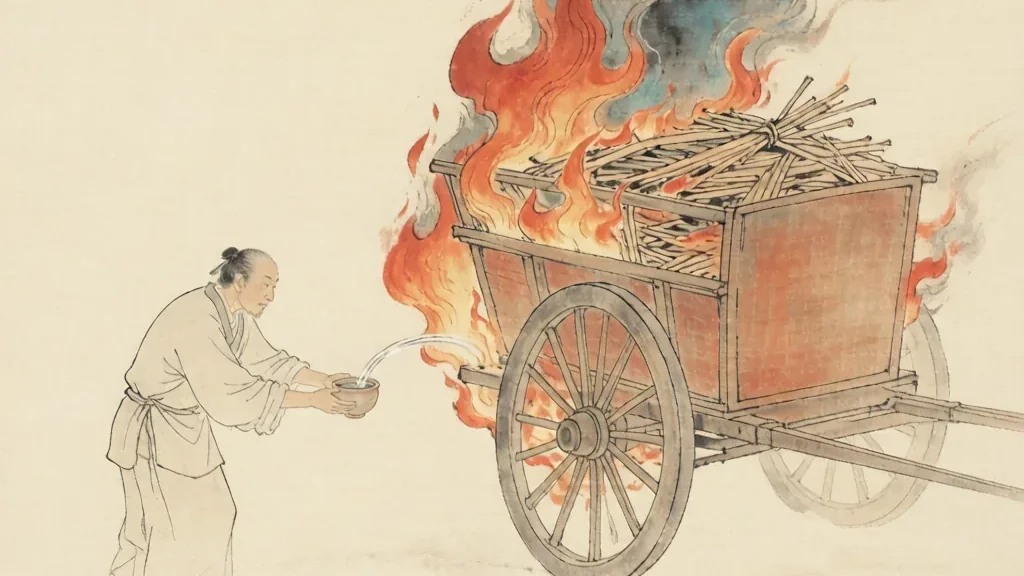
Some problems are so vast that the kindest gesture barely dents them, and the Chinese idiom bēi shuǐ chē xīn captures that helpless ratio perfectly. Written as 杯水车薪 and pronounced , it means literally "a cup of water on a cartload of firewood" — and it is used whenever a small effort is thrown against a problem so large that it can never hope to matter. The image is vivid: a blazing cart piled high with dry logs, and someone rushing up with a single cup of water. The water is real, the goodwill is real, but the fire does not care. For an English-speaking reader meeting Chinese culture for the first time, this four-character phrase is a wonderfully compact window into how classical Chinese compresses a whole parable into sound and shape. In this article we will trace the idiom back to the philosopher Mencius, explore what it teaches about the limits of good intentions, and consider when a "cup of water" is still worth throwing.
The Story Behind the Words
The earliest appearance of the idea comes from the Mencius (孟子), one of the Four Books of the Confucian canon, composed in the fourth century BCE. In a famous passage, Mencius argues with a king who claims to be compassionate yet fails to feed his starving people. Mencius says, in effect, that a person who tries to do good with far too little is like someone using a single cup of water to put out a cartload of burning wood. The wood keeps burning; the gesture, though sincere, changes nothing. The metaphor was aimed at rulers who imagined that a few scattered acts of charity counted as genuine benevolent government.
What makes the image stick is its concreteness. A "cartload of firewood" (, where means firewood or kindling) is a huge, combustible mass. A "cup of water" () is a sip. The disproportion is almost comic, and that is the point. Mencius was not describing a cruel person but a well-meaning one — and he insisted that good intentions without adequate means are not enough. The phrase has survived more than two thousand years because the scene it paints is instantly, universally understood.
Literal Meaning and Structure
Broken down character by character, the idiom is a tidy piece of classical construction. (杯) is a cup or small drinking vessel; (水) is water; (车) is a cart or carriage; and (薪) is firewood or fuel. Put together, "cup-water-cart-firewood." A native speaker hears not just the objects but the relationship: the water is applied to the cartload of wood, and the result is futility. Chinese idioms of this form often leave out verbs and particles, letting the nouns stand in a frozen tableau, and the listener supplies the story.
This compression is part of what makes so expressive. Four syllables, eight characters at most, carry an entire argument. Where an English speaker might say "that's far too little to make a difference," a Chinese speaker can simply say and a thousand years of commentary do the rest. The idiom belongs to a large family of phrases built from a concrete visual paradox — the smaller thing set against the larger thing it cannot affect.
The Philosophical Lesson
At its heart, the idiom is a warning about proportion. Mencius used it to argue that virtue must be matched by capacity. A ruler who loves his people but lacks the systems, grain reserves, and policies to feed them is, in this image, offering a cup when a flood of relief is required. The lesson is not that one should stop helping, but that one must be honest about scale. Treating a symptom while ignoring a cause, or donating a little where a structure is rotten, can lull a person into feeling virtuous without accomplishing anything.
Modern readers sometimes resist this message because it seems to dismiss small kindnesses. But the idiom does not condemn the cup of water; it diagnoses a mismatch. There are moments when even a cup matters — a sip for a dying traveler, a bandage on a small wound. The phrase applies specifically when the effort is wildly out of scale with the need and is offered as if it were sufficient. Knowing the difference is itself a form of wisdom the classical teachers prized: understanding not only what is good, but what is effective.
How It Is Used Today
In contemporary Chinese, is used across politics, business, and daily life. A newspaper might say that a tiny fine against a polluting factory is a cup of water on a cartload of embers. An environmentalist might say that planting one tree cannot offset a forest cleared for a highway. A manager might admit that a single motivational speech is a cup of water against a company's deep cultural problems. The tone is usually wry, sometimes self-deprecating.
The idiom also appears in self-criticism. People use it to acknowledge that their own contribution, however heartfelt, is insufficient to the crisis at hand — climate change, poverty, a personal loss. In that context it is a humble phrase, a way of saying "I know this is not enough, but it is what I can give." That dual life — as a critique of others and a confession about oneself — is part of why it remains so alive in ordinary speech.
Related Idioms of Scale and Effort
sits among several idioms that measure effort against result. (水滴石穿, "dripping water pierces the stone") makes the opposite claim: tiny, persistent effort eventually wins. (抱薪救火, "carrying faggots to fight a fire") describes an effort that not only fails but makes things worse. Together these phrases form a little calculus of action: some small acts accumulate, some are futile, some are dangerous. The classical mind loved these balanced contrasts because they trained judgment.
For the learner of Chinese, this cluster is a gift. Master one and you have a handle on the others. You begin to see that are not random proverbs but a connected web of images about human effort, fate, and proportion. When you hear , you can answer with , and a whole conversation about patience and scale opens up.
A Closing Reflection
There is a quiet sadness in that English speakers often miss. It is not a sneer at weakness; it is a recognition of the gap between caring and changing. Most of us, at some point, have stood with our cup before a cartload of fire — a kind word against grief, a small gift against injustice, a single good day against a hard life. The idiom does not tell us to turn away. It tells us to see clearly, to bring more than a cup when more is possible, and to keep our tenderness honest about its limits. In a culture that prizes both effort and self-knowledge, that clarity is its own kind of virtue.
Mencius and the Art of Argument
Mencius was one of the great debaters of the classical age, and bei shui che xin shows his method at its best. Rather than lecture a ruler with abstract morality, he reached for a concrete, almost comic picture, a cup thrown at a burning cart, that the listener could not mistake. This style of teaching through vivid contrast runs through the Mencius: a single image does the work of a long sermon. The idiom survives because the picture is unforgettable, but behind it lies a deliberate rhetorical craft. Mencius wanted the king to feel the disproportion between his small kindness and his people's great need, and the image made that disproportion visible in a way plain words could not. The king could not plead that he did not understand, because the cup and the cart needed no commentary.
Echoes in Other Languages
The worry that a tiny effort cannot fix a vast problem is not unique to Chinese. English speaks of a drop in the bucket and a bandage on a broken leg, while many cultures have proverbs about spitting against the wind. What makes bei shui che xin distinctive is its specific, physical tableau, a cup of water and a cartload of firewood, drawn from a philosophy text rather than folk speech. Comparing it with equivalents in other tongues shows a shared human intuition: we all recognize the gap between caring and changing. The Chinese version simply dressed that intuition in the materials of an agricultural world, where water and fuel were daily matters of life and death. The image still works because the contrast is something anyone can picture in an instant.
❓ Frequently Asked Questions
📝 Chinese Vocabulary
杯水车薪 — : a cup of water on a cartload of firewood; a futilely small effort.
杯水 — : cup of water (a tiny amount).
车薪 — : a cartload of firewood (a huge, combustible mass).
孟子 — : Mencius, the Confucian philosopher who popularized the image.
成语 — : a four-character Chinese idiom.
梁惠王 — : King Hui of Liang, the ruler Mencius debated, urging him that scattered charity is no substitute for real governance.
仁政 — : Benevolent government, the active, systematic care for the people that Mencius said rulers must provide.
战国 — : The Warring States period, the turbulent era in which Mencius lived and taught.
🎉 Fun Facts
- The idiom is more than 2,300 years old, dating to the Warring States period and the writings of Mencius.
- In classical China, "firewood" (薪) was a measure of wealth, since fuel was essential for cooking and heating — so a "cartload" was genuinely huge.
- The phrase appears in modern Chinese environmental debates, where activists call small penalties "a cup of water on the fire."
- Unlike many idioms drawn from battles or romances, this one comes straight from political philosophy about the duties of a ruler.
- In Chinese-English dictionaries, bei shui che xin is commonly rendered as a drop in the bucket or too little too late, showing how its image maps onto English idioms of futility.
- Modern management guides quote the idiom to caution leaders against token reforms that look active but change nothing, what they call a cup of water answer to a systemic fire.