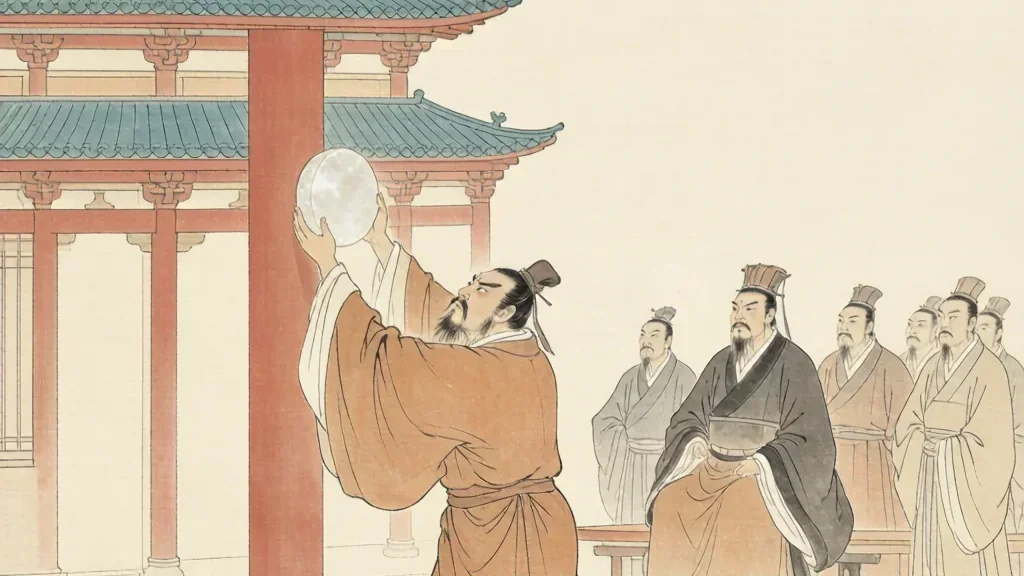
The idiom 完璧归赵, pronounced , means to return the intact jade disc to the state of Zhao, and it describes the safe return of something entrusted to one's care, especially after danger. The story belongs to Lin Xiangru, the Zhao statesman who was sent to the court of Qin with the famous 和氏璧 jade and who outwitted the Qin king to bring it home undamaged. Recorded in the 史记, the tale showcases diplomatic courage, quick wit, and the protection of a national treasure against a stronger rival. Over two millennia the four characters have become a graceful way to say that a borrowed or entrusted object has been returned whole. This article examines the jade itself, the perilous embassy, Lin Xiangru's stratagem, the standoff at the Qin court, the return journey, and the idiom's migration into everyday politeness.
The He Shi Bi Jade
The 和氏璧, the Ho Shi Bi, was one of the most celebrated jade discs in Chinese legend. According to tradition, it was discovered by a man named Bian He, who found an unworked stone and insisted it contained jade, suffering the amputation of his feet when rulers doubted him, until its value was finally recognized. The stone was then carved into a luminous disc prized above gold.
Jade held supreme cultural value in ancient China as a token of purity, authority, and heavenly mandate. A fine disc was not mere wealth but a symbol of legitimate power, which is why a single piece could be treated as worth a string of cities. The He Shi Bi carried this aura, making it an object that kings coveted and that Zhao guarded jealously.
By the time of the story the disc had passed into the hands of the king of Zhao. Its fame was such that the king of Qin, the strongest ruler of the age, openly offered fifteen walled cities in exchange. The offer was less a trade than a test of Zhao's nerve, because refusing might invite war and accepting might mean losing the treasure for nothing.
The Crisis of the Embassy
The king of Zhao faced a dilemma with no good exit. If he sent the jade and Qin reneged on the cities, Zhao would lose its heirloom. If he refused, Qin could claim insult and march. His court debated until Lin Xiangru, then a minor retainer, stepped forward with a plan and a pledge to recover the disc or die.
Lin Xiangru's offer was audacious for a man of low rank. He argued that Zhao could not be blamed if Qin broke its word, but that Zhao would be shamed if it clung to the jade out of fear. By volunteering, he shifted the problem from a contest of states to a contest of wits, betting that a clever envoy could outmaneuver the Qin court.
The king sent him with the disc, and the embassy became a tense mission into the lion's den. Lin Xiangru traveled knowing that his life and his state's honor rode on a single piece of jade and the sharpness of his mind.
Lin Xiangru at the Qin Court
At the Qin palace, the king received the jade with delight and showed it to his ladies and attendants, but he made no move to assign the promised cities. Lin Xiangru saw that the bargain was a pretext and that the disc would not be paid for. He had to act before the treasure was absorbed into the Qin treasury.
He approached the king and said the disc had a flaw that only he could point out, a ruse to regain physical possession of it. Once the jade was back in his hands, he retreated to a pillar, raised the disc, and declared that he would dash it to pieces rather than surrender it dishonorably. The threat was credible because a shattered disc was worth nothing to Qin.
This moment is the dramatic heart of the idiom. Lin Xiangru converts a disadvantage into leverage by being willing to destroy the very object he was sent to protect. His readiness to break the jade protected it, because the king wanted it whole and could not call his bluff.
The Hostage of Ritual
Having seized the initiative, Lin Xiangru demanded that the king observe a fast and hold a solemn ceremony before receiving the disc, buying time. He used the delay to send a trusted companion south with the jade hidden, racing it back to Zhao by a secret route while the Qin court performed rites.
The stratagem depended on the gap between Qin's ceremony and its sincerity. Lin Xiangru gambled that the king would prefer a staged ritual to open confrontation, and that the days of fasting would let the disc escape. The plan worked because the jade's safe arrival in Zhao was accomplished before Qin could react.
When the king learned the disc was gone, he faced a choice: punish the envoy or save face. Killing Lin Xiangru would not recover the jade and would stain Qin's reputation, so the king instead received him with formal courtesy and sent him home. The stronger state had been checked by a weaker man's nerve.
The Return to Zhao
The disc's arrival back in Zhao completed the arc that gives the idiom its name. It returned 完, intact and undamaged, to 赵, the state of Zhao, despite the overwhelming power of Qin. Lin Xiangru came home not with a treaty of cities but with the treasure and the greater prize of national honor.
For this success the king of Zhao richly rewarded him, raising him above the general Lian Po and setting in motion the later quarrel resolved by the bearing of the birch. The jade episode and the apology episode are thus two chapters of one career, both preserved in the same biography of the Shiji.
The safe return echoed beyond politics. It established Lin Xiangru as a model of the counselor who protects his lord's goods through cunning rather than force, a figure later officials emulated when entrusted with delicate missions.
The Idiom in Diplomacy and Daily Life
In statecraft the tale became a touchstone for the clever envoy. Chinese histories cite Lin Xiangru when praising diplomats who recover what was nearly lost, and the idiom names the ideal outcome of any negotiation: the treasure home, unbroken, and the realm unbent.
In daily speech the phrase softened into politeness. When someone returns a borrowed book, tool, or garment in good condition, the owner may say it was 完璧归赵, turning a small courtesy into a echo of an ancient embassy. The grand historical resonance makes ordinary honesty feel dignified.
The idiom also appears in letters and notes acknowledging the return of manuscripts or gifts, where the writer playfully compares a friend to Lin Xiangru. Its use in such gentle contexts shows how a story of life-and-death statecraft filtered down into the etiquette of neighbors.
Symbolism of the Jade
The jade disc stands for more than a stone. In Confucian thought jade embodied the virtues of the gentleman: purity, resilience, and quiet strength. To return it intact was thus to return a symbol of moral integrity, not just a pretty object. The idiom quietly equates safekeeping with righteousness.
The disc's flaw that Lin Xiangru invented also matters. By claiming an imperfection, he reminded the king that even a prized treasure is subject to human judgment, and that the envoy, not the throne, knew its truth. The small lie about a flaw became the hinge of the whole deception.
Finally, the unbroken disc affirms that some things should pass through danger unchanged. The idiom assures us that care and courage can shield what we value, even when surrounded by greater force, a consoling belief in an unstable world.
Why the Story Lasts
The endurance of 完璧归赵 lies in its compression of tension and triumph. Four characters hold an embassy, a standoff, a threatened smashing, a secret flight, and a homecoming. The listener supplies the drama, which makes the phrase endlessly reusable.
It also lasts because it honors brains over brawn. Lin Xiangru wins not by fighting but by reading the situation and committing to a credible threat. A culture that prizes civilized wisdom over raw might naturally treasures a hero who defeats a giant state with a pillar and a promise.
Lastly, the idiom satisfies a universal wish: that what we lend or entrust comes back whole. Whether the object is a jade disc or a borrowed umbrella, the phrase names the happy ending everyone wants, which is why it survives in both court and kitchen.
❓ Frequently Asked Questions
What does 完璧归赵 mean?
It means to return the intact jade to Zhao, and it describes the safe, whole return of something entrusted to one's care.
Who was Lin Xiangru?
He was a Zhao statesman who delivered the He Shi Bi jade to Qin and brought it home undamaged through cunning.
How did he protect the jade?
He threatened to shatter it against a pillar and used a ritual delay to smuggle it back to Zhao.
Where is the story written?
It is recorded in the Shiji, the Records of the Grand Historian by Sima Qian.
Why did Qin not punish him?
Killing him would not recover the jade and would disgrace Qin, so the king sent him home with courtesy.
How is the idiom used now?
It gracefully notes that a borrowed item has been returned in good condition, echoing the ancient embassy.