The idiom 鬼斧神工, pronounced , means the axe of ghosts and the workmanship of gods, and it describes craftsmanship or natural formation so exquisite that it seems beyond human making. The phrase derives from the 庄子, where Zhuangzi uses the image to marvel at a piece of skilled work that looks as if supernatural beings had fashioned it. Over the centuries the idiom migrated from the artisan's bench to the landscape itself, now praising both human art and the uncanny beauty of mountains, caves, and stones. This article examines the Zhuangzi passage, the original object of wonder, the meaning of ghost and god as makers, the contrast with ordinary labor, the extension to nature, and the phrase's role as the highest Chinese compliment to artistry.
The Origin in the Zhuangzi
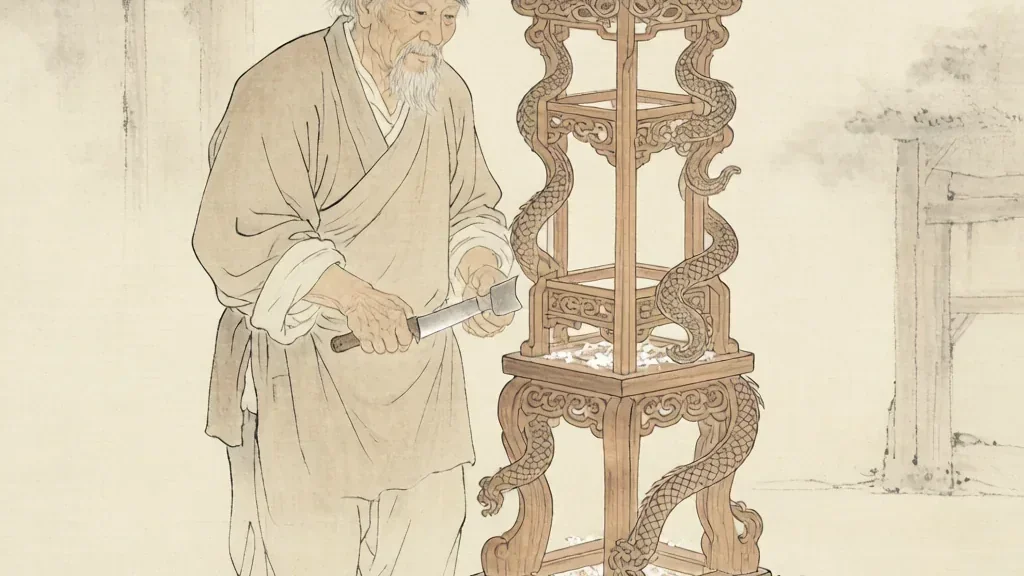
The idiom is rooted in a story in the Zhuangzi about a craftsman who fashions a bell-stand or similar object of such perfection that observers conclude only spirits could have made it. Zhuangzi employs the marvel to make a point about skill so absorbed into the maker that the work seems effortless and otherworldly.
In the original anecdote, the artisan explains that his result came from stilling the mind and forgetting distinctions, so that the form arose without forced effort. The ghostly axe and divine craft are thus metaphors for a skill that has passed beyond self-conscious striving into something that looks supernatural.
The Daoist frame matters. For Zhuangzi, the finest making resembles the spontaneous productivity of heaven, which is why he reaches for ghosts and gods as comparators. The idiom therefore carries a philosophic charge: true craft participates in the creativity of the cosmos.
The Original Object of Wonder
The object Zhuangzi describes is a piece of lacquerwork or woodcraft, a ceremonial stand shaped with uncanny precision and grace. Witnesses cannot believe a human hand produced it, and the story turns on that disbelief as the measure of excellence. The work is not merely correct but transfixing.
Such objects mattered in ritual life, where a bell-stand or vessel was both functional and sacred. A stand of perfect form honored the rite and, by its beauty, seemed to partake of the divine it served. The idiom captures the moment when utility and holiness meet in a single shaped thing.
The anecdote also implies a standard for judgment: when viewers reach for the supernatural to explain a work, the work has succeeded beyond ordinary praise. 鬼斧神工 is the verbal form of that gasp of disbelief, preserved as a fixed phrase.
Ghost and God as Makers
The two halves of the idiom pair the ghost's axe with the god's craft. In Chinese usage ghosts and spirits populate the unseen world and are credited with powers beyond the living. To say a thing bears their tools is to say it could not have come from mortal hands alone.
The ghost suggests the eerie, the uncanny edge of skill; the god suggests its benign, elevated quality. Together they cover the full awe of a perfect object, at once strange and sublime. The pairing is balanced, neither frightening nor merely flattering.
Importantly, the phrase does not literally assert demons made the object. It is hyperbole, a way of saying that human skill reached a pitch where normal explanation fails. The ghost and god are figures for the limits of our understanding of genius.
Skill Beyond Striving
Zhuangzi's deeper point is about how such work is achieved. The craftsman stills his heart, fasts his mind, and lets the form appear, rather than forcing it by anxious effort. The result looks divine precisely because it is not strained; it flows as nature flows, without the marks of struggle.
This ideal contrasts with mere diligence. A clumsy worker sweats and the product shows it; the master works as if guided by spirits, and the product shows no seam between intention and form. The idiom thus honors a quality of ease that only long discipline can purchase.
The lesson traveled into later theories of art. Painters and calligraphers spoke of forgetting the brush and the hand, of letting the spirit move the ink, echoing the Zhuangzi's craftsman. 鬼斧神工 became the name for the outcome of such self-forgetting skill.
From Artisan to Nature
A major shift in usage extended the idiom from human craft to natural scenery. Towering peaks, wind-carved caves, and strangely shaped rocks came to be described as 鬼斧神工, as if ghosts and gods had sculpted the earth. The move is natural: landscapes that awe us also seem beyond human making.
This extension shows the idiom's flexibility. What began as praise of a bell-stand now praises a canyon or a glacier, because the same feeling of supernatural authorship arises before both. Nature, in this view, is the original ghostly craftsman, and human artists only imitate it.
Travel writing and local guides lean heavily on the phrase for scenic wonders. To call a formation 鬼斧神工 is to say no engineer or sculptor could improve on it, conceding the victory of the natural over the made.
Craftsmanship in Chinese Aesthetic
Chinese aesthetic has long valued the trace of the unaided hand at its best, the sense that a thing looks both deliberate and inevitable. The idiom names the top of this scale, where technique becomes indistinguishable from inspiration. It is the summit word in a vocabulary of praise.
In workshops, masters used the phrase to urge apprentices toward effortless precision. The goal was not more force but finer attunement, until the work seemed given rather than made. The ghostly axe was the symbol of that attained grace.
The phrase also marks the boundary between craft and art. A useful object well made is craft; an object that stuns is, by this idiom, touched by the divine. The line is drawn not by materials but by the viewer's sense of the impossible made present.
Use in Modern Chinese
Today the idiom appears in museum labels, tourism copy, and reviews of fine work, from jade carving to architecture. It is the go-to phrase when a writer wants to say a creation or a place is astonishingly, almost supernaturally well formed.
It is often paired with 巧夺天工, a related phrase meaning craftsmanship that rivals heaven's own, and the two together form a chorus of supreme praise. Speakers alternate them to avoid repetition while keeping the register of awe.
Because it can describe both nature and art, the phrase is unusually versatile. A single sentence might call a cliff 鬼斧神工 and then a nearby temple carving the same, linking the earth and the human hand in one breath of admiration.
Why the Phrase Endures
The idiom endures because it solves a real problem: how to praise the unpraiseable. When skill passes understanding, ordinary adjectives fail, and the ghost and god supply the missing superlatives. The phrase is a built-in astonishment.
It also endures because it is balanced and musical. The four characters pair neatly, ghost with axe, god with craft, and the rhythm makes it pleasant to say. A complimentary phrase that is also a pleasure to utter tends to survive.
Finally, it honors mystery. By crediting spirits, the idiom admits that genius has something inexplicable, which flatters both maker and viewer. We like to think the best work comes from beyond us, and 鬼斧神工 says exactly that with a smile.
❓ Frequently Asked Questions
What does 鬼斧神工 mean?
It means the axe of ghosts and work of gods, describing craftsmanship or natural form so fine it seems supernaturally made.
Where does it come from?
It derives from an anecdote in the Zhuangzi about a craftsman whose perfect work looked beyond human making.
Does it refer to real ghosts?
No, it is hyperbole; it means the skill is so high that normal explanation fails and only spirits seem capable of it.
What does Zhuangzi teach through it?
He teaches that the finest work comes from a stilled mind where form flows without strained effort.
Can it describe nature?
Yes, it commonly praises awe-inspiring landscapes like peaks and caves as if shaped by spirits.
How is it used today?
It is a supreme compliment in art, craft, and tourism for anything astonishingly well formed by hand or nature.