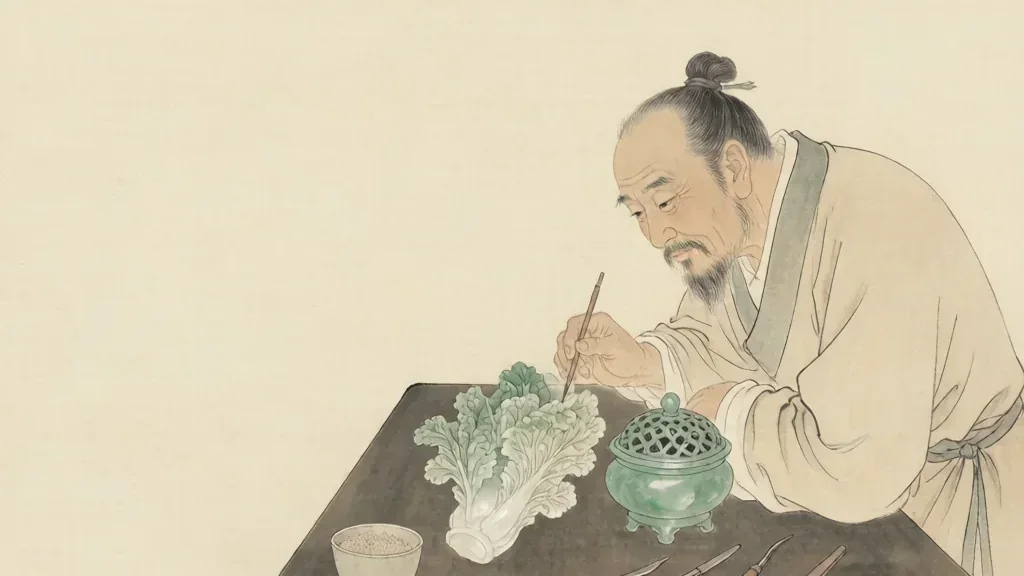
The Chinese idiom 巧夺天工 (qiǎo duó tiān gōng) describes human craftsmanship so exquisitely refined that it seems to rival or even surpass the work of nature itself. The phrase is reserved for objects and creations of extraordinary skill, where the artisan's hand achieves a perfection normally associated only with the natural world. In daily speech it functions as the highest compliment one can pay to a maker, whether of a carved jade pendant, a lacquered screen, an embroidered robe, or a meticulously planned garden. Unlike ordinary praise for hard work, this expression specifically celebrates an almost magical fusion of ingenuity, patience, and aesthetic judgment. Understanding the idiom opens a window onto a deep current in Chinese aesthetics: the belief that the finest human art does not compete with nature by imitating it clumsily, but completes and elevates it through intelligence and feeling.
Etymology and the Literal Meaning of Each Character
The four characters of 巧夺天工 can be parsed individually to reveal the logic of the whole. The first character, 巧 (qiǎo), means clever, skillful, or ingeniously wrought. The second, 夺 (duó), means to seize, to take away, or to outdo. The third, 天 (tiān), means heaven or nature, the cosmic order that produces mountains, rivers, and living things without labor. The fourth, 工 (gōng), means work, craft, or the labor of making. Read together, the phrase literally states that skill seizes away the work of heaven, implying that human making has become so accomplished it can displace nature's own production.
This literal reading carries a subtle tension worth noticing. To say craftsmanship "surpasses" nature is not a claim that people are greater than the cosmos. Rather, it marks the moment when human effort attains such grace that the boundary between the made and the born becomes difficult to perceive. The idiom therefore praises not brute force but a refined intelligence that knows when to shape, when to leave alone, and when to reveal latent beauty in raw material.
Earliest Recorded Uses in Classical Literature
Scholars generally trace the idiom to passages in medieval Chinese writing where it was used to praise the splendor of palaces, gardens, and ritual objects. The core idea appears in descriptions of opulent architecture and finely worked ornaments produced for the court. Over centuries the wording was stabilized into the fixed four-character form familiar today, and it entered the vast storehouse of chengyu that educated speakers drew upon to lend weight to their prose.
What is striking is that the expression was never merely decorative vocabulary. It performed a cultural argument: that civilization, properly conducted, does not despoil the world but adds to it a second, human kind of beauty. When a writer called a garden or a vessel 巧夺天工, he was asserting that culture and nature could be reconciled in a single object, and that the reconciliation itself was a moral achievement.
The Aesthetic Philosophy Behind the Phrase
Chinese artistic theory has long held that the goal of the craftsman is not the faithful copying of external appearances but the capture of spirit and vitality. The notion that human work might equal nature's rests on the assumption that both draw from the same underlying principle, often discussed in terms of qi, the vital energy that animates all things. A master artisan was thought to channel cosmic energy through his tools, so that the finished piece shared in the liveliness of the natural world.
This philosophy explains why the idiom attaches to objects that feel inevitable rather than forced. A clumsily ornate item, no matter how laborious, would never earn the label. The praise is reserved for works in which complexity appears effortless, where restraint and abundance are balanced, and where the material's own character is honored rather than concealed.
Use in Garden Design and Landscape Architecture
Nowhere is the ideal of 巧夺天工 more visible than in the classical Chinese garden. Garden builders of the Ming and Qing periods practiced a discipline of borrowing scenery, concealing boundaries, and arranging rocks, water, and pavilions so that the constructed landscape seemed to have grown rather than been built. Famous gardens in Suzhou demonstrate this principle in miniature mountains of stacked limestone, in windows that frame a single branch like a painted scroll, and in winding corridors that reveal the garden in carefully timed glimpses.
The gardeners' art was explicitly compared to that of painters and poets, and the best gardens were described with phrases that amount to our idiom. The aim was not to reproduce a wilderness but to distill the feeling of nature into a humanized space, so that a visitor walking a few hundred paces might experience the vastness of rivers and mountains compressed into a courtyard.
Jade, Lacquer, and the Decorative Arts
The decorative arts provide the most literal demonstrations of the idiom. Jade carving in particular demands years of apprenticeship, because jade is dense and unforgiving and the carver must follow the stone's internal fractures rather than impose an alien design. A flawless openwork pendant or a covered vessel with interlocking chains cut from a single block invites exactly the reaction the phrase describes, since the viewer cannot easily believe the object was made by hand.
Lacquer work, cloisonné enamel, and carved lacquer trays similarly attracted the compliment. The layered application of lacquer, sometimes built up through dozens of coats and then carved back to expose a design, produces depth and luminosity that look less manufactured than grown. In each case the material's slowness and resistance are overcome by patience, and the result seems to have been coaxed out of the substance rather than stamped upon it.
Imperial Workshops and Court Patronage
Throughout the Ming and Qing dynasties, the court maintained specialized workshops in the capital where the most skilled artisans in the realm were gathered to produce objects for the emperor and his household. These workshops concentrated expertise in jade, enamel, ivory, horn, and textiles, and they established standards of finish that circulated outward to the wider market through gifts, patterns, and retired craftsmen.
The imperial context mattered because it linked the idiom to power and legitimacy. A ruler surrounded by objects described as 巧夺天工 was tacitly presented as a patron of civilization itself, a sponsor of the harmony between human order and natural beauty. The phrase thus moved easily between aesthetic and political registers, praising both the maker's hand and the regime that nurtured it.
Famous Historical Examples of the Ideal
Among the works most often associated with the spirit of the idiom are the carved lacquer screens of the Ming period, the jade objects in the imperial collection, and the intricate ivory balls with nested spinning layers attributed to Cantonese carvers. Each of these survives as evidence that the compliment was not empty flattery but a response to genuinely astonishing technique. The nested ivory balls, in which a single sphere is hollowed into rotating concentric cages, remain a touchstone example of the kind of feat the phrase celebrates.
Less tangible but equally important are the great gardens and temple complexes whose design was remembered in literature as surpassing nature. Although many originals have been altered or lost, their reputation persisted through texts, paintings, and later reconstructions, keeping the idiom alive as a standard against which new work was measured.
The Idiom in Poetry and Belles-Lettres
Literary writers used 巧夺天工 and its near synonyms to elevate description beyond mere reporting. A poet praising a friend's embroidered fan or a painted screen was participating in a long convention in which material beauty became a occasion for reflection on taste, friendship, and the transience of fine things. The phrase allowed a writer to compress an entire aesthetic judgment into four characters, a compactness prized in a culture that valued allusion and economy.
In travel writing and local gazetteers, the expression frequently described waterfalls, caves, and rock formations, but there it was often paired with the contrary claim that nature itself remained superior. The interplay between natural wonder and human artifice formed a recurring rhetorical game, and the idiom sat at its center as the term for the highest achievable human version of natural perfection.
Modern Everyday Usage and Social Meaning
Today the idiom is thoroughly domesticated. It appears in museum labels, tourist brochures, cooking shows, and casual conversation about anything from a wedding cake to a smartphone's industrial design. Its persistence shows how durable the underlying value is: even in a technological society, Chinese speakers reach for an ancient phrase to say that something was made with such intelligence and care that it feels almost unnatural in its perfection.
The social function of the compliment has also broadened. Where once it crowned the products of imperial workshops, it now circulates as encouragement to contemporary makers, students, and small businesses. To call a young craftsperson's work 巧夺天工 is to enroll them in a lineage of excellence stretching back more than a millennium, which is itself a form of cultural continuity.
Relationship to Kindred Craft Idioms
巧夺天工 belongs to a family of idioms that praise making, and distinguishing them sharpens its meaning. 鬼斧神工 (guǐ fǔ shén gōng) credits the work to ghosts and gods rather than to human skill, often used for natural formations or feats of apparently supernatural execution. 匠心独运 emphasizes the originality of the designer's conception. 锦上添花 (jǐn shàng tiān huā) speaks of adding beauty to something already beautiful. Knowing these neighbors helps a learner place the idiom precisely: it is the term for supreme human craftsmanship measured against the standard of nature.
Together these phrases form a vocabulary for talking about quality without resorting to vague superlatives. They let a speaker specify whether the wonder comes from skill, from inspiration, from fortunate addition, or from sheer inexplicability, and they preserve a shared cultural memory of what excellence has historically looked like in Chinese hands.
❓ Frequently Asked Questions
What does qiaoduo tiangong literally mean?
It literally means that skill seizes away the work of heaven, expressing the idea that human craftsmanship can rival or surpass nature.
How is it different from guifu shengong?
Guifu shengong credits ghosts and gods with the work and often describes natural formations, while qiaoduo tiangong specifically praises human skill.
What kinds of objects does the idiom describe?
It is most often used for fine carvings, lacquerware, embroidery, gardens, and any object of exceptional made beauty.
Can it be used for modern things?
Yes, speakers apply it to pastries, industrial design, and digital art when the making shows rare refinement and intelligence.
Why does the idiom praise nature and craft together?
Chinese aesthetics holds that the best human art completes rather than competes with nature, channeling the same vital energy.
Is the phrase common in daily speech?
It is a familiar compliment taught to children and used in museums, tourism, and casual praise of skilled work.